




Pakatan's marriage on the rocks
I see that the mainstream media are going to town with this recent spate of squabble between the component parties of Pakatan Rakyat. From their headlines and their commentaries, you expect the coalition to crumble tomorrow.
The headline on the front page of the Star on July 2 read ‘Pakatan set for collapse in Kedah’.
The day before, the Kedah DAP had announced its decision to withdraw from the PAS-led government over the demolition of the sole pig abattoir in the state.
The DAP holds only one seat in the state assembly, whereas PAS has 16 and PKR, 5, against Umno’s 12, MCA, 1, and Gerakan, 1. How can Pakatan be set for collapse without DAP’s lone seat?
I see that the mainstream media are going to town with this recent spate of squabble between the component parties of Pakatan Rakyat. From their headlines and their commentaries, you expect the coalition to crumble tomorrow.
The headline on the front page of the Star on July 2 read ‘Pakatan set for collapse in Kedah’.
The day before, the Kedah DAP had announced its decision to withdraw from the PAS-led government over the demolition of the sole pig abattoir in the state.
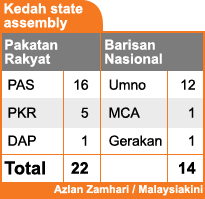 The DAP holds only one seat in the state assembly, whereas PAS has 16 and PKR, 5, against Umno’s 12, MCA, 1, and Gerakan, 1. How can Pakatan be set for collapse without DAP’s lone seat?
The headline in the Star on July 3 was even more alarmist - ‘Splitsville – Kedah government in turmoil, Penang faces villagers revolt’. The villagers’ revolt is a minor local problem that should have been solved. But how does a local problem cause a ‘Splitsville’?
Of course, we all know that the Star is owned by MCA, and it is supposed to be part of the propaganda machine for the ruling BN coalition. It is meant to be used to demonise the opposition Pakatan coalition, especially in magnifying the problems of those state governments where it has taken power.
The further deterioration of journalistic ethics among highly-paid professionals in that monolithic media organisation is tragic to watch.
Fortunately for Malaysia, the coverage and the commentary in the alternative media are much more balanced. I notice that independent commentators in Internet new portals are also beginning to criticise Pakatan. But they do it fairly and rationally, without demonising this year-old political coalition like the Star .
Pakatan a very strange political beast
Recently, during a discussion with the editor of new Chinese-language news portal Fung Yin Times , I suggested to him that the alternative media should not side with Pakatan so much as to avoid all criticism of their shortcomings.
It is not good journalism for one. For another, it will also hurt Pakatan because if the civil society does not check its abuses, it will continue to rot without knowing it.
The editor agreed, but complained that every time they carry a story detailing the failing of the Pakatan coalition, it gets fewer hits than stories that attack BN!
That may be so, but the open squabbles between the component parties of Pakatan must have confused many supporters. They have been used to the united, placid, singular BN’s façade for too long. Perhaps, in their mind, such scurrilous washing of dirty linen in public by the Pakatan parties betrays a certain degree of disunity and lack of discipline.
They may not be entirely wrong. Pakatan is a very strange political beast. Formed only a year ago, they obviously have not adjusted to their new reality of power sharing and working within the complex power relation of coalition politics.
 Any political coalition is necessarily a marriage of convenience. Just as a real life marriage takes perennial high maintenance, a political marriage of convenience needs constant nurturing and constant internal interaction to function and grow.
DAP, PAS, and PKR have their different constituencies; their members are made up of different ethnographic backgrounds, and their ideologies are poles apart. Driven into the narrow alley of a political coalition in order to share power in the states that they have conquered, it would be a miracle if they do not squabble openly as they do now.
We must not forget that these parties have been in the political wilderness for a very long time. The culture of launching a verbal assault through the media to gain attention has been ingrained in their soul.
Perhaps, they are less skillful and less inclined to call up their opposite numbers in Pakatan for a cup of coffee and a friendly chat to talk over their problem. It would be a long time before they all think like government members.
Naturally, there too must be intense struggle for power at all levels among the three components of the Pakatan coalition.
They may all be members of the same state government, but they cannot run away from the numbers game. They cannot be equal everywhere. Personal ego, jealousy, past conflict, and the fight for important positions must play havoc with the harmonious relation required for a problem-free relationship.
The internal factional fight within each party may also jeopardise inter-party relationship. The secret unity talk between some top Umno and PAS leaders is a case in point.
Besides, political parties are not the sanest of organisational creatures. Party leaders may not have full say in what their local leaders think or say. When the local faction of the party speaks out against a coalition partner, their national leaders may not be able to dissuade them from doing so.
History of rivalry and mutual suspicion
It is now obvious that Pakatan has yet to develop an internal mechanism for regular consultation to establish common policies and common stand on issues that may arise from time to time.
They also lack the internal channel for rapid consultation to deal with their differences. Without such mechanism in place, they will continue to take their case to the media and cause their fragile coalition to lose much face.
PKR’s Tian Chua has declared this phenomenon as a good thing - it shows that the members of the Pakatan coalition are equal and they are democratic. There is some point in that.
We have seen how Umno dominance within BN has allowed them to speak with one voice in public at the expense of the legitimate complaints of other component parties within the ruling coalition. But component parties representing minority communities suffer the consequences of sweeping disagreements under the carpet.
In retrospect, coalition politics in any country is a messy thing. Strange bedfellows do not sleep easy together anywhere.
Pakatan Rakyat has been in existence for slightly over a year. Given their past history of rivalry and mutual suspicion, it is a wonder that their experimentation with coalition politics has worked so well.
It goes to show that political power is the strongest motive for political parties to seek alliances from the most unlikely partners. As long as they remain focus on taking power at the federal level in the next general election, the component parties of Pakatan are not going to allow this fragile coalition bite the dust any time soon.
But their top leaders and their rank-and-file members do have to make some serious psychological adjustment. They must cease thinking like members of three individual separate political parties. Perhaps, they should register Pakatan Rakyat as a official coalition with the Registrar of Society.
SIM KWANG YANG was member of parliament for Bandar Kuching from 1982 to 1995. He can be reached at kenyalang578@hotmail.com.


Are you sure you want to delete this comment?
This action cannot be undone.