




Currents of change in the river of history
I look back 20, and even 30 years ago, and I suddenly realise with a start that indeed Malaysian politics has changed beyond recognition. If you are caught in the swirling currents in the river of history, you would not be conscious of the currents of change.
Like a fish swimming in water, the fish would not really know what it feels like to be swimming in water. In modern parlance, the poor fish has no frame of reference, with which it can compare and evaluate its experience.
Fortunately, we human beings have out of a sense of self-consciousness and our memory.
They are the anchors upon which we can assess the intractable change in our body politics. Thirty years ago, nobody I knew was very rich. I was working in a construction company as a manager for a grand monthly salary of RM500 a month.
The standard salary for a clerk (now given the euphemism of an ‘administrative assistant') was about RM200. A new car was a real status symbol then.
I bought my first car, a Toyota Corolla 1.3 for RM18,000, when I became elected as MP for the first time in 1982, long before the expensive and rickety national Proton cars came into existence.
 My grand total repayment for my car loan came up to RM200 a month. But then,
kembong
fish cost RM2 per kilo in the wet market.
My grand total repayment for my car loan came up to RM200 a month. But then,
kembong
fish cost RM2 per kilo in the wet market.
In 1982, the DAP suffered its worst defeat in history, winning only six seats in Peninsular Malaysia. The party chairman and DAP strongman Dr Chen Man Hin lost his Seremban seat to the MCA president then, Lee San Choon.
The poll in Sarawak and Sabah was staggered to be held three days after the general election in Peninsular Malaysia in 1982.
The DAP made history in Sarawak by winning two seats, including my Bandar Kuching constituency, and Fung Ket Wing won the Sandakan seat in Sabah, making up nine DAP seats in parliament.
There were no other significant opposition parties in Malaysia at that time. That was a time when Tun M ( above) had just taken over the helm of leadership in the country.
Bad times for opposition
I remember Anwar Ibrahim ( below ) then, elected to the parliament for the first time, serving as the parliamentary secretary of a minor ministry. He looked worn out in his first day in Parliament.
Those were bad times for opposition politics, and I was painted as a communist sympathiser, definitely anti-government, and whatever press statement I issued would be thrown into the wastepaper basket beside the news desk in Sarawak and in KL.
The newspaper editors told me about this in private gingerly. The PC had just surfaced, and the World Wide Web had not been invented yet.
Those were the bad old days when relatives and old classmates would avoid being seen with me in public. They made me feel like a plague, like H1N1 of the present days.
The bright young professional men I tried to recruit always had a family to feed and a job to hold down. That was when I discovered the solid virtues of the working class people, the hawkers, the fishermen, the construction contractors and labourers.
Nobody talked about politics in public, and the myth of the kedai kopi as the primal forum for shaping public opinion is overblown. Democracy, justice for all, and Ketuanan Rakyat were a dream that Malaysians could never summon the courage to dream about in those bad old days.
Politics was all about race and religion, and about cari makan.
I have seen many of my personal friends and relatives ‘migrate' overseas to greener pastures. I have always thought that only birds and animals migrate with the change of seasons, and human beings emigrate or immigrate.
But one has to make concessions to the polluting effect of Malenglish. So, ‘migrate' it has to be!
I still remember Steven Gan, attending an environmental NGO conference as a young idealistic journalist in the 1980s. I'm glad he has gone on to found Malaysiakini, and helped change Malaysian politics forever.
 I remember Suhaimi Azam fondly, as the demure petite Malay journalist and her friends who were all casualties of the evil
Operation Lalang
. The wound to our national soul inflicted by that hideous mass arrest was indeed deep and painful.
I remember Suhaimi Azam fondly, as the demure petite Malay journalist and her friends who were all casualties of the evil
Operation Lalang
. The wound to our national soul inflicted by that hideous mass arrest was indeed deep and painful.
I was a columnist with a couple of English and Chinese papers. The editors were always in mortal fear of unseen hands of the 'authorities', and self-censorship was the norm.
It was the tortured age for writers like me, who could never write as we thought, twisting the nib of our pen this way and that. Writing fees were minimal at best.
Twenty or thirty years later, I find myself in a different Malaysia. Five (or four) states are in the hands of the opposition coalition. Pakatan Rakyat is gaining momentum, despite their ceaseless public squabbles. The DAP is in cohorts with PAS, despite Karpal Singh.
Invisible mental prison of despair
There are now 16 million internet subscribers, and half a million bloggers, mostly buzzing with anti-government sentiments.
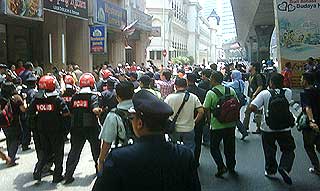
As you read this, tens of thousands of Malaysians ( below ) are marching on the streets against the ISA. Such a public demonstration of discontent, especially by a largely Malay/Muslim party such as PAS would be unthinkable 30 years ago.
If you paint a picture of Malaysia Today to a Malaysian 20 or 30 years ago, he would have laughed at you for 'day-dreaming'. He would have told you, "That is impossible. You are a dreamer. You must be realistic. It is better we all migrate."
I bristle whenever I hear this sort of statements. If you listen to them, you will be enveloped in an invisible mental prison of nihilistic despair. You get a lot of these statements on the internet too.
 Just go to RPK's
Malaysia Today
. At one time, RPK was so flustered with such comments on his blog that he compared his writing to ‘offering flowers to monkeys'!
Just go to RPK's
Malaysia Today
. At one time, RPK was so flustered with such comments on his blog that he compared his writing to ‘offering flowers to monkeys'!
I'm also thinking of the 3,000 Penans starving in Belaga in Sarawak. Left to themselves, they will never starve in the jungle. Cut down their jungle, flood it to make a dam, and their natural supermarket is destroyed overnight.
Things have changed too for them, but for the worst. Can you ask them to migrate to Australia then?
As I write, I'm thinking of the policemen playing hide and seek with the demonstrators against ISA on the streets of Kuala Lumpur. City traffic will be held in a gridlock.
I look at the pictures on Malaysiakini, and see young Malay men arrested by the police. There is no fear on their faces.
I'm a columnist, and I have to bear witness to history. This is my testimony: Malaysia has changed, and change we must - for the better.
SIM KWANG YANG can be reached at kenyalang578@hotmail.com .


Are you sure you want to delete this comment?
This action cannot be undone.