




DAP needs to fortify Pakatan partnership
Soon after his victory in the 2008 general election, Khalid Samad, the PAS MP for Shah Alam, held an open dialogue session with parishioners in a Catholic church that was located in his constituency, the first for any Malay MP in Peninsular Malaysia on either side of the political divide.
Soon after his victory in the 2008 general election, Khalid Samad, the PAS MP for Shah Alam, held an open dialogue session with parishioners in a Catholic church that was located in his constituency, the first for any Malay MP in Peninsular Malaysia on either side of the political divide.
Since then, other PAS leaders such as Dr Dzulkefly Ahmad, MP for Kuala Selangor, and PAS Mursyidul Am Tok Guru Nik Aziz, have made important gestures and statements that signaled their intention to show a more moderate face of PAS to the non-Malay electorate, many of whom had voted in PAS MPs in Perak, Selangor and KL.
 By taking these important steps, PAS has done much to ‘protect' its coalition partner in Pakatan Rakyat, the DAP, from being attacked by the non-Malay BN component parties by using the tactic stating that a vote for the DAP represents a vote to establish an Islamic state in Malaysia.
Sadly, the moves made by some of the PAS leadership have not been reciprocated by the DAP, leaving PAS and to a lesser extent, PKR, open to attacks that the opposition coalition is betraying the cause of Islam.
PAS-DAP relations have come a long way, especially after the 2008 general election and the formation of Pakatan Rakyat. DAP leaders openly campaigned for the PAS candidate in the Kuala Terengganu by-election and more recently, for deposed Perak MB, Nizar Jamaluddin, in the Bukit Gantang by-election.
I am sure that DAP will be out in full force to campaign for the PAS candidate in the upcoming Permatang Pasir by-election.
Such a situation would have been unthinkable, even prior to the 2008 general election, given the extent to which DAP was harmed politically by its association with PAS under the Barisan Alternatif (BA) in the 1999 general election.
 But while the DAP has been sincere in its attempts to win crucial non-Malay votes for PAS candidates in the Kuala Terengganu and Bukit Gantang by-elections, it has been less vigilant in protecting PAS from being ‘tainted' by its association with the DAP.
The mainstream media, especially the Malay language press, have always portrayed the DAP, unfairly in my opinion, as being anti-Islam and anti-Malay.
The most recent manifestation of this was by associating, without basis, a blog site that was purported to have written anti-Islam and anti-Royalty posts to Anthony Loke, DAP MP for Rasah.
Do no harm
I have no doubt that much of this negative portrayal have turned off many Malays from voting for the DAP. While this may not significantly harm the DAP politically, as long as it manages to retain a high level of non-Malay support, this negative portrayal may yet come back to haunt PAS among the Malay voters.
It is not sufficient for DAP leaders to insist that their remarks have been taken out of context or to protest violently against unfair portrayals by the mainstream media that they are anti-Islam or anti-Malay.
Given that it is operating within the context of a multi-racial and multi-religious opposition coalition and given that this coalition needs to make electoral inroads among Malay voters in the next general election if it is to replace the BN, the DAP actually needs to go out of its way to convince the Malay electorate that it is not only anti-Islam but pro-Islam, in the same way that it is pro-other religions.
To help Pakatan achieve this end, I propose the following three simple rules for the DAP.
Firstly, ‘do no harm'.
By this, I mean that DAP leaders should avoid making any statements that could be misrepresented as being anti-Islam.
 Sometimes, this may not seem as easy as it appears. For example, Jeff Ooi, DAP's MP for Jelutong, was having disagreements with a councilor from PKR over his role in blocking certain development projects but made the error of lashing out at a Muslim NGO, JIM, which the councilor belongs to.
Understandably, this statement provoked a slew of protests against Jeff among Muslim NGOs and raised many an unhappy eyebrow among PAS and PKR members and leaders, some of whom had and still have close associations with JIM.
This situation could easily have been avoided if Jeff had separated the supposed intransigence of the PKR councilor in question from the Muslim NGO which he belongs to.
I applaud Anthony Loke's principled stand when he criticized a column written by Ridhuan Tee in Utusan Malaysia which focused not on the tragic circumstances under which Teoh Beng Huat died but cast aspersions on him having a child out of wedlock.
Tee's column was certainly distasteful and uncalled for but there were more than enough bloggers who quickly denounced Tee's remarks.
Strategic thinking out of the box
Strategically speaking, there was little to be gained politically by criticizing Tee. The downside is that Anthony's statements could easily be used against him and ‘spun' as if he was criticizing a Chinese convert to Islam or that he was condoning having children out of wedlock.
Secondly, ‘think outside the box'.
The DAP, after many years of denying accusations that it would help PAS establish an Islamic state, has built up an internal knee-jerk reaction towards issues such as the sale of alcohol and gambling.
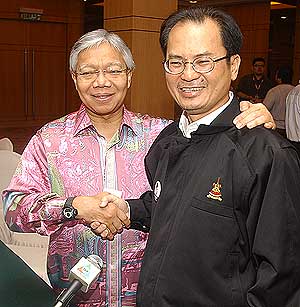 The latest manifestation of this was when Hasan Ali, the senior PAS exco in Selangor, proposed a ban on the sale of alcohol in Malay majority areas in the state. Ronnie Liu, the DAP state exco for matters to do with local government, was right in interpreting this as a matter of what the law allows or does not allow.
But instead of making this strictly a matter of local ordinances, he could have turned the situation around to say that the state government was concerned about the sale of alcohol to minors in general as well as to Muslims.
He could have announced a state wide campaign that would look into the sale of alcohol to minors and to ask all grocery stores, in Malay majority and non-Malay majority areas, to ensure that alcohol is not sold to Malay customers.
It could have been dovetailed with a state-wide campaign to reduce drunk driving. Instead of harping on the differences that exist between the DAP and PAS, they could instead work on common areas of interest which most Malaysians, regardless of race and religion could agree on.
At the national level, the DAP should be secure enough in its position within Pakatan to propose that the opposition coalition would consider restricting the growth of 3D / 4D outlets and other gambling outlets if the opposition came to power at the national level.
Such a move would give PAS an easy campaign tool for it to use among its conservative Malay supporters. If the DAP, which is led by non-Muslims, is willing to consider restricting gambling activities, what kind of light does it shed on the UMNO-led BN coalition?
Thirdly, ‘be sincerely opportunistic'.
If the Malay electorate was asked which DAP leader they most admire, my guess is that Lim Guan Eng would come out tops and by a wide margin.
Standing up for Malay rights also
Most Malays would remember that the current Chief Minister of Penang was convicted and incarcerated under the Seditions act because he stood up for a rights of a young Malay girl who was allegedly raped by a former Menteri Besar of Melaka.
Subsequent examples of DAP leaders standing up for the rights of Malays have been few and far between.
I am sure that DAP leaders have helped countless number of Malays in their work as MPs and ADUNs, in the same way in which they have helped countless number of Malaysians of other races.
But politics is about perception and without more of such examples, the DAP would find it hard to convince the electorate that its political interests are not anti-Malay or anti-Islam.
 The political sense of the DAP leadership is especially attuned when it comes to making political capital associated with issues that are of concern its non-Malay voting constituency.
But with PAS increasingly coming under attack for supporting the DAP, a few well placed moves, even symbolic ones, to show that DAP empathizes with the Malay population in Malaysia is much needed. For example, a few days after the anti-ISA gathering in KL, PAS Youth publicized that one of the protestors from JIM was involved in a traffic accident on the way back to Penang.
A visit to the hospital by a DAP leader from Penang, with a small donation that would help cover the hospital expenses incurred, would have done much to quell some of the criticism arising from Jeff Ooi's statement regarding JIM.
To make itself aware of these opportunities requires a change in the political ‘senses' of the DAP leaders.
It requires DAP leaders to go out of their way to acquire information from unfamiliar networks so as to be aware of the ‘hot topics' which are of concern to the Malays.
It requires DAP leaders to go out of their way to engage with the Malays including having regular dialogues with Muslim NGOs, arranging for Muslim speakers to address DAP leaders so that they are aware of the latest happenings in the Muslim world and to have reciprocal visits to places which DAP leaders would otherwise be unwilling to venture, including mosques and religious schools.
As the month of puasa begins later this month, perhaps it could be a time of reflection for the DAP and its leaders, most of them non-Muslim, to think of more concrete steps in which they could show solidarity with their fellow citizens.
I am sure it would be more than welcomed by their compatriots in PAS and if done in a sincere and respectful manner, could protect PAS from many of the attacks and allegations which have been and will continue to be thrown their way.
Ong Kian Ming is a PhD candidate in Political Science at Duke University. He can be reached at im.ok.man@gmail.com


