




One mountain, two warring tigers
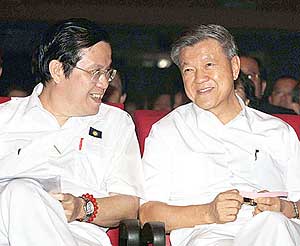
I was sharing a meal with some friends, including the leader of a local MCA branch. He asked me what I thought of this continuing tussle between Ong Tee Keat and Chua Soi Lek, and I gave my two cents’ worth.
His feelings were obviously more ambivalent. He supported Ong’s reform agenda and his exposure of the Port Klang Free Zone (PKFZ) scandal, but he looked askance at the party chief’s apparent persecution of Chua. He has a point, for he argued that at this critical time for MCA, the party needed every leader of impressive calibre, including Chua.
I was sharing a meal with some friends, including the leader of a local MCA branch. He asked me what I thought of this continuing tussle between Ong Tee Keat and Chua Soi Lek, and I gave my two cents’ worth.
His feelings were obviously more ambivalent. He supported Ong’s reform agenda and his exposure of the Port Klang Free Zone (PKFZ) scandal, but he looked askance at the party chief’s apparent persecution of Chua. He has a point, for he argued that at this critical time for MCA, the party needed every leader of impressive calibre, including Chua.
 I pointed out how MCA was unable to canvass for Chinese votes in the seven by-elections won by Pakatan Rakyat since March 8 last year. This relatively young but articulate and thoughtful MCA grassroots leader smiled wryly and said, “You know how it is. Party members would attend the MCA dinner during these by-elections. When dinner is over, they would go over to the DAP ceramah to listen to the speeches!”
Then he admitted that in the general election last year, he too voted for the opposition.
I think the ambivalent and painful feelings expressed by this local MCA leader would be quite typical of a large swath of MCA members across the country.
In fact, it must be very uncomfortable to be a MCA leader these days. The party had just suffered its worst electoral defeat in the political tsunami last year, and party morale must be an all-time low.
A fight to the death
At a time when you hope that a newly-minted party president in the person of Ong Tee Keat can bring some meaningful change to create a new direction to this premier party in Malaysia, you have this business of a very divisive and acrimonious extraordinary general meeting, pitting two factions against each other in a fight to the death.
Every morning, sensational headlines and vivid pictures scream across the front pages of the Chinese national dailies such as Sin Chew Daily and Nanyang Siang Pau . All kinds of speculations, expose, criticism, and inside information flood the Internet, especially in the news portals - Malaysiakini , Merdeka Review , Fung Yin Times , and the new Chinese pages of Malaysian Mirror .
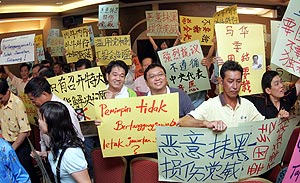 I cannot blame the news hounds though. Confrontations and conflicts are the primordial stuff of which news is made. The Ong-Chua fight has all the elements of an unfolding drama much more exciting to watch than soap opera on TV. Besides, the outcome will indeed determine the future fortune of the MCA and the country as a whole.
Then, there are the countless Chinese-language blogs spawned by these Internet newspapers, taking sides and waging a passionate war of words across the virtual world.
Right now, the impasse confronting the MCA is the messy spectre of the two EGMs, sponsored by the two opposing camps, a scenario reminiscent of the fight between Tan Koon Swan and Neo Yee Pan in 1984-1985.
That protracted war weakened MCA considerably, and they won only 17 parliamentary seats in the 1986 general election, while DAP won 24.
I agree with political analyst Khoo Kay Peng’s view that this tussle is not merely a struggle for power between two individuals with bloated political ambition. It is a conflict between the new MCA that is struggling to be born and an old MCA that has too much stake in who controls the party.
Ong has probably seen the writings on the wall. In the 2008 general election, MCA won only 15 out of the 40 parliamentary seats contested by the party, while MIC and Gerakan have been reduced to the status of mosquito parties. They have also lost the control and dispensation of patronage in five states to the Pakatan coalition.
In those urban seats with absolute Chinese majority, the MCA has been routed by DAP. In the 15 seats won by MCA, the party relied heavily on Malay support based on the strength of their alliance with Umno.
In short, MCA’s old narrative of “Chinese representation within the BN government” is now on the brink of sinking into oblivion. Unless MCA reinvents itself, the party looks set for a course towards extinction in the near future. This has to be confirmed by the fact that the MCA has been impotent in attracting Chinese votes in the seven of the eight by-elections won by Pakatan in the past 18 months.
Opening PKFZ can of worms
It is partly for this reason that Ong has decided to open the whole can of PKFZ worms. Many of my friends around me have described Ong as “brave”. Indeed Ong has gained a great deal of credibility and support for his bold revelation of the PKFZ scandal among Malaysia’s non-partisan Chinese population, who are sick and tired of pandemic corruption at the highest level of government.
But in politics, bravery alone is not necessarily a virtue; in the eye of the opportunistic and the corrupt, “bravery” is equated with downright “foolishness”.
When Ong has rocked the PKFZ treasure boat in the stormy sea of money politics, a congruence of threatened forces comprising politicians, businessmen and even members of the underworld must now seek to topple Ong, both out of spite and perhaps seeking to minimise damage to their vested interest. Personally, I find Ong’s tale of persecution against him quite believable.
This avalanche of anti-Ong forces have now found a front man in the person of Chua Soi Lek. He has allegedly amassed more than the 800 delegates’ signatures required for the convening of an EGM. Rumours of how each signature is worth in ringgit terms fly around the Internet.
While we wait to see how this business of two EGMs is going to be resolved, it is too early to tell which faction will come out the eventual winner. Chua does seem to have the full support of all those faded personalities under the aegis of former president Ling Liong Sik. The battle seems to be shaping up as the new versus the old in this ancient party.
But if indeed Ong is trying to bring reform to MCA, then he has failed in one critical task: he has not offered a new political narrative that outlines a different direction for the party in the 21st century.
The gradual demise of the MCA in recent times can be attributed to the perception of the Chinese that the party is but a silent accessory to Umno’s brand of communal demands since the time of Ling. The political castration of MCA reached its height under the leadership of Ong Ka Ting, who seemed to have led the party from its main political cockpit to concentrate on non-political agendas such as ‘life long learning’.
Ong has not spelt out a new philosophy, especially in the crucial area of power relation with Umno. In any case, MCA has weakened itself so much over the past six decades that such renegotiation with Umno for a new relationship has become impossible anyway.
In the lack of such an articulation of a new vision for MCA members and the Chinese community as a whole, Ong’s fight with Chua can only be perceived as a confrontation between two tigers.
As an old Chinese proverb says, “a single mountain cannot accommodate two tigers”. When two tigers fight, one will be injured.
That will leave DAP and the Pakatan coalition laughing all the way to the vote bank in future elections.
SIM KWANG YANG can be reached at kenyalang578@hotmail.com.


