




The nearest NRD office is still too far for Penans
While Sarawak just celebrated its 45 anniversary of being part of Malaysia, the problem of the so called "stateless" people continues to plague the state.
This problem is pronounced among its Penan community living deep in the interiors of Belaga in the Kapit Division and Baram in the Miri Division.
It is estimated that there are about 12,000 Penans in the state, of whom 80 percent live in the Baram interiors.
While Sarawak just celebrated its 45 anniversary of being part of Malaysia, the problem of the so called "stateless" people continues to plague the state.
This problem is pronounced among its Penan community living deep in the interiors of Belaga in the Kapit Division and Baram in the Miri Division.
It is estimated that there are about 12,000 Penans in the state, of whom 80 percent live in the Baram interiors.
In a recent interview with Bernama , deputy home minister Jelaing Mersat singled out four main reasons why the Penans make up the bulk of the "stateless" people in Sarawak.
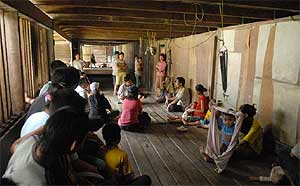 "The first reason, plain and simple, is the distance. The Penans live in isolated settlements where accessibility is difficult," he said.
He said for instance, it would take them 14 hours to travel to Miri from Long Banga in Baram through timber tracks.
"In Lusong Laku in Belaga, they will have to travel about 12 hours to reach Bintulu town or 10 hours to Kapit town.
"Then again, they can only go if they can afford the trip," he said.
"Poverty is thus the second reason," he said.
He noted that to charter a 4-wheel drive from Lusong Laku to Bintulu and back would cost RM1,500 per person.
"This does not include food, lodging, transport and other expenses while in town.
Special units formed
Jelaing said timber camps operating in the two areas use to give free rides to these people but only for certain distance or stretches.
"The availability of public transport will definitely make things more convenient to them. The absence of this facility is what discourages them," he added.
Thus with all these problems, it is not hard to understand why they are not bothered about getting their MyKad or birth certificates.
Of course they are aware of the absolute importance of all these documents, he said.
However, according to Jelaing, the government is not washing its hands off the problem stressing that "special areas will warrant special attention."
"For Sarawak since 2004, we have formed the special mobile unit to service both coastal and the interior areas.
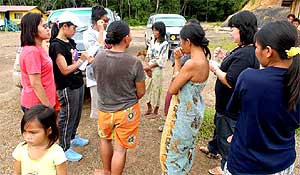 "In a recent exercise, we spent about RM30,000 to send a team to Lusong Laku for about a week," he said.
He said in the exercise in late July, the team managed to approve on the spot 227 MyKads and 125 late birth registrations representing an increase of 30 percent in the number of Penans in the area having the documents.
He said after the Hari Raya festivities a similar team would visit the Penan settlement areas in Long Murum, the site of the new RM3 billion Murum Hydro Dam project capable of generating 944MW of electricity.
There are about 1,000 Penans living in seven settlements in the area such as Long Wat, Long Luar, Long Tangu, Long Menapa, Long Singu, Long Malim and Long Uba.
Their social woes
Jelaing also said it had been discovered that out of the estimated 1,000 workers working at the site, only about 30 were locals.
"We need to act before things get more complicated. More foreign workers will arrive for the Murum project which is scheduled for completion by 2013," he said.
Many more too may be coming to work in timber and oil palm plantations in surrounding areas.
"The foreign workers might marry the local girls. But once their work contracts expire, they may leave their wives and children behind with neither the MyKad nor birth certificates," he said.
Jelaing said another big problem was those outsiders might claim they were Malaysians later in order to stay back.
 "It is very difficult to monitor movement of people as we have a very long porous border with Kalimantan in Indonesia.
"But the fact remains we need to help our own citizens. We are also banking on community leaders in such areas to help us," he said.
For Hulu Rajang member of parliament Billy Abit Joo whose constituency covers the whole of Ulu Belaga, he wants all deserving Penans to obtain their MyKads and birth certificates before Murum Hydroelectric Dam is operational.
"As far as I'm concerned, they need the help of the government and all Malaysians.
"We should not be too stiff on the conditions, the criteria otherwise we will never be able to solve the problem," he said.
- Bernama


Are you sure you want to delete this comment?
This action cannot be undone.