




S'wak and Sabah adopted children in M'sian family
I begin to suspect that it is in the bone of my latest prime minister to attempt solving long-standing and deep-seated problems by grand but superficial gestures.
He has announced a cabinet decision to make Sept 16 a national public holiday, as if a public holiday will solve any of the complex problems in regional integration.
I begin to suspect that it is in the bone of my latest prime minister to attempt solving long-standing and deep-seated problems by grand but superficial gestures.
He has announced a cabinet decision to make Sept 16 a national public holiday, as if a public holiday will solve any of the complex problems in regional integration.
So far, I have not heard any Sarawakian or Sabahan jump for joy for this move that is considered 46 years overdue!
By now, I'm quite tired of grumbling about the 20-point agreement for Sabah and the 18-point agreement for Sarawak made prior to the formation of Malaysia on Sept 16, 1963.
It would feel like barking up a blank wall, and even young Sabahans and Sarawakians have ceased to care.
 Some remnants of the agreement have been retained. The Sarawak immigration autonomy still remains, and has often been abused by the state government to ban the entry of West Malaysian opposition leaders from entering the state.
Elected YBs can still speak English in the Sarawak state assembly if they so choose, but that does not necessarily raise the standard of their debate.
Looking back over 46 years of national experience in the federation of Malaysia, how many Sabahans and Sarawakians are really satisfied with their membership within this nation-state?
How many of them are convinced that their forebears had made the correct decision for these two Borneon states to form Malaysia with Malaya and Singapore?
All that they have to do is to look to Brunei. The Sultan of Brunei had the foresight to abstain from the Malaysian proposal, at a time when their large oil and gas field had not been discovered.
Sarawak propped up Brunei dollars
To-day, the Sultan of Brunei is the richest man in the world, and his subjects enjoy a standard of living that is the envy of Asean countries, because of their rich deposit of oil and gas.
If I'm not mistaken, Brunei citizens do not even pay income tax. Foreign cars are incredibly cheap because there is no import tax on them. Their GDP per capita is fifth highest in the world.
The trouble with Brunei is that you cannot have any fun there. During the weekends there, Brunei tourists would drive for a few hours to the town of Miri, and Brunei dollars become a major source of income for Sarawak's fledgling tourism industry.
One of the major push for Sarawakians' decision to form Malaysia in 1963 was the fear over territorial integrity. With such a small and young population then and now, how can Sarawakians defend their borders if they decided not to join Malaysia and to go it alone?
They needed the security forces from West Malaysia to ward off foreign invaders. This question became all the more urgent after the Brunei Revolt launched by Yassin Affendi and Azahari against the Sultan of Brunei in December 1962, to be followed by the violent Indonesian Konfrontasi a while later.
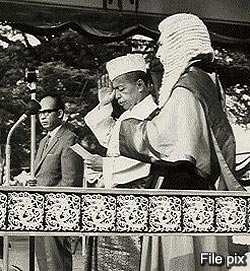 Both external threats were repelled with the help of armed forces from the UK, at a time when Malaysia was not in existence. Commentators have since observed that the need for protection from Malaya was the psychological push for many Sarawak community leaders to accept the Malaysian proposal.
Today, Brunei is the same old small country with a very small population. We have not seen any country invading this rich sultanate to date. National defence takes more than a standing army to manage indeed.
Or take Singapore for that matter. It too, decided to form Malaysia in 1963, but was expelled from the federation in 1965. It is a small island with no natural resources and no land. It had a population of less than two million then, and could hardly defend itself militarily from external threat.
The rest, as they say, is history, a glorious success story of a small republic with nothing but an industrious population and a highly efficient and clean government. Singapore is now considered a first-world developed nation with one of the highest per capita incomes in the world.
The question asked by many Sarawakians and Sabahans in the privacy of their skulls is: If Brunei and Singapore could go it alone, why not Sarawak and Sabah with large masses of land and plentiful natural resources?
Contrasting fortunes
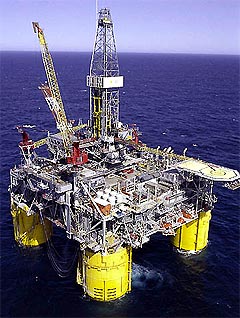
To-day, Sarawak and Sabah are the very pictures of socio-economic backwardness. The massive revenue from the rich oil and gas goes to Petronas, the number one cash cow of the country that is under federal jurisdiction.
With mere five percent royalty of the oil and gas going to the state government, Sarawakians and Sabahans have been deprived of the enjoyment of their natural resources.
The rich timer resources have long been depleted by greedy logging companies who are often crony capitalists closely aligned to the ruling elite in the two states. Recently, large scale land grab by plantation companies have even deprived farmers of their native customary rights land.
 Corruption in public life is blatantly rife, but as long as the state BN in Sarawak and Sabah will provide the fixed deposit to prop up the Umno regime in Kuala Lumpur, do not expect the MACC to visit either state any time soon.
There is little industry to speak of in these two states, in sharp contrast to the industrialisation in the Klang Valley, Penang, and Johore. Wages are low, as low as RM400 for a waiter and RM600 for a clerk, so low that even foreign workers in West Malaysia would scoff at them!
As a result, there has been an exodus of Sarawak youths from the kampongs of Sarawak drifting to Singapore and West Malaysia in search of better job prospects. In many remote villages, you will find only the very old and the very young holding the empty fort.
You hear the odd calls from within Sarawak and Sabah to secede from the Malaysian Federation. I do not see that as a viable option. In any nation state, the territorial imperative is paramount in keeping intact the national border. Any attempt to take Sarawak or Sabah out of Malaysia will be met with brutal police and military reactions.
The only solution is for Sarawakians and Sabahans to join the national tsunami and launch a peaceful revolution at the ballot box in future general elections, and then renegotiate a new social contract with Kuala Lumpur, on oil and gas royalties, on attracting foreign investment, and all those areas that have been neglected by the central government for decades.
A mere public holiday on Sept 16 will do nothing to right the wrongs of 46 years of federal neglect over Sarawak and Sabah. Without real partnership in national integration, Sarawak and Sabah will continue to stand out as two adopted children of the large Malaysian family.
Sim Kwang Yang can be reached at kenyalang578@hotmail.com


Are you sure you want to delete this comment?
This action cannot be undone.