




Corruption, our national scourge
I was sitting in the neighbourhood coffee shop with some friends one rain drenched evening when the young and not unattractive Indonesian waitress came out the front and ran down the corridor like the wind.
The other more adult Indonesian worker came forth and volunteered an explanation. A police car was spotted at the back entrance of the coffee shop.
I was sitting in the neighbourhood coffee shop with some friends one rain drenched evening when a young and not unattractive Indonesian waitress came out to the front and ran down the corridor like the wind.
The other more adult Indonesian worker came forth and volunteered an explanation. A police car was spotted at the back entrance of the coffee shop.
The coffee shop owner told her not to worry, for it was a matter of paying a small amount of cash. The Indon lady sniggered and said that the policemen were not after cash.
Then again, there was this time when I was summoned to meet an officer in the national registration department in Kuching to receive the birth certificate of an Iban boy in the village. I had personally helped the boy to apply for it by late registration, which is always a tedious and time-consuming process.
It was fasting time during one Ramadan season. When I arrived at the officer's desk, the young officer looked exhausted, and said I had to pay RM10. I paid, and he slipped the note under his file. There was no receipt. I understood, picked up the birth certificate and left. He was too small a fry to be bothered with.
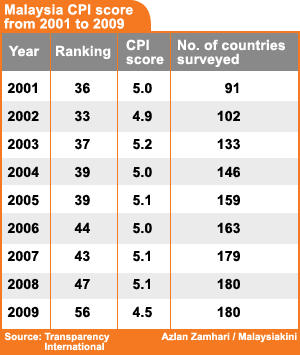
 Therefore, is it any surprise that Malaysia's ranking in the Transparency International corruption perception index (CPI) in 2009 has plunged nine places from last year's 47th to this year's 56th spot?
In a recent poll conducted by the independent Merdeka Centre and commissioned by the Centre for Independent Journalism, 74 percent of the respondents were dissatisfied with the way the government was handling the issues of corruption and abuse of power.
By now, public perception is that corruption in public life is the worst pandemic political and moral cancer in our body of politics. Whatever private citizens want to do with the government officialdom at whatever level, some kind of under-table money is expected to be paid.
Perhaps the tone for this massive corruption pestilence has been set by the award of government contracts by negotiated tender. There, the federal and state government minister sits at the top of the corruption food chain that also includes senior government bureaucrats down the line of command.
The opaqueness of the cavernous government machinery allows for seedy deals to be struck away from the light of public scrutiny, and for an innovative way for rent to be paid and collected.
The evil of such corrupt ways of awarding contracts is obvious. Without the free competition among a few qualified contractors as is the case with an open tender system, the contract sum can be inflated many times over.
Corruption is stealing from the poor
On a national scale, this practice of negotiated contract will incur massive wastage of public funds, perhaps in the billions.
The Auditor General's annual report is full of such common practise of over-pricing in government procurement of goods and services. Very seldom has any official action been taken against the offending parties.
The company that is awarded the main contract do not have to do any work. They just sub-contract the project to one or more main sub-contractors for a fee and these main-subcontractors will then sub the parcels of the project out to more sub-sub-contractors.
By the time the small fish that actually carry out the project begins work, there is no hope of profit except by cutting corners. They too bribe the government project supervisor to get their sub-standard work approved for progressive payment. Even the minor clerk and the humble office boy needs to be bribed to get the progressive payment voucher speeded up!
 The negotiated tender is a goldmine for crony capitalism, but a corrosive financial blackhole that eats into our national resources, taking away funds that would help eradicate poverty and improve social and medical services.
Corruption is stealing from the poor. Corruption is also a curse upon healthy business investment. Long term and robust business growth does depend very much on good business ethics and free open competition.
The home page of Transparency International has this to say under the heading 'Integrity deficit':
"Bribery in business captures news headlines around the globe and leads to massive reputational and financial repercussions for the implicated companies.
"Bribery, though, represents only part of the picture when profit comes at the expense of integrity and sustainability. Other corrupt practices, such as corporate fraud, cartels and undue influence on public policy, work as destructive forces that undermine fair competition, stifle economic growth and ultimately undercut companies' own existence.
"Featuring analysis of more than 75 experts, Transparency International's 2009 Global Corruption Report lays bare these and other corruption challenges that cut across countries and industries, exposes soft spots in existing corporate anti-corruption measures, and examines promising innovation in the sector.
"With its roots in a lack of transparency and accountability, the global economic crisis brings into sharp focus the need for the business world to align its dynamism and innovation with a concerted stance against corruption.
"The business case is irrefutable: "Basing a company or fund's future on personal relationships and unpredictable systems or simply operating in a dark space without oversight and accountability is a path to guaranteed failure," said Huguette Labelle, the TI Chair."
Trust in public institutions crippled
Foreign direct investment will also stay away from countries with much lower standard of integrity and transparency, because the murky ground in business poses great risk to their investment funds.
Will Malaysian businessmen invest in Afghanistan or Somalia, the two most corrupt countries in the world in 2009 according to TI?
But the greatest evil of pandemic corruption is the mortal wound it inflicts upon public morality in our national life. It destroys the trust of the rakyat in public institutions, in law and in any form of authority. It pulverises the spirit of rule of law.
When people know in their heart that connected crony capitalists can gain fabulous wealth within a short time, because those in the powerful position to grant such patronage make their decision based upon their personal discretion, rather than following an open and rational procedure, people become cynical and look askance at the law of the land.
The public life of the nation and the public noble utterances of those in high political places then become a huge hypocrisy in the silence and the privacy of the hearts of the people. The common expression of the people when watching the national political figures making their speech on the stage is a perennial sneer. The moral authority of political life is permanently crippled.
When that has happened over a long period of time, some citizens may even come to believe that whatever you do to get rich quickly is alright, even if it is against the law, as long as you don't get caught. The reasoning is this: If all those leading political luminaries can do it, why not I?
 When this sort of thwarted mentality becomes pervasive norm, fraudulent business practices prevails in the private sector, and all kinds of crimes fester in everyday life.
The release of the 2009 Transparency International corruption index is a humiliating condemnation of Malaysia's effort in curbing corruption, despite of and perhaps because of the antics of the unreformed MACC.
Thus far, the government's reaction to this latest TI ranking has been mere denial. The PM Najib Tun Razak simply said that mechanism has been put in place, and it will take time to work, and perhaps our poor ranking will be improved next year.
I doubt corruption in public life and private sector will improve next year, or in the next five years.
If you look at those countries with very low corruption indices close to the maxim 10 mark, they are all advanced liberal democracies, with the exception of Singapore and Hong Kong. They also tend to be rich countries where the per capita income of the citizens is many times that of Malaysia.
The conclusion is clear. We will begin to weed out corruption when we have a real two-coalition system and the ruling party can be changed once every so often.
Democratisation is a key factor in fighting corruption.
Sim Kwang Yang can be reached at kenyalang578@hotmail.com.


Are you sure you want to delete this comment?
This action cannot be undone.