




Lab's prescription will improve corruption index ranking
The government has pledged to elevate Malaysia's corruption perception index (CPI) ranking to the top quadrant in 2012 through the implementation of key measurements identified by the National Key Result Area (NKRA).
The government has pledged to elevate Malaysia's corruption perception index (CPI) ranking to the top quadrant in 2012 through the implementation of key measurements identified by the National Key Result Area (NKRA).
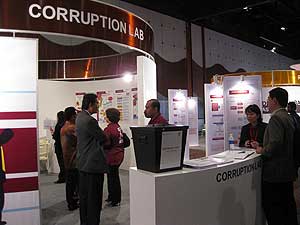 If this target is applied to this year's ranking which covered 180 countries, Malaysia needs to place itself in the top 45 countries, a leap of 11 positions.
This year Malaysia recorded its worst CPI ranking, plunging nine places from last year's 47 to 56.
However, according to Hisham Nordin, who leads the 'laboratory' on fighting corruption - one of the six NKRAs - Malaysia could reach the target by implementing the measurements drafted by the lab.
The short-term target is to improve Malaysia's index score from the current 4.5 to 4.9 in 2010, said Hisham when presenting the lab's NKRA report in the government transformation programme open day.
The two-day event is being held at the Sunway Convention Center today and tomorrow to showcase over 2,000 projects and 100 programmes identified under the six NKRAs. Tomorrow’s event is to open to public.
Lab consists of civil servant from various ministries and agencies set up for each NKRA to identify the problems and challenges in each area and draft effective measurements and projects to achieve the desired results.
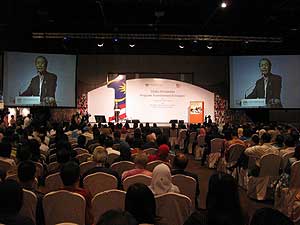 The lab to fight corruption had drafted over 30 measurements related to law amendments, improvement of transparency and accountability of government agencies, with specific timelines for implementation.
One of them is the completion of corruption trials within one year as study shows the faster the trial, the higher the chance of conviction.
Whistleblower Act, political funding
In his briefing to civil servants, Hisham revealed that the Attorney- General’s Chambers had began to study this measurement and expects implementation in the third quarter of 2011.
Other measurements, including imposing a minimum jail sentence, publishing names and details of convicted offenders, disclosing details of all government procurement above RM500,000, disclosing the usage of government allocation to parliamentarians, making the legal and prosecution director post of the Malaysian Anti-corruption Commission independent from the AG chambers, and the setting up of price database to prevent overpriced procurement.
According to Hisham, the Whistleblower Act will be tabled in the second Parliament sitting next year.
 One that would raise eyebrows is the revamp of political funding. A mini-lab will be set up to study the capping and monitoring of political contributions, disclosure of donors and funding sources, and supplementary funding by government to reduce reliance on private sources.
The study will be completed by the first quarter of 2011 but the implementation is pending approval.
Hisham conceded this measurement will be difficult to realise because it needs agreement from both ruling and opposition parties.
However, Hisham said the political masters had "agreed principally" on the other measurements.
He stressed that unlike the previous administration which only made pledges but failed to walk the talk, this time it will be a success as the government "never had a plan that is so serious and structured".


