




'GST = taxation without end'
exclusive Postponement of the second reading of the Goods and Services tax (GST) Bill in Parliament only offers Malaysians a brief respite in the legislative process.
exclusive Postponement of the second reading of the Goods and Services tax (GST) Bill in Parliament only offers Malaysians a brief respite in the legislative process.
Tony Pua, the DAP parliamentarian for Petaling Jaya Utara, is convinced that the government will push through the draft law because it is desperate for cash. The scheme will allow the government to milk citizens endlessly.
Its desperation is such that it is even willing to negotiate the inevitable "bureaucratic nightmare" that will eventually cost both the private and public sector more to implement the policy than what will be gained in return, he said.
 The introduction of the GST will see a ten-fold increase in the number of companies paying tax, compared to the current sales and service tax (SST) system.
"The government already has a lot of problems with (the) 20,000 companies (paying SST). There is fraud, there are delays, etc. Under the new system, the number of companies will increase to over 200, 000," said Pua ( left ) in an interview that preceded the postponement.
He added that it is misleading to claim that the GST will be more friendly to the pocket compared with the SST, because it is not likely that the tax rate will stay at the proposed 4 percent.
"From what I understand from the director of taxation in the Finance Ministry...the break-even point...in terms of the amount (to be) collected is actually 4.2 percent (to be on par with SST collection)," he claimed.
The government is also wrong in claiming that it is exempting the poor from GST by not imposing GST on basic goods, he said, because production input will still be taxed.
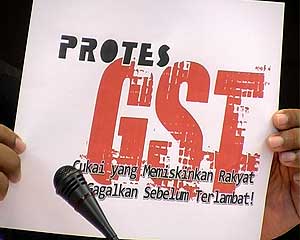 "For fertiliser, (the farmers) have to pay GST, for water treatment, (they) have to pay GST, for pest control, (they) have to pay GST - for everything else in the production (process) the farmers will have to pay GST.
"Naturally the price of rice (for example) will go up or the farmers will be extremely squeezed. So (even if) rice is exempted, the price will still go up."
Kedai runcit owners will be hit twice in that they will have pay GST but will not be able to claim it back. Neither can they pass it on consumers because the products they sell are zero-rated, he added.
But what else can the government do if it is truly up against the wall?
Plenty, replied Pua, including practising proper procurement procedures and avoiding wastage of public funds.
His comments conclude a two-part interview on the issue. Excerpts follow, with the content edited for language and brevity.
Malaysiakini: Why is GST such a contentious issue and why is Pakatan Rakyat against it?
Tony Pua: We object for the fundamental reason that, if the government wants to tax the people, there must be a need for it. Now there is no need. The GST may be the best form of tax system in the world...(or) it may not be. But even if it is the best form of tax system in the world, the government should not be taxing people when it doesn't need to.
GST comes with its own set of problems and difficulties. In the Malaysian context we all know that 85 percent of workers (do not have their income) taxed. (This is) not because they don't want to pay tax or because they're hiding their money, but because their income falls below the taxable threshold.
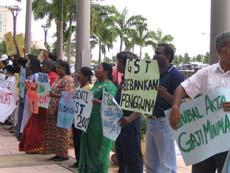 When GST is implemented, this whole 85 percent will be affected. Of course the government will say, ‘Oh, we are not taxing basic goods. Your
pas
ar malam
, the
kedai runcit
will be exempt from GST'. But even basic goods, rice for example (will not be exempted from tax). If you are exempted from GST in consumption of rice, you are not exempted from GST in the production process.
When GST is implemented, this whole 85 percent will be affected. Of course the government will say, ‘Oh, we are not taxing basic goods. Your
pas
ar malam
, the
kedai runcit
will be exempt from GST'. But even basic goods, rice for example (will not be exempted from tax). If you are exempted from GST in consumption of rice, you are not exempted from GST in the production process.
For fertiliser, (the farmers) have to pay GST, for water treatment, (they) have to pay GST, for pest control, (they) have to pay GST - for everything else in the production (process) the farmers will have to pay GST. Naturally the price of rice will go up or the farmers will be extremely squeezed. So while rice is exempted, the price will still go up.
Similarly for your pasar malam , your mom-and-pop kedai runcit . What will happen is that they will not have to charge GST, so when you walk into these shops, (the goods are) GST-free. But then again, (the shopowners) are charged GST for the products that (they) buy from bigger companies. So it cannot be ‘I pay my suppliers GST, but at the same time I don't increase the price for consumers'.
The argument is that the producers can claim back the GST, therefore it will not be added on to the price of goods and services.
No, for the exempted retailers, that is your mom-and-pop shops, they cannot claim back. Those who are exempted cannot claim a refund, otherwise there will be a major leakage. Everyone would claim to be a small shop, everyone will claim back, without charging.
What about for the producers of the goods...before the goods reach the shops?
Okay, everything will add up to 4 percent. It may be 10 producers before, and each part of the chain of production will have to pay 0.5 percent. The final consumer pays 4 percent. In this case, since the mom-and-pop shops are not charging customers the 4 percent, they themselves will have to pay the 4 percent and cannot claim it back.
So the overwhelming majority of Malaysians will be affected by GST. The question then is who suffers more? GST is a well-known, documented tax system that is heavier on the poor than the rich.
 In countries where the income gap between the rich and the poor is minimised, the impact is minimal. Where the income disparity is large, like in the case of Malaysia - we have the biggest income disparity in the entire Southeast Asia, one of the highest in Asia - then it becomes a heavier burden on the poor.
How does it become a heavier burden? Now, if I am earning RM1,000 a month, I will spend most of my money on my basic needs. I may be able to save RM100 a month.
I was having dinner with someone last night and was told that if he was earning RM1,000 a month, he would spend RM1,200 and fall into debt. Which means that nearly 100 percent of the income is taxed at 4 percent.
If my income is taxed at 4percent, if I am earning RM20,000 a month, my expenditure could be half of that, more than sufficient for me to have a good life, but RM10,000 of my income goes to my savings, and I am only taxed for 50 percent of my income, which I consume.
That's where the unfair bit comes in. For the poor, they are taxed on nearly 100 percent of their income, and for the rich, they are only taxed on a portion of their income.
You have spoken at length about the government's over-dependence on petrol. Is this, and the fact that we don't have a large enough tax base, a valid argument for the necessity of GST? The government's running out of money, so it has to implement GST...
My argument is that the country is indeed relying too much on petrol money. The argument that you tax people because you are running out of petrol money is silly. So you run out of more petrol money, you tax the people more. It does not make sense.
The unfortunate thing is that, as (former premier) Dr Mahathir (Mohamad) himself has stated, RM270 billion was collected from Petronas by the government over the past five years, 2004-2009. Where did all this money go? Did the people's income go up because of this money?
 What the government should have done is to invest this money in a way that would have generated more income for the people. Invest it in a way that when it comes to the workforce, and their income is higher.
The natural effect of raising the income of the people is that they pay more taxes. One way of curbing reliance on petrol money is to increase the income of the people so they pay more taxes.
That's what happened in Singapore. They have no petrol. They have no windfall taxes, they have nothing. What they did was they raised the income of the people, so that even at low incomes the government collects money.
Unfortunately for Malaysia, our incomes have stagnated not just in the past five years, but in the past 10, 15 years.
You said that the government estimates it will receive about RM1 billion from GST, but we also know that the estimated cost of implementing GST in Australia was about AU$5 billion. Can we afford this? Will this cost the government more than it will earn?
Actually, for the first two years, it will be a money-losing venture for the government. The government has announced the 4 percent strictly for ease of consumption. Once it is implemented, once the people have gotten used to it, I expect the government to raise it to 5 percent, 7 percent and possibly 10 percent down the road.
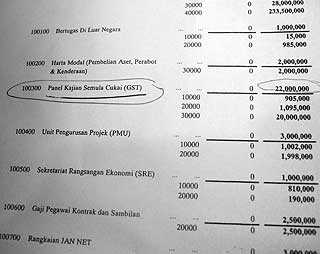 This is a very dangerous way of collecting money from the people because institutions in the government have not been reformed such that the tax payers money are used in a proper way, used in the most value-for-money method.
What the minister has stated is that the government will make RM1 billion. From what I understand from the director of taxation in the Finance Ministry... the break-even point, not in terms of cost, but in terms of the amount (to be) collected is actually 4.2 percent (to be on par with SST collection).
That means that the government will collect less under the 4 percent tax system. This only shows it will increase the tax rate.
And your point about the cost of implementation is a major factor. It was calculated that break- even point for implementing GST is 10 percent - meaning you need to collect 10 percent to make the GST exercise worthwhile.
You have the Federation of Manufacturers of Malaysia. You would expect them to support GST. Why? Because with lower tax, exporters don't need to pay tax. But it came up with a statement strongly against the GST for the simple reason that (manufacturers) don't believe that the Malaysian government can cope with the bureaucracy involved.
Under the SST, 20,000 companies are taxed. The government already has a lot of problems with the 20,000 companies. There is fraud, there are delays, etc. Under the new system, the number of companies will increase to over 200,000. More than 10 times and the number of documents to be processed will increase to over 100 times. The whole bureaucracy of managing this will be a nightmare for the government.
For the exporters, they will think, ‘Although it will be tax-free for me, I am afraid that my refund will come back very late'. The government promises refunds in 14 days, but can they do this, and avoid the fraud that occurs?
We know there are businesspersons in Malaysia who will take every opportunity to defraud the government. By the time they are detected of committing fraud, these people could be anywhere.
The largest economy in the world, the US, after a report done in 2008, decided not to implement the GST.
So you're expecting a bureaucratic nightmare?
It is a bureaucratic nightmare. Even efficient countries like Singapore, Australia or the US have problems with the GST, so you can imagine what it will be like in Malaysia.
So why do you think the government wants to push through this tax, given the problems that it will face?
The only reason I can think of is that it is financially desperate. The financial state of the country is probably a lot worse than what it has revealed to us. If you look at the overall context of what is happening to Malaysia, you will see how the jigsaw fits together to show that we are really short of funds.
Subsidies are being called back at a pace never seen before. Sugar prices have gone up, we know petrol prices will go up, next electricity tariffs will go up.
We are
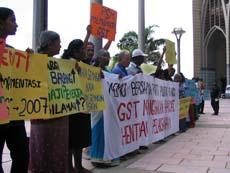 seeing all sorts of new taxes. Credit card tax, real estate property gains tax and now GST. We also know that toll rates will go up because government will no longer want to increase compensation for the toll companies.
All this says there is something wrong with the financial state of the country, and if you ask me to make an intelligent guess, all this is because over the past five or four years, (national) income was artificially inflated by windfall income by oil and gas sector...windfall because of the sudden oil prices. This doesn't come from normal economic activities. Just that the oil prices were very high and we got a lot of money.
The government continued to take loans on top of this. Instead of reducing the number of loans because we have this windfall money, what they did was to cap the proportion of loans it took and these loans became very big.
It has maintained a deficit of 3-4 percent every year for the past five years despite the windfall income. These deficits are quite high, and the bonds will be due in the next three to eight years, and that is the period where the government will be desperate for cash.
What has happened to the money earned?
If you look at the budget, and this has been my specialty since I joined politics, the government has burnt every single sen of it. Every year we talk about the Petronas contribution; in 2004 it was RM20 billion, in 2005 it was nearly RM70 billion. It's a huge increase. More than 40 percent of our budget is sourced from Petronas.
The fact that we are in deficit means that we have spent everything. If I am at a ceramah I will say that the government spent it on submarines, on boats that cannot sail, on military aircraft...stuff that doesn't being economic development to the country.
So they are desperate and they are bringing in GST because of this. What else can they do if they don't introduce GST?
There is a lot they can do. One thing I am very upset with is that, when Najib (Abdul Razak) came into power, he said he would implement the open tender process or at least closed tenders that ensure that the government receives value for money for the projects that it gives out or the assets that it sells. This has not been carried out. In Penang, where Pakatan has implemented open tenders for the work done, we have been criticised for it.
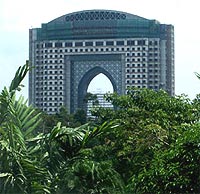 Take the recent award of the Matrade International Convention Centre project, the largest in Malaysia. The RM628 million contract was awarded to Naza TTDI, not the most of famous of developers, without either an open or closed tender.
When I asked the minister in Parliament, why it was given the job and why other developers weren't invited to bid, the answer was ‘they submitted the proposal first'. I, too, would like to give a lot of new proposals to the government; then maybe I'll make some money out of it.
How is the government paying the RM628 million? It is a lot of money. We can't afford (such payments) any more. The government paid for it with a piece of land. When we asked about the value of this land, the government said it is RM167 million. Eh, this developer is very generous! ‘I build something worth RM628 million but I'll take payment of RM167 million'.
So the answer raised more questions. When we checked...of course, if I were a private developer, I would have to hype up my company so I can sell my shares at a higher price...the valuers out there valued (the land) as anything between RM1 billion and RM1.5 billion.
Why wasn't this piece of land separately tendered off or auctioned so the government could get the best value for it? This happened (last) December, and it shows that the government has no resolve to change the way it is administrating the procurement exercises, the privatisation processes. Without those changes, they can keep taxing the people. It will never end.


Are you sure you want to delete this comment?
This action cannot be undone.