




Dayaks battle against gangsters and spin doctors
comment Sarawak's natives are fighting hired thugs to defend their Native Customary Rights (NCR) land. According to the Borneo Resources Institute Malaysia (Brimas), an NGO campaigning for NCR, gangsters have been trying to intimidate Iban villagers who blockaded a road against a timber company on March 12.
comment Sarawak's natives are fighting hired thugs to defend their Native Customary Rights (NCR) land. According to the Borneo Resources Institute Malaysia (Brimas), an NGO campaigning for NCR, gangsters have been trying to intimidate Iban villagers who blockaded a road against a timber company on March 12.
Brimas says the Iban communities of Sungai Tepus, Balingian, midway between Sibu and Bintulu, have lodged three police reports against the loggers, Bitani Maju, but their NCR land has not been protected.
 Instead, their blockade across the logging road has been removed by the police. Even worse, the villagers allege that a group of gangsters, traveling in ten cars, have been threatening them since the blockade began.
Mark Bujang, Brimas Executive Director, told the press that on April 3, Oren anak Linggang, a villager from Rumah Osay, was badly beaten up by gangsters. Bujang said the thugs, escorted by a local penghulu, had obstructed the vehicle Oren was traveling home in, near the road junction to his longhouse. A witness, Banyau anak Timbang, said he was able to escape.
Banggau anak Panggai, head of Gerubat, the communities' anti-logging action committee, was quoted as saying, "I told Oren to lodge a report at the Balingian police station the next day. However, instead of taking down his report, the police arrested Oren."
Banggau was unable to explain why Oren was detained. "The gangsters seem to be controlling the police and also our community leaders," Banggau claimed. "We do not want any untoward incident to happen, so we appeal to the police to take action and stop the gangsters from harassing us any further."
Police ignored villagers' reports
Reports of hired thugs and police using violence against villagers protecting NCR land are common. In 1999, four men described as gangsters from Miri, were shot dead in a fight, after a company called Sarawak Oil Palm tried to muscle its way into NCR land belonging to Iban longhouses Rumah Busang and Rumah Bali, near Bintulu.
 According to Rumah Busang leaders, the gangsters, brandishing samurai swords, had roughed up villagers in an attempt to terrorise them into giving up their NCR to the oil palm plantation. The longhouse communities made seven police reports, but they were ignored.
Villagers say on Sept 1, 1999, eight thugs and twelve villagers clashed near Rumah Busang. Four gangsters died and the other four fled.
Nineteen villagers were jailed over the killings. None was convicted except an elderly man, Jalen anak Anton . Jalen, 74 at the time, put his thumbprint to a confession, although he could not understand Malay or English, and was visually impaired. He was treated with respect by staff and other inmates in Lambir Prison. He was finally released in 2007 and given a hero's welcome on returning home.
The story was covered extensively in the Chinese press. There was widespread public sympathy for the Iban villagers: land grabs have led to poverty, hunger and resentment in many communities throughout the state.
A Gawai Kelingkang Bujang Berani , a ceremonial offering for the 19 detainees, was held in Rumah Busang on October 2, 1999. In attendance were 500 local leaders from surrounding villages, as well as journalists from local newspapers and CNN. This celebration of bravery was said to be the first Gawai Kelingkang in Sarawak for fifty years.
Following the conflict, gangsters have not threatened the Busang and Bali longhouses, and Sarawak Oil Palm has withdrawn from the Ibans' NCR land.
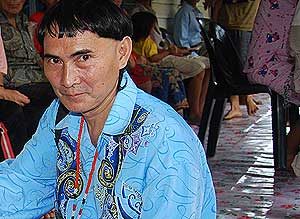 The Iban have a reputation for being fierce warriors. Ritual taking of heads in battle has ceased for over a century, except for some headhunting during the despised Japanese occupation. But urban thugs remain wary of the strength in numbers of entire longhouses. This may explain why the alleged assault on Oren took place on the main road, at some distance from the longhouse.
Purveyors of spin
A more modern and sophisticated approach to promote the takeover of NCR lands by logging and plantation companies is public relations . Wealthy logging companies such as Samling and Interhill, as well as palm oil companies such as IOI Pelita use Corporate Relations Officers and ‘communication strategy' consultants. They need these spin doctors to minister their injuries to their image, suffered from reports of illegal invasions into NCR lands, violence against locals by hired thugs, and sexual abuse of local girls and women.
However, these corporations' claims of ‘sustainable development' and ‘respect for indigenous people's rights' are contradicted by widespread NCR blockades, and recent court rulings in favour of NCR lawsuits against logging and plantation companies.
The most recent victory for NCR plaintiffs was on March 31 in Miri. High Court Justice Abdul Aziz bin Abdul Rahim awarded victory to Lah Anyie and the Kayan village of Long Teran Kanan in Tinjar, Baram.
The Kayans have been fighting a 12 year court battle against a palm oil company, IOI Pelita, and the Sarawak government, over the illegal occupation of their NCR land.
 The judge stated the leases awarded to IOI Pelita by the state government were "bad and in breach of the law". The ruling declared the palm oil plantation leases had violated the villagers' constitutional rights under Article 5, which protects the right to live, without deprivation of the land as a source of livelihood, and Article 13, which safeguards the right to property.
IOI, a leading global palm oil producer and founding member of the Roundtable for Sustainable Palm Oil (RSPO), has defended itself against bad press, using all the corporate relations weapons at its disposal.
Last December, the BBC reported the Malaysian government and palm oil companies have been accused of "laying waste to (the) last remaining rainforests of Borneo in what has been described as a corporate land grab". After visiting the IOI estate in Tinjar, the BBC described it as "a scene of absolute devastation: a vast scar on the landscape."
Attacks on the BBC and opponents of palm oil corporations were then launched by organisations calling themselves 'NGOs', including the Palm Oil Truth Foundation, World Growth and Deforestation Watch (whose website is, sadly, defunct).
A month earlier in November, in a letter to Malaysiakini , Tim Wilson, a Senior Consultant to Australian public relations firm SDA Strategic, had also argued that palm oil "provides a sustainable livelihood for poor rural farmers" and "probably reduces the transfer of land from forest to agriculture".
At the same time, he admitted that under current government policy, most palm oil plantations in Malaysia and Indonesia provide profits , not to poor rural smallholders, but to wealthy corporations.
It is clear that these international purveyors of spin have had no significant contact with rural farmers in Sarawak whose NCR land has been taken illegally by palm oil corporations.
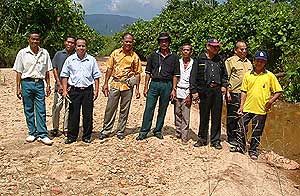 These farmers continue to fight the loss of their land to mammoth companies. They intend to determine their own future, and make their own living, from palm oil or any other crop they choose to grow.
It appears Dayak NCR landowners remain defiant of the state government, the police, hired gangsters, spin doctors and all other comers.


Are you sure you want to delete this comment?
This action cannot be undone.