




Bakun dam: Reclaiming broken promises
Troubled from the start, the Bakun hydroelectric dam project appears to be on a steady road to failure.
Troubled from the start, the Bakun hydroelectric dam project appears to be on a steady road to failure.
Started in 1993, the project, which was estimated to cost about US$2.4 billion appears to be in the red again with its main stakeholder Sime Darby Bhd last week estimated cost overruns of RM450 million.
 But in the shadows of what is to be the largest dam in Southeast Asia, members of native community displaced by the project in Sarawak are fighting to claim a string of unfulfilled promises.
Among these is the promise of free houses in the new settlement as compensation for being forced out of their settlements.
Kayan community member Hary Wing Miku claimed that the communities, comprising 10,000 members mainly from the Kayan, Kenyah, Kajang, Ukit and Penan groups, are now being forced to pay for their housing units.
“The Belaga District Office is trying to force the villagers to sign a document compelling us to pay RM52,000 for the houses,” said Hary, now based in Bintulu.
“The community is refusing to pay, and some villagers whose original homes will not be submerged by the water are considering returning there.”
Getting the state and federal governments to keep their word has been an uphill battle, he said, mainly because most of the promises were only made verbally.
It is precisely for this reason that Hary, with the help of the Sarawak Indigenous Lawyers’ Association (Sila), is now drafting a legal document to bind the government to its promises.
12-point document
The 12-point document, dubbed the Bakun Agreement, is a compilation of the pledges made on matters such as compensation, royalty, shareholdings, land rights, and an education trust fund.
Sila member Abun Sui Anyit from the Kenyah community, who had moved to the new settlement in Sungai Asap as a teenager, said the final version of the agreement will be ready by the end of this month.
“We will conduct workshops to explain the terms of the agreement and then get the communities, government and other stakeholders to sign (the document),” he said.
But getting the government’s signature will be no walk in the park.
 To begin with, the government appears reluctant even to own up to its actions, having recently
axed
a RTM documentary on the issue and terminating the contract of its producer, citing “budget constraints”.
To begin with, the government appears reluctant even to own up to its actions, having recently
axed
a RTM documentary on the issue and terminating the contract of its producer, citing “budget constraints”.
More critically, however, agreeing to the Bakun Agreement would mean agreeing to pay at least RM19.4 million a year, not including land compensation, and providing amenities free of charge for as long as the dam is in operation.
In the case of royalties, payment will have to be made annually for the next 999 years - a tall order by any standards.
‘Only by-election promises honoured’
To date, even the promises fulfilled have been half-measures which have left the communities feeling short-changed.
For example, the resettlement site had no amenities when they first moved forcing the residents to buy four-wheel drive vehicles and travel up to five hours to Bintulu to get provisions.
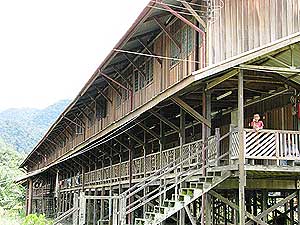 Even today the settlement only receives radio transmission, and has a clinic and two primary schools.
Hary said his father was promised RM52 per tree for his 3,000 cocoa trees but was eventually only paid a lump sum of RM24, 000 for both the land and crop.
Two years ago, the rest of the residents had a rude shock when they received lump-sum bills for water and electricity consumption since they moved into the settlement.
They were initially promised free amenities because they were “not used to cash transactions” and this was to be reviewed when the villagers “learn to handle cash”.
While he is aware that the demands are large, Hary said these are commitments made by the government, which has a moral and legal obligation to fulfill them.
“Sometimes I wish that there is a by-election in Belaga. It seems to be the only time the government keeps promises,” he said.
Related story: Demands in the Bakun Agreement


Are you sure you want to delete this comment?
This action cannot be undone.