




How Najib can win friends and influence Sarawakians
The Flying Doctor Service (FDS) in Sarawak is a lifeline for impoverished Sarawakians. Helicopter flights are meant to deliver medicines, vaccines and care for pregnant mothers and children every month.
The Flying Doctor Service (FDS) in Sarawak is a lifeline for impoverished Sarawakians. Helicopter flights are meant to deliver medicines, vaccines and care for pregnant mothers and children every month.
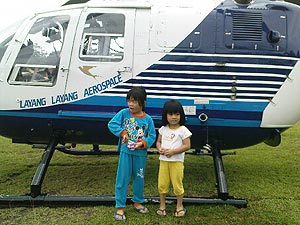 The Emergency Medevac, or Medical Evacuation, Service (EMS) transports critically ill patients from remote communities to the referral hospitals of Kuching, Sibu and Miri, and also between these three hospitals.
But some voters in the recent Sibu by-election have lost family members, because the FDS and EMS flights have been stalled on and off, over the past three years. Victims of severe head injuries, suffering from bleeding in the brain, and admitted to Sibu Hospital, have been denied access to mercy flights to Kuching to be operated on by a neurosurgeon, for example.
Sibu Hospital caters for 600,000 people in the Rejang Basin. Among them are some of the poorest people in Malaysia. Many of them can only get to hospital by express boat. For the best part of three years, ill patients needing transfer for medical attention in Kuching could only be moved using private helicopters, if they were wealthy timber tycoons, or if they worked for a multinational company. If they were members of the Armed Forces, army helicopters could be used.
From 2007 to last year, both the FDS and EMS throughout Sarawak were interrupted frequently. A hefty RM63.4 million contract was awarded in 2006 to SAR, a peninsular Malaysian company with RM10 million in debts, with only a single, grounded aircraft, and with experience in neither FDS nor EMS.
Last September, PKR strategic bureau director Tian Chua demanded a probe into the FDS/EMS contract, questioning "whether anyone in Putrajaya was assisting SAR to keep hold of a contract they evidently had no ability to perform". The Treasury and the Health Ministry never responded.
This sordid scandal provides an insight into the two main grievances of many Sarawakians who voted against the Sarawak United People's Party (SUPP) and the Barisan Nasional (BN) in the May 16 Sibu by-election.
These two burning issues are corruption and extremely poor basic public services.
Brighter prospects for Najib
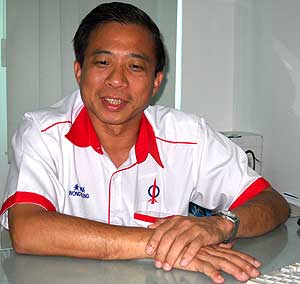
For all the Pakatan Rakyat euphoria over underdog Democratic Action Party (DAP) candidate Wong Ho Leng's ( below ) marginal victory in Sibu, Prime Minister Najib knows the next Sarawak state assembly elections, or combined state and parliament elections, will see very few similar upsets.
 The overwhelming might of BN machinery and wealth will ensure that transportation, the mainstream media, institutions such as the police, the Election Commission and the civil service, and the distribution of political largesse, will remain in BN's hands.
Sarawak timber tycoons may hedge their bets somewhat by contributing small amounts to Pakatan candidates, but the bulk of their political donations and coverage by their newspapers will be at Najib's disposal.
Pakatan cannot match these resources. The coalition's leader, Anwar Ibrahim, is unlikely to commit significant funds to the costly election campaigns in the vast interiors of Sabah and Sarawak. Political observers say Anwar sees little hope of winning many parliamentary seats in Najib's ‘fixed deposit' states.
Najib can also rely on the support of Sarawak's majority of poor and uneducated voters. The BN scales or dacing logo has been the only government symbol they have ever known, since the days of the White Rajahs.
Most rural voters cannot imagine Pakatan parties as being an alternative government, because reports of Pakatan governments' successes have been blacked out in the local press and broadcast media, while Pakatan's calamities and defections have been celebrated.
Two-thirds of Sibu's voters are urban Chinese. Most of these are Foochows, well-known for being resourceful, for valuing education highly, and for traveling widely. Many Sibu Chinese also enjoy instant access to alternative internet media. Yet the DAP won only by a whisker.
 Such ‘connected' urban Chinese voters make up barely a fifth of all Sarawakians. Optimism that the Sibu result may embolden other voters in the state is illusory. The disproportionate weight given to rural seats will guarantee victory to Najib in the upcoming state or general elections.
Keeping ‘White Hair'
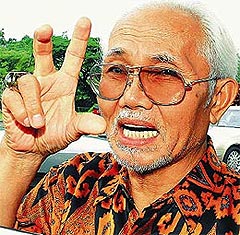
Najib will be unlikely to want to tinker with the current state leadership. Although Chief Minister Abdul Taib Mahmud ( above ), given the moniker ‘White Hair' locally, has proven to be a liability in hustings in urban, Chinese-dominated seats, he still commands tight control over his dominant state BN party, Pesaka Bumiputera Bersatu (PBB).
The PBB is projected to win almost enough state assembly seats to rule even without the help of the troubled and fractured SUPP. And the PBB can be relied on to deliver a large parliamentary voting bloc to Najib, as Taib did triumphantly in March 2008.
The SUPP is fast losing its relevance. Najib needs only the aging Taib to stay alive and in power long enough to ensure 30 or 31 parliamentary seats are retained by the BN, mostly by the PBB, to keep Umno in control nationwide.
Najib is unlikely to discard Taib at this crucial juncture before the 13th General Election. Besides, Taib has crushed influential rivals in the PBB who might have embraced Umno and invited the peninsular party to take over, as the late Mustapha Harun did in Sabah in 1994.
The colossal investment and effort required to establish 31 or so new Umno divisions in Sarawak would pay off in the long run, in the form of a large chunk of new Umno delegates loyal to Najib. But in the near future, Najib might see this adventure as being too risky, with a tight general election looming.
A hasty Umno invasion might also provoke a backlash from PBB supporters loyal to Taib's family, as well as from voters sharing the fiercely anti-peninsular, independent-minded streak that runs through the political spectrum.
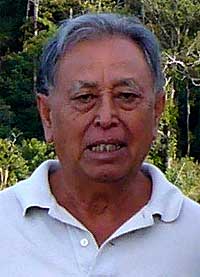 Umno would not have the luxury of a natural constituency of Muslim immigrants flooding Sarawak, unlike Sabah in 1994. In Sabah, former Chief Ministers Mustapha Harun and Harris Salleh (
left
) had already paved the way for Umno's entry, by
relaxing immigration rules
for Muslims from Mindanao and Indonesia.
Umno would not have the luxury of a natural constituency of Muslim immigrants flooding Sarawak, unlike Sabah in 1994. In Sabah, former Chief Ministers Mustapha Harun and Harris Salleh (
left
) had already paved the way for Umno's entry, by
relaxing immigration rules
for Muslims from Mindanao and Indonesia.
Banking on ‘feel-good' factors
Najib may instead opt to ride on a crest of improved economic indicators, beginning with 10.1 percent year-on-year GDP growth in the first quarter of this year, and the sunny slogans of 1Malaysia and the New Economic Model (NEM), to recapture a two-thirds majority in Putrajaya. Najib would then be able to replace Taib and the PBB, with his own man and Umno, later.
Besides corruption and poverty, there were undoubtedly other factors at play during Najib's Sibu defeat. There was the row over Umno's ban of the word "Allah" in Christian literature. SUPP's internal schisms and perceived subservience to Taib's economic dominance played badly among Chinese business and working classes.
Local unhappiness over the BN's broken past promises to alleviate perennial floods, and provide jobs and university places, played a role too.
National issues also registered, such as anger over the police killing of Aminulrasyid Amzah, and the frenzied tub-thumping of Malay supremacist groups like Gertak and Perkasa.
Najib will have his hands tied over most of these issues. He will certainly be able to do little to combat corruption, too.
But he can still address the other major issue causing distress among Sarawakians: poor public services. He can curry favour by committing more federal resources for infrastructure, health and education direct to Sarawak, without going through the tangled web of business interests woven by Taib's family. He can finance better roads, schools and hospitals, and channel more electricity and clean water into rural homes throughout this neglected state.
Najib will baulk at increasing oil royalties for Sarawak from five percent to 20 percent, as his rival Anwar has pledged. But with the signs of an upswing in the economic cycle, he would do well to honour his campaign promises to Sibu, for a start.
If the PM works on winning Sarawakian hearts and minds, he may soon forget the anguish of his narrow loss in Sibu, and continue to prosper from his fixed deposit.


Are you sure you want to delete this comment?
This action cannot be undone.