




TI-M: Politics-business cocktail a dangerous brew
Malaysians have far too long tolerated money politics, noted Transparency International - Malaysia (TI-M), in saying that it is high time that legislation is drafted to prevent politics from being mixed with business.
Malaysians have far too long tolerated money politics, noted Transparency International - Malaysia (TI-M), in saying that it is high time that legislation is drafted to prevent politics from being mixed with business.
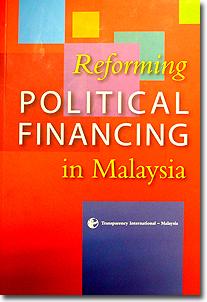 In its book ‘Reforming Political Financing in Malaysia’ launched on Sunday, the corruption watchdog recommended the enactment of a Political Parties Act to provide full disclosure of the sources of funds to political parties and to regulate such sources.
Under the Act, political parties would not be allowed to own businesses, as this is deemed to open the floodgates to nepotism, patronage, conflict of interest and abuse of power.
This would overcome problems with the Societies Act and Elections Offences Act, which are riddled with loopholes that can and have been exploited by political parties, it said.
Although TI-M does not recommend a blanket ban on business ownership, it advocates the divestment of party assets following the example of the Kuomintang party in Taiwan, which is in the midst of doing so and returning the cash to the Treasury.
The business wealth of Malaysian political parties is worrying, the book noted, considering the trend of assets changing hands to private firms.
Quoted in the book, former Umno president Mahathir Mohamad estimated that the party was worth RM1.4 billion in property, cash and assets in 2003 - the year he stepped down as premier.
By MCA president Chua Soi Lek’s own admission, his party is a “rich party” with investments reportedly worth about RM2 billion.
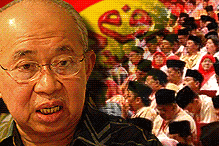 Following the money trail to find out who owns what is not as easy as one would imagine, said former Umno treasurer Tengku Razaleigh Hamzah (
left
).
Following the money trail to find out who owns what is not as easy as one would imagine, said former Umno treasurer Tengku Razaleigh Hamzah (
left
).
“If you go to these directors (of companies accused of holding party assets), they will say it is their money, not Umno’s … all these holdings, double cross-holdings, you don’t know who owns what,” he told the authors.
Other issues which arise include the interests of minority shareholders in public-listed companies, who may not get a say about the involvement in politics.
TI-M is primarily concerned about the ownership of media companies by political parties which, on top of corruption, leads to an uneven playing field.
While the MCA-owned Star and Umno-majority owned Utusan Malaysia are not party organs, the NGO noted that both media outlets provide “partisan information” which enable their owners to carry out “year-round campaigning”.
Accounting for expenses
Fair and free elections can also be ensured through full disclosure of funding and expenditure that precedes the campaign period.
“Expenses related to the election should therefore be backdated to the dissolution of the previous Parliament or legislative assembly,” the book noted, recommending that a neutral caretaker government be appointed as well.
Similarly, expenditure on electoral activities of political parties including in-kind donations should be disclosed and capped.
At present the Election Commission does not require reports on services rendered or goods sold to election candidates if the ‘claim’ is not made within two weeks or loans are ‘written-off’.
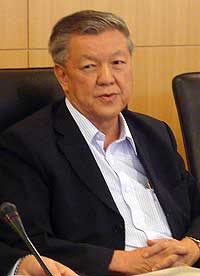 Chua admitted that this is why election expenses balloon beyond the RM200,000 allowed in contesting a parliamentary seat.
“The official amount does not reflect the true spending. Usually a candidate spends RM500,000 to RM1 million during campaigning,” he said.
Party elections should not be spared either, said TI-M, considering the large sums that change hands during these events.
Outside election periods, parties can be kept clean by capping individual contributions, to avoid “corrosive money” from those who intend to exert control.
TI-M proposed that foreign donations be outlawed in the interest of sovereignty, conceding however that a mechanism should be formulated to allow Malaysians abroad to contribute.
The law is currently silent on this matter, just as it is on funds raised through politically-linked organisations in the form of research centres and youth organisations.
In South Korea, the book noted, policy research institutes are required to provide a report on their annual activities to the National Election Commission.
The parties’ accounts should be open to public scrutiny, as is the case in countries like Japan and Singapore, through regular disclosure during non-election periods.
During an election period, TI recommended that such disclosure be made on a daily basis.
Related story: Dr M: Politics is money, there is no escape


Are you sure you want to delete this comment?
This action cannot be undone.