




Long Bulan... from plenty to poverty
Sometime in the early 1990s, I had to make the difficult journey from Kuching to visit the Kenyah village of Long Bulan, deep in the labyrinths of the Rejang Valley, to learn about the impact of the planned Bakun dam.
It was a harrowing trip as our party of 10 had to travel by land through Belaga and cross the Balui River. It took two or three days for us to travel by land, mostly over timber tracks, using a...
Sometime in the early 1990s, I had to make the difficult journey from Kuching to visit the Kenyah village of Long Bulan, deep in the labyrinths of the Rejang Valley, to learn about the impact of the planned Bakun dam.
It was a harrowing trip as our party of 10 had to travel by land through Belaga and cross the Balui River. It took two or three days for us to travel by land, mostly over timber tracks, using a land cruiser for the purpose.
For the final leg of the journey, we had to trudge for many long hours on foot under the hot sun. We had to cross raging rapids before we ended up at our destination. The river bank was muddy and slippery, and I had to scramble like a monkey up the bank, while the local children were laughing and running across the slick surface, while carrying our heavy bags.
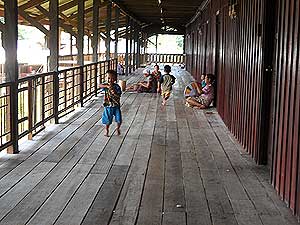 The size of Long Bulan surprised me, for it was nothing short of a small town. I was told that the longhouse had about 1,000
pintu
or doors, stretched out beneath the mountain top as far as the eye could see. The village had a primary school, and even a small clinic.
The size of Long Bulan surprised me, for it was nothing short of a small town. I was told that the longhouse had about 1,000
pintu
or doors, stretched out beneath the mountain top as far as the eye could see. The village had a primary school, and even a small clinic.
The majesty of the village building was awe-inspiring. I was told that the village had been built a century ago. The main pillar, carved out of ancient giant Belian wood, was a wonder to behold. In cash terms, the whole longhouse must have been worth many millions, what with the priceless wood, and their collection of ancient pots, pans and gongs.
 I was told by the villagers that their most precious commodity was salt. Because of the isolation of their physical location upriver, common salt was hard to come by. A large bag of this humble commodity could have been exchanged by us for a whole wild boar the villagers had hunted.
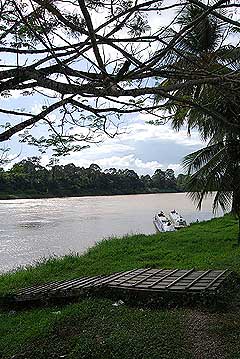
Since we arrived in the evening, we took a bath in the clear, clean, cool and refreshing river beside the longhouse. The only impediment was the abundance of mosquitoes. I wondered what these mosquitoes had been feeding on before our arrival.
The meeting with the Long Bulan villagers began in the packed kampung hall. I was surprised to see a sizeable number of Iban villagers present. Apparently, many Iban had come to the area as loggers, but had then settled down and married with the local Kenyah women. During the meeting that night, Iban was freely spoken as the lingua franca .
No hanky-panky
My host was Ubong Nuing, a former communist, who had since joined my political party, DAP, to continue his fight for the people. As usual, his speech was full of fire.
As I settled down to rest for the night, I was invited to my bed by the mother of the Tua Kampung. She told me that she was 90 years old, but long years of jungle life had toughened her and had conferred her excellent health at her grand old age. She lit two mosquito coils for me: one she put at the head of my bed and the other she laid beside my feet. She was fussing over me as if I had been her own grandchild.
 She apologised to me for not offering me any alcoholic drink. "We belong to a very strict Christian group, the SIB, which does not approve of drinking alcohol. In fact, even smoking is discouraged. Visitors like you would not want to indulge in any hanky-panky!"
However, I discovered that smoking was, in fact, widely tolerated. One of the young ladies present rolled some local tobacco for me in a conical cheroot.
"We make this tobacco ourselves from the leaves of the wild banana," I was told.
I took a long drag. The rokok apong tasted unusually good, but the fumes sent my head reeling to the heavens. It was one of the most delicious tobaccos I have ever sampled, before or since.
One lady remarked, to laughter all around, that I now had to marry the girl if she asked me to. That was the Kenyah way: a man who smokes a cigarette lit for him by a lady has to marry her if she asks. But being non-Kenyah, I was exempted from this tradition.
I rested very well that night in that breathtakingly beautiful longhouse in Long Bulan. I woke up at five the next morning together with the rest of the longhouse folk. After a hearty breakfast of mountain rice, I bade farewell to the Long Bulan folk to begin the long journey home.
Drowned by Bakun
I have since heard that Long Bulan was one of the 18 villages that is to be flooded over by the Bakun dam. Many of their villagers chose to allow themselves to be moved, during the resettlement programme.
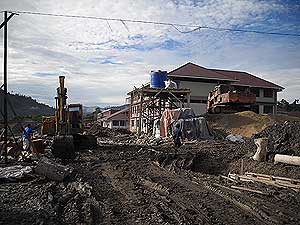 They were relocated to Sungai Asap (
right
), where they suffered immensely from a shortage of food and a lack of land to plant their crops. Hunger and deprivation have become part of their daily problems.
They were relocated to Sungai Asap (
right
), where they suffered immensely from a shortage of food and a lack of land to plant their crops. Hunger and deprivation have become part of their daily problems.
On the other hand, I was glad to learn that part of Long Bulan's community had resisted resettlement, and had instead chosen their own land upriver, at Long Lawen, above the Bakun Dam impoundment area. They, too, have suffered from their move, but even now, they have their own land to farm, and the intact jungle to feed them. As long as they work hard, all their daily needs are taken of by the land on which they live.
Until this day, I am dead set against the mammoth Bakun hydroelectric project, a white elephant that has penalised and tormented ordinary people. I look forward to a change of a state government, to reverse the suffering of these people. I still dream of the day when we can vote an opposition party into power in Sarawak.
SIM KWANG YANG was member of parliament for Bandar Kuching, Sarawak from 1982 to 1995. He can be reached at sky8hornbill@gmail.com. All comments are welcomed.


Are you sure you want to delete this comment?
This action cannot be undone.