




How David beat Goliath in Iban land rights war
Nowhere in the annals of Sarawak’s history has the struggle over land rights been more heated than the battle for Semilajau in the late 1990s.
Nowhere in the annals of Sarawak’s history has the struggle over land rights been more heated than the battle for Semilajau in the late 1990s.
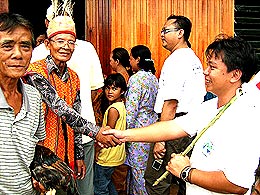 This fertile stretch of land along the Bintulu-Miri main road had been farmed by Iban farmers for many generations. The land is fertile and has always provided plenty of sustenance for those hardworking people. These Iban relied entirely on their land for all their needs in an independent existence in the jungle.
They claimed the right to till their land as part of their customary heritage. They had cleared the primary jungle and by doing so, had ploughed the way for their farms and orchards. This is how they had established their claim to customary rights to farm and own the land for as long as they can remember.
Those rights were fully-recognised under the native customs or adat , long before the laws of modern Malaysia came into being.
And these rights were entrenched in the Land Code, Sarawak’s set of land laws.
‘Squatters’ on their ancestral land
In the 1990s, the native farmers found, to their great surprise and dismay, that their rights had been snatched away by a public listed company. The state government had awarded this company a licence to log timber on the Iban villagers’ land.
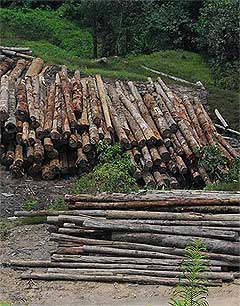 This company, a giant modern conglomerate, had claimed the land rights for the whole Semilajau area for agricultural purposes.
Pretty soon, the 14 longhouses in the Semalajau area had received eviction notices from the authorities claiming that the villagers were squatting illegally on ‘state land’.
The villages all along the main road became the subjects of intimidation by the plantation company. The company gave them notice to move out, or face the legal consequences of such an act of ‘illegal’ squatting.
Thousands of Iban found themselves squatters on their own land.
On one occasion, the police, assisted by the company’s enforcement personnel, tried to evict the longhouse folk by force. Truckloads of enforcement personnel appeared one fine day, equipped with chainsaws and axes, threatening to cut down all the longhouses.
But the longhouse dwellers had been prepared for these threats of violence. They came out of their longhouses with parangs or machetes and a collection of weapons. They stood their ground in defence of their longhouses.
The young children and women lined up in front, in an attempt to appeal to the company’s sense of humanity. They formed a human chain to deter the enforcement personnel from advancing. The men stood behind, ready to move forward for battle if their families were attacked.
The situation grew tense. In the end, the police and enforcement personnel capitulated , wisely, for their own safety, and to avoid a bloodbath.
A defiant Gawai Sandau Ari
Shortly afterwards, the Tuai Rumah , or chief, of one village received a letter from the court, summoning him to appear to answer a charge of ‘squatting’.
The day before he was to appear in court, the community called a general meeting, to be attended by the Tuai Rumah of surrounding longhouses, and all their village committee representatives, to celebrate a Gawai Sandau Ari .
I was invited to attend the Gawai , to witness the ‘waking of a new dawn’, a traditional Iban celebration. By late morning, as the Tuai Rumah arrived one by one and the mass gathering had the air of celebration and a traditional mass meeting.
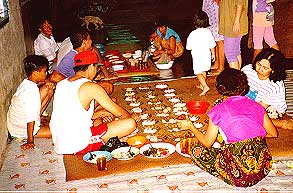 All manner of people, young and old, were wandering up and down the longhouse verandah or
ruai
, in a celebratory and collectively optimistic mood. A huge gathering like that would have been considered an ‘illegal assembly’ by the police.
All manner of people, young and old, were wandering up and down the longhouse verandah or
ruai
, in a celebratory and collectively optimistic mood. A huge gathering like that would have been considered an ‘illegal assembly’ by the police.
But it was natural and traditional for the Iban to celebrate their Gawai in that fashion, and there was nothing that the police could do to stop them.
The meeting was called to order by three Tuai Rumah , Ayan, Kutau and David Imeh the three grassroots leaders who had been coached by NGOs to organise dissent against the grabbing of their customary land.
The meeting soon began to delve into the serious business of protecting their villages. The 14 longhouse chiefs made their speeches, one by one, pledging to defend their lands with their lives. A pig was killed, and the Tuai Rumah took turns to dip the end of their parangs in the blood, swearing allegiance to the fight for their lands.
This was accompanied by much shouting and a declaration of war by onlookers who gathered in large numbers. The sights and sounds of the huge crowd of agitated Iban, waving their spears and their parang, made the hairs on the back of my neck stand on end.
Presently, one of the old men, who had been reading the lines of the slaughtered pig’s liver, declared that careful reading of the signs had told him that the day’s Gawai would be fruitful.
This announcement was greeted by a loud cheer from the gathering. Then somebody picked up a shotgun and climbed up to the roof of the longhouse. He fired three shots that echoed loud and clear, signaling the start of the joyous Gawai festivities.
Courting danger en route
The villagers apparently wanted to demonstrate their anger with a tour de force . Early the next morning, they began transporting villagers in large numbers in a three-tonne open truck, from Similajau all the way down to Bintulu town where the court hearing was to be held.
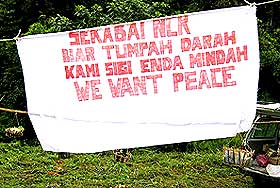 I understand the truck driver had to make many trips up and down the Bintulu road, and the journey for the villagers crowded on the truck was dangerous but nobody seemed to mind.
That morning, the small, sleepy town of Bintulu awoke to find the streets choked with angry Iban, awaiting the beginning of the trial against their fellow villagers.
When the court was called to order, and the name of the accused was read out, the judge was surprised to see the entire audience in the courtroom stand up to answer the charges laid before the Tuai Rumah . Many of these kampung folks actually walked to the front of the court and started to ‘cast’ all kinds of hexes and curses on the court proceedings.
The situation was both humorous and ridiculous.
The judge then adjourned proceedings until another, "more sedate time", mumbling under his breath that the villagers’ lawyer should also be charged... for contempt.
The case dragged on for a long time without any conclusive result. After a few years of this legal tug-of-war, the plantation company sought out the villagers to discuss a settlement out of court.
Eventually, the contesting parties came to an agreement that was acceptable to all, and thus the great battle over the land in Semilajau was finally resolved.
SIM KWANG YANG was member of parliament for Bandar Kuching, Sarawak from 1982 to 1995. He can be reached at sky8hornbill@gmail.com. All comments are welcomed.


Are you sure you want to delete this comment?
This action cannot be undone.