




Sarawak ripe for political transformation
The politics of Malaysia is condemned to be ethnic in nature. Much of the political discourse in our country is determined by the most dominant force in our land: the United Malays National Organisation (Umno). Everything political must be considered within Umno’s parameters of racial balance.
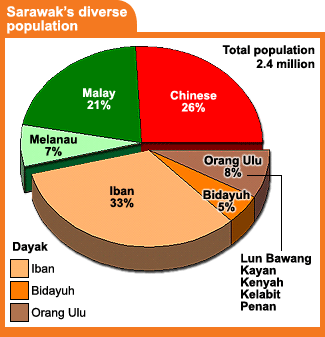
Yet the racial imperative in Malaysia is perturbed, and unsettled, by the anomaly of the unique ethnic composition in Sarawak. By the logic of race, during the time of Merdeka, when Malaysian independence was achieved in 1963, the Master Race in Sarawak ought to have been the Iban.
The politics of Malaysia is condemned to be ethnic in nature. Much of the political discourse in our country is determined by the most dominant force in our land: the United Malays National Organisation (Umno). Everything political must be considered within Umno’s parameters of racial balance.
Yet the racial imperative in Malaysia is perturbed, and unsettled, by the anomaly of the unique ethnic composition in Sarawak. By the logic of race, during the time of Merdeka, when Malaysian independence was achieved in 1963, the Master Race in Sarawak ought to have been the Iban.
 After all, the Iban form 34 percent of Sarawak’s population, and ‘deserved’ to be the dominant ethnic group in the state.
Indeed, from 1963 right up to 1970, the most powerful political office in the land, the Chief Minister’s office, was occupied by an Iban politician from the multiracial Sarawak National Party (Snap), Stephen Kalong Ningkan.
This situation was obviously not satisfactory to Umno politicians, who saw themselves as the only legitimate representatives of national power. Umno’s aim was the usurpation of the Iban pre-eminence in state politics.
This they achieved by virtue of engineering the collapse of the Ningkan government and the departure of Snap from the ruling state Alliance. Umno replaced Snap with another stop-gap Iban party, under Penghulu Tawi Sli, in 1970.
The general election in 1970 brought an opportunity for Umno to reclaim their position of Malay dominance in Malaysian politics. During the general election that year, the Sarawak Alliance and BN replaced the Iban chief minister with a Muslim Melanau, to occupy the prized seat of chief minister.
 That was how Abdul Rahman Ya’akub, and later, his nephew Taib Mahmud, ascended to the supreme position of chief minister.
So, 1970 was a most momentous, even epoch-making general election, shortly after the racial violence in Kuala Lumpur was quelled. There was a realignment of national forces jostling for power in the aftermath of May 13, 1969.
The newly-formed BN roped in many of the opposition parties into the fold of the government, in the name of reducing political squabbling, ostensibly to concentrate on ‘development’.
The pre-eminent opposition party in Sarawak, the Sarawak United People’s Party (SUPP), manoeuvered itself into position as a member of the ruling Alliance, in support of Abdul Rahman Ya’akub’s Pesaka Bumiputera Bersatu (PBB), lending great credence to the Alliance’s image as a multiracial coalition.
PBB has complete dominance
PBB laid claim to automatic occupation of the office of the chief minister, thanks to the fact that it was a composite multiracial party, with a large chunk of its membership and leadership coming from the Iban, Malay and Melanau native groups of Sarawak.
 It was only natural, in the context of racial politics, that the office of the chief minister had to be occupied by the leader of the PBB, Abdul Rahman. With many of Snap’s leaders defecting to the Iban component of PBB, the weakened opposition party had to abdicate their political dominance, yielding power to the Alliance of Sarawak. That altered the power structure of Sarawak for the next 40 years.
The period between 1970 and 2000 was a long, continuous process of concentration of state power under the authority of the PBB faction within the ruling BN.
Thus the PBB, through a prolonged period of gerrymandering and new delineation of electoral boundaries, managed to consolidate their hold on the majority of native-dominated seats in the state assembly.
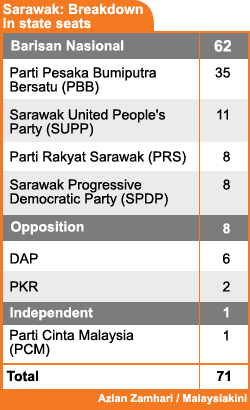 As of today, there are 35 seats in the state assembly to which the PBB can lay claim, out of the total number of 71 state constituencies up for grab. That means the PBB, on its own, can virtually hold state power without any help from any other parties, thus completing its total domination of local politics in Sarawak.
Against this rise of hegemonic power of PBB, the other components of the Sarawak BN have only waned in influence and prestige, over the past four decades.
In the year 2010, it would not be far from the truth to observe that Sarawak politics is dominated by the PBB. The PBB can rule Sarawak with minimal reference to other BN components.
That is how the virtual power of dictatorship is now concentrated in the hands of the PBB’s CM Taib Mahmud. Within the realm of Sarawak, Taib Mahmud can do anything he pleases, and the state has no instruments of check and balance to curb his power.
 But now, Sarawak may be due for a radical structural change, after four decades of BN monopoly. Taib Mahmud is showing his 74 years of age, the longest-serving national leader of the BN.
The next opportunity for change in Sarawak will be in the next half decade or so. Sarawak is now ripe for another wholesale transformation. As long as the problem of succession to Taib Mahmud remains uncertain and unknown, the coming decade will provide an opportunity for transition of power within the BN, as well as for the opposition coalition.
I would like to make my own political position clear here: I am personally against all politics of race, because I do not think there is such a ‘thing’ as a real ‘race’. Our polity is made up of individuals, and not of races. The concept of race has no ontological basis.
Taib Mahmud marries Lebanese woman
SIM KWANG YANG was member of parliament for Bandar Kuching, Sarawak from 1982 to 1995. He can be reached at sky8hornbill@gmail.com. All comments are welcomed.


