




New twist in Libya's turmoil, Japan's crisis deepens
The battle over Libya has undergone a dramatic shift as the United Nations has now passed a resolution in the Security Council, allowing member states to take action to stop the killing of innocent civilians in that troubled nation.
The battle over Libya has undergone a dramatic shift as the United Nations has now passed a resolution in the Security Council, allowing member states to take action to stop the killing of innocent civilians in that troubled nation.
The Arab League of nations, together with the United Kingdom, France and the United States, are now formulating plans to mobilise an international coalition to impose a ‘no-fly zone' in Libya, and to take concrete steps to prevent the massacre there from worsening.
The international community has finally resolved to bring the considerable military might of Nato and some of the Arab League nations into play.
 With the approval of the United Nations resolution to employ the resources of Nato and Arab nations, the United States and her allies on the international stage have finally gained the moral and legal legitimacy of the union of nations to stop the atrocities committed by Muammar Gaddafi and his forces.
The decision by the United Nations has cast the Libyan conflict in a new light. While the Libyan government has requested a ceasefire, Gaddafi and his forces are still attacking the pro-democracy forces on the ground, and continuing to commit crimes against humanity.
The developments on the ground remain confusing, but we can expect to have a clearer picture as the United Nations resolution takes effect in the next few days.
The deployment of international military intervention in Libya, in contrast to the ongoing wars in Afghanistan and Iraq, is being done with a great deal of sensitivity. The US is trying hard not to be seen to be taking a leadership role.
This is a wise move by the American President, Barrack Obama, to avoid appearing to assume an overbearing role in the war in Libya.
The upcoming military intervention must be a truly international effort to restore peace in the Middle East, without the stigma of American unilateralism and dominance in world affairs.
Arab revolution
Meanwhile, the Arab revolution continues unabated. The Arab world is in turmoil. The spark of rebellion against dictators has now spread out, and is not only burning in Egypt, Tunisia and Libya, but also in Yemen, Bahrain, Syria and many other countries in the Arab peninsula.
This spate of unrest represents a region-wide political awakening of the people against the burden of deeply entrenched tyranny. It looks like we shall continue to be haunted by major seismic shifts in the balance of political power, in that part of the world.
We do live in interesting times. During these upheavals, we Malaysians ought to give support to those communities trying to implement historic changes, in conflict with the forces of repression and feudalism.
Japanese crisis deepening
At the same time, the crisis in Japan is deepening by the day, as the world is trying to come to terms with losing over seven thousand lives (the casualty toll so far) while taking stock of some twelve thousand people estimated missing in the twin disasters of the earthquake and Tsunami.
This is Japan's worst natural catastrophe, and we will not know the full extent of the carnage for many years and decades to come.
We have to be moved by the Japanese attitude of stoic courage. They have maintained a high degree of communal spirit, and personal discipline, in the midst of their inexpressible misfortune.
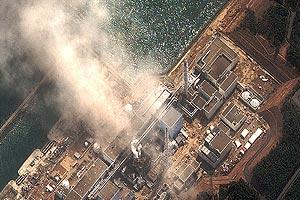 The biggest story in the whole Japanese saga is the global fear of leakage from the nuclear meltdown in the Fukushima Daiichi site.
A week after the disaster, the authorities are still unable to control the nuclear spill. The world is experiencing terrible anxiety regarding the risk of nuclear poisoning on a massive scale.
It is a shocking reminder to mankind of the terrible threat of nuclear pollution to an entire population. It is certainly a warning to all of us to rethink our traditional policy of depending too much on a nuclear energy policy.
The world must now turn to other avenues of seeking new energy sources. To prevent over- dependence on petroleum, natural gas and other traditional sources of energy, we have to develop a more sustainable, multi-faceted policy of energy exploration to get us away from the spectre of nuclear energy.
We shall watch closely whether the crisis on Mount Fukushima will develop into a Class 5 nuclear disaster.
SIM KWANG YANG was member of parliament for Bandar Kuching, Sarawak from 1982 to 1995. He can be reached at sky8hornbill@gmail.com. All comments are welcomed.


