




Transformation: Is it futile?
COMMENT I can imagine many email inboxes, browser pages, Facebook walls and Twitter timelines being saturated with reports, commentaries and counter-commentaries about all things Bersih.
COMMENT I can imagine many email inboxes, browser pages, Facebook walls and Twitter timelines being saturated with reports, commentaries and counter-commentaries about all things Bersih.
From the right and proper role of the police force, to legal and philosophical assertions about freedom of assembly and to whether Bersih 2.0 represents a genuine desire for electoral reforms or whether the rally was simply a political ploy to serve partisan interests, little of the discourse-space has been left untouched.
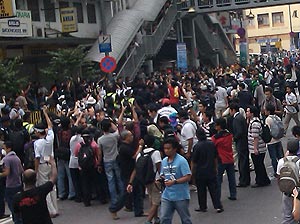 Where I lean on, some of the matters above are implied throughout this piece. In any case, this humble contribution to the conversation surrounding Bersih stems from a profound sense of futility that the entire episode has visited upon the BN and Umno transformation promise.
From March 2008 onwards, numerous tropes were repeatedly employed by Umno and the government to portray an urgent desire to reform, transform; to berubah or rebah , after a period of muhasabah .
And despite far too many speeches and remarks about transformation being peppered with generalities, concrete measures have been taken across the different spheres where improvements are meant to occur.
The current administration's affinity with acronyms is accompanied by well-publicised substantive reforms to economic and social policy. Reforms within the party - which is my chief subject here - should not go unnoticed either.
Amendments to Umno's constitution now allows for greater right of suffrage and there are recurring ‘grassroots-targeted' welfare events and other services - job fairs, scholarships and health programmes - that are not without visibly positive consequences for the general public.
That's all well and good. But as the Bersih 2.0 affair so conclusively exposed, the initiatives above have not been supplemented by a realignment of Umno's ideological stance on democratic rights - where dissent is tolerated as a permanent feature of a functional political landscape.
Caught in a time-wrap when challenged
Ever faithful to the traditional, reactionary, belligerent, fear-mongering script, Umno also appears unable to resist concocting racial and religious hazards where none exist.
Seemingly caught in a time warp, whenever challenged on so-called "soft issues" - things that go beyond the ringgit and sen - Umno's responses bespeak a rather unidimensional comprehension of politics, even if that outdated comprehension gets played out in the new media (and in an increasingly vulgar manner, too).
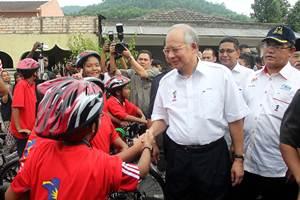 Dare I say, if the party's transformation, supposedly towards inclusiveness, and away from traditional comfort zones - the move that Umno leaders are so keen to proclaim at every juncture these days - is limited to walkabouts, driving into towns in more modest cars, and welfare-themed programmes, then I'm sorry, but this is no renaissance.
For all the talk of a Model Politik Baru that does not rely on a "politics of development" to woo voters, Umno still defines much of its success, or failure, along those very lines. Its raison d'etre and its case for being a party of the future remain terribly impoverished.
Now, this is not to say that employment, wages, security and peace are not important to the electorate. But if politics is a game of numbers, it is also the art of nuance, and Umno would be grossly mistaken if it thinks those aforementioned issues monopolise bottomline considerations via a simplistic, unchanging algorithm.
After all, in an increasingly open market, relying almost exclusively on development, welfare and some ill-defined affability with the common folk as one's long-term strategy is inherently risky. For there is no reason another party cannot administer those services just as well, if not better, especially when the incumbent's track record is pretty chequered if we're brutally honest.
Transformation agenda remains ideologically regressive
Under such circumstances, the game-changing element lies in displaying thought leadership and remaining in touch with the future, rather than being haunted by the past.
Specifically here, it is about upholding the principles of justice, liberty, fairness and democracy as the cornerstone of one's political struggles, rather than exercising self-delusion by intimating that these are irritating concepts no one but Bangsar-ites will ever care about.
Sadly, Umno and BN are simply not showing up to these ideational skirmishes for the future. Instead, they remain in the past; upon encounter, they pack up their gear and do their business on the old grounds of fear, repression and denial, surrendering all initiative to Pakatan without the latter having to do much at all.
The transformation agenda thus remains, paradoxically, ideologically regressive, if not vacuous. Sure, there are a few individuals who are the exceptions to the rule, and they retain my greatest admiration, for nothing could be harder than trying to absolutely change the mindset of party members with a fundamentally divergent worldview, while still remaining popular and true to one's conscience.
More often than not, something gives. But perhaps that begins to explain why I wonder if futility will be the defining feature of Umno's speculative foray into a transformation phase, ushering not renewal but the final chapters of its long stint in power.
If after the disastrous results of 2008, Umno's response is to be more reactionary and reductive when the opponents to whom it lost ground rush to occupy a more progressive plane, perhaps it has clearly lost the plot. I would be most glad to be proven wrong.
SHAHRIL HAMDAN was the deputy chairperson for the United Kingdom and Eire Council for Malaysian Students in 2007/08. Upon returning to Malaysia, he served as an assistant to a parliamentarian before leaving for the UK again, where he is now pursuing his Masters degree in Race, Ethnicity and Post-colonial Studies at the London School of Economics. He considers himself to be an unashamedly cosmopolitan Malay-Muslim and is quite prepared to be associated with the (pejorative) term 'Melayu liberal'.


Are you sure you want to delete this comment?
This action cannot be undone.