




Fukushima disaster a wake-up call for M'sia
COMMENT One year ago, the people of Japan suffered a monumental environmental disaster which has brought the country to its knees.
COMMENT One year ago, the people of Japan suffered a monumental environmental disaster which has brought the country to its knees.
The Mar 11, 2011, Tohoku earthquake which measured 9.0 on the Richter scale, had the explosive force of seven million tons of TNT.
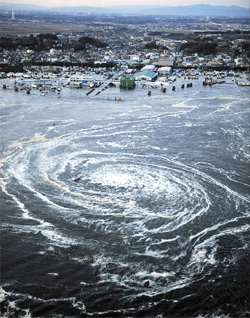
 It was the most powerful earthquake ever to have hit Japan and it triggered a massive, towering tsunami 45 feet high, which swept six miles inland and destroyed everything in its wake.
.
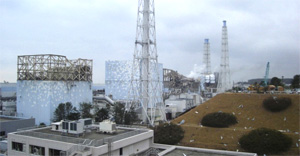
The tsunami also interrupted the power supply to four nuclear reactors of the Fukushima Daiichi nuclear power plant run by the Tokyo Electric Power Company (Tepco).
This loss of power wrecked the cooling mechanisms of the reactors, which then led to overheating of nuclear fuel rods and eventually to hydrogen gas explosions and a nuclear meltdown in three of the reactors.
On Mar 10, 2012, a Japanese national police agency report confirmed 15,854 deaths, 9,677 people injured and 3.155 people missing.
The extent of the final human tragedy and economic costs will not be known for decades, as many health, technical, social, legal and economic problems remain.
Major challenges include stabilising the reactors, managing more than 100,000 tons of radioactive water and spent nuclear fuel, cleaning up the site contaminated with radioactive debris, and proceeding to cold shutdown and decommissioning of reactors, which could take another 20 years.
 The Japan Centre for Economic Research has estimated that it could cost Japan US$250 billion, including compensation for the 180,000 people evacuated from the area.
Large tracts of land are now radioactive and will remain uninhabitable for hundreds of years.
Malaysia is marginally outside the ‘Pacific Rim of Fire’ and is not prone to earthquakes like Japan. But it was not an earthquake or tsunami that caused the Fukushima nuclear disaster.
The primary cause was a breakdown in electrical power supply to the nuclear power plant’s cooling systems which led to overheating and the meltdown.
Murphy’s Law
Therefore, human error, poor reactor maintenance or negligence can also cause a similar nuclear catastrophe, as it did in Chernobyl in 1986. Similar conditions are known to prevail in Malaysia.
Murphy’s Law dictates that as long as something can go wrong, in time it will go wrong. There is simply no such thing as nuclear safety or a fail-safe nuclear reactor.
The nuclear industry and its proponents argue simplistically that plane crashes have not put an end to air travel. Surely, there is absolutely no comparison between a fatal air crash and a nuclear meltdown.
Fukushima is a wake-up call to the Malaysian people to think seriously and act decisively.
The Malaysian government is actively planning to build a nuclear power plant for the generation of electricity. This decision is based on the false premise that nuclear energy is cheap, clean and safe.
The Malaysian government has erroneously underestimated the economic cost of building and operating a nuclear power plant. Contrary to disinformation disseminated by the nuclear industry and its cohorts, nuclear power is not cheap.
Nuclear economics is masked by enormous government subsidies for expensive reactor construction, uranium enrichment, nuclear waste management, insurance against accidents, government loan guarantees, and decommissioning.
The ratings and risk company, Moody’s Corporate Finances, recently estimated that nuclear energy’s capital cost per kilowatt was 275 percent higher than that of wind energy and 150 percent higher than solar energy.
Numerous Wall Street studies and independent energy analysts have estimated that electricity from renewable energy sources costs an average of six cents per kilowatt-hour, while electricity from nuclear energy is about 12–20 cents per kilowatt-hour, excluding the cost of any catastrophic nuclear accident.
Full insurance against a nuclear accident would increase the price of nuclear-generated electricity to US$3.40 per kilowatt-hour.
Although the government informs us that it has not made up its mind about nuclear energy, in the wake of the Fukushima nuclear disaster, it is in fact quietly proceeding to carry out its plan.
In June 2009, the government singled out nuclear energy as one of its options for electricity generation.
Nation’s first nuclear power plant
In 2010, it identified nuclear energy as one of the Entry Point Projects in the Economic Transformation Programme, adopted a National Nuclear Policy, and established a Nuclear Energy Programme Implementing Organisation, as recommended by the International Atomic Energy Agency.
In January 2011, the Malaysia Nuclear Power Corporation (MNPC) was established and tasked with implementing a nuclear energy development programme that is expected to deliver Malaysia’s first nuclear power plant by 2021.
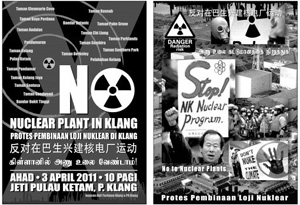 A Nuclear Power Infrastructure Development Plan is being prepared and is expected to be ready by 2013. The MNPC has already undertaken a nuclear power pre-feasibility study and an initial site selection study.
A steering committee is studying the possibility of delivering a twin unit nuclear power plant with a total capacity of two gigawatts.
The first unit is expected to be completed in 2021, giving it a development timeline of 11-12 years, from pre-project to commissioning.
The final decision to ‘go nuclear’ is expected to be made in 2013 or early 2014.
All this development is supposed to take place according to guidelines, covering 19 key areas, set by the IAEA, which has a vested interest in promoting nuclear energy worldwide and therefore cannot be expected to be impartial.
One key area involves the disposal of radioactive nuclear waste, which continues to be stored temporarily in pools of water alongside nuclear reactors in 30 countries.
After six decades, the nuclear industry is still unable to come up with a safe method of permanently disposing of long-lived radioactive waste.
For example, plutonium nuclear fuel rods have a half-life of 24,400 years.
In other words, it will take 24,400 years for the radioactivity of any quantity of plutonium to be halved.
As nuclear waste cannot be permanently disposed of safely, it will have to be ‘managed temporarily’ for at least 100,000 years.
In other words, lethal radioactive waste will be with us ‘forever,’ And yet, there is no social institution on the planet that has lasted for more than 2,000 years.
The reality is that, if medieval Man had used nuclear energy, we would still be ‘managing’ his nuclear waste today.
To bequeath such a lethal legacy to future generations of Malaysians is unconscionable, unethical and immoral, and would be tantamount to genocide.
Malaysians must not countenance nuclear energy and knowingly destroy the well-being of future generations.
The official reasons for investing in nuclear energy are not borne out by the facts. Malaysia has undeveloped energy sources in abundance and a greater supply than demand, including newly-found gas and oil reserves in the fields off East Malaysia.
Impeccable evidence exists that nuclear energy is economically and environmentally unsustainable.
Fukushima has made the governments of several countries with nuclear power plants to listen to public opinion and review their energy options. Germany will phase out nuclear power by 2022, and Switzerland by 2034.
The US has frozen its nuclear energy programme. Italy has voted ‘no’ to nuclear energy in a referendum. China, Venezuela and Taiwan have decided to suspend the building of new nuclear reactors.
But the Malaysian government continues to misrepresent nuclear energy as a “valid energy option” to justify its covert plans to build a nuclear power plant, instead of renouncing nuclear energy and committing to sustainable renewable energy, energy efficiency, and energy conservation, as other governments have done.
I call on the people of Malaysia and civil society organisations to come together and mount a public campaign against nuclear energy, and say "NO" to the government, in support of the precautionary principle and in the name of democracy.
RONALD MCCOY is a former president of the Malaysian Medical Association and International Physicians for the Prevention of Nuclear War.


Report this comment
Are you sure you want to delete this comment?
This action cannot be undone.