




'Parliament's radiation as dangerous as ARE'
If enviromental movement Save Malaysia Stop Lynas’ (SMSL) allegations of dangerous radiation emission at the abandoned Asian Rare Earth (ARE) plant in Bukit Merah, Perak, are accurate then even the Parliament building is hazardous.
If enviromental movement Save Malaysia Stop Lynas’ (SMSL) allegations of dangerous radiation emission at the abandoned Asian Rare Earth (ARE) plant in Bukit Merah, Perak, are accurate then even the Parliament building is hazardous.
“I have with me here a radiation monitoring gadget, and to make a reading you need a certified machine.
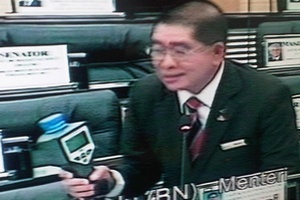 “I took a reading at the Parliament; outside at the door it is 0.22 microsievert per hour, here it is 0.1 microsievert (if) check under your chairs, we don’t know the reading,” said Science, Technology and Innovation Minister Maximus Ongkili (
above
) brandishing the Identifinder, a geigercounter used to measure radiation levels.
“I took a reading at the Parliament; outside at the door it is 0.22 microsievert per hour, here it is 0.1 microsievert (if) check under your chairs, we don’t know the reading,” said Science, Technology and Innovation Minister Maximus Ongkili (
above
) brandishing the Identifinder, a geigercounter used to measure radiation levels.
This would be the case if “background radiation”, which is naturally occurring radiation present in the environment, said Maximus in wrapping up the emergency motion tabled by Fong Po Kuan (DAP-Batu Gajah), this morning.
He added that the radiation readings by SMSL do not account for “background radiation”.
Maximus summarised that the SMSL’s projection of the radiation reading near the plant in Bukit Merah was around 0.19 microsievert per hour, and the reading near the dump site in Bukit Kledang at about 0.2 microsievert per hour, could be inaccurate.
He explained that the background radiation level in Malaysia is 0.05 microsievert per hour, adding that a comparison should be made with background readings at the ARE location, which varies from 0.2 to 0.75 microsievert per hour.
“The readings are higher compared to other locations because the location is a former tin mine which produced tailings that contained thorium dan uranium,” said Maximus.
As for SMSL’s claim that the readings were above the safe levels, which is more than 1 milisievert per year, Maximus refuted this by saying that the group’s conversion did not take into consideration the radiation emission of 0.2 microsievert per hour.
“The reading of 0.2 microseivert per hour equals to 1.6 milisievert per year, but this reading minus the background reading which is also 1.6 milisievert per year, and the final reading is zero,” he added.
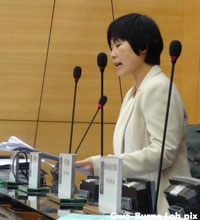 Earlier, Fong (
right
) raised alarm bells arguing that even after 18 years the Mitsubishi Chemical’ plant posed health hazards to residents in Ipoh.
Earlier, Fong (
right
) raised alarm bells arguing that even after 18 years the Mitsubishi Chemical’ plant posed health hazards to residents in Ipoh.
The ARE plant which began operations in 1982, was blamed by the 11,000 residents in the area as being the cause of increasing birth defects and eight leukaemia cases, seven of which resulted in death.
The Mitsubishi group of companies had then shut down the plant in 1992 and spent nearly US$100 million, at that material time, to clean up the site.
In order to douse fears, resulting from SMSL’s recent findings, Fong proposed that the ministry re-visit the area with the NGO to ensure the residents’ safety.
She also suggested that Ipoh General Hospital provide information on cancer patients and whether they were from the affected areas.
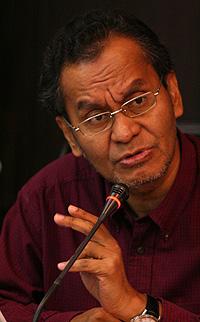 Kuala Selangor PAS MP Dzulkefly Ahmad (
left
) opined that radiation measurements alone will not suffice, they must be corroborated with clinical and medical evidence.
Kuala Selangor PAS MP Dzulkefly Ahmad (
left
) opined that radiation measurements alone will not suffice, they must be corroborated with clinical and medical evidence.
“That’s why I suggest that any approach taken should be multi-disciplinary,” he added.
Meanwhile, Kota Belud BN MP Abdul Rahman Dahlan took potshots at SMSL and the opposition saying that the equipment used were not calibrated properly.
He added that such equipment if not operated by trained professionals will give false readings.
Maximus said since the AELB began its decommissioning and disposal project in 2003, the agency detected no accidents or radiation contamination that affected workers, the public or the environment.
“This indicates that AELB is always monitoring the project to ensure that all requirements are met by the company,” he said.
AELB’s environmental radiation monitoring system at the ARE site, to ensure that detection can be made in real-time of any leakage as a result of activities, has also been undertaken.
“This will help AELB to provide preventive measures immediately if needed. Latest data for the company-owned landfill in Bukit Kledang can be found on the AELB’s website each day for public reference.
“So based on the facts, YB Batu Gajah’s claims and allegations are unwarranted as the government via AELB will always put the safety of the people first,” said Maximus, reassuring that the Health Ministry will also monitor the situation.


