




'Political conspiracy put me under ISA'
ISA FOCUS Before second prime minister Abdul Razak Hussein died on Jan 14, 1976, Abdullah Ahmad was his young, ambitious and powerful political secretary.
But seven months after the death of his boss, Abdullah was sleeping on a concrete floor, in a cell at the police Special Branch's holding centre near the Police Depot in Kuala Lumpur. Later, Abdullah was transferred to the Kamunting Detention Camp in Perak.
 Widely known as 'Dollah Kok Lanas', he had been detained under the Internal Security Act, accused of being a "communist".
Had it not been for his five years of detention, he joked during an interview with Malaysiakini at his house last week, he "could have become the prime minister or at least a DPM or senior minister, as some people had thought"...
ISA FOCUS Before second prime minister Abdul Razak Hussein died on Jan 14, 1976, Abdullah Ahmad was his young, ambitious and powerful political secretary.
But seven months after the death of his boss, Abdullah was sleeping on a concrete floor, in a cell at the police Special Branch's holding centre near the police depot in Kuala Lumpur.
Later, Abdullah was transferred to the Kamunting detention camp in Perak.
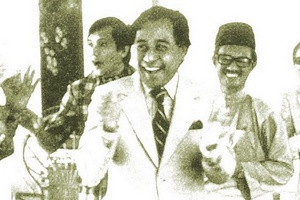 Widely known as 'Dollah Kok Lanas', he had been detained under the Internal Security Act, accused of being a "communist".
Had it not been for his five years of detention, he joked during an interview with Malaysiakini at his house last week, he "could have become the prime minister or at least a DPM or senior minister, as some people had thought".
Dollah said Hussein Onn, who became PM after Razak's death, had met him several times to warn him of his impending arrest.
"Hussein told me, 'we are arresting you not because we think you are a communist, but we need to put you away because we are planning to prosecute Harun Idris (then the menteri besar of Selangor and Umno Youth chief) for corruption. There is a need for us to do a balancing act. Just go away for six months'."
"And I agreed - because I was supposed to be under house arrest," said Dollah, now 75.
Harun Idris was sacked from Umno after he refused to resign following graft allegations and subsequently, he was tried and sentenced to five years in prison.
"I thought, ‘Never mind. Six months of good rest and relaxation in my own house'. Instead, I was detained for five years, Hussein promised house arrest but I was sent to the holding centre and stripped naked the first night," recalled Dollah.
At that time, Dollah, who had served Razak for 13 years, was only 38 and had three young children between the ages of two and five years. His wife was a PTD (Administration and Diplomatic Service) officer.
Diplomatic relations
In detention, he was interrogated for months on end on his relationship with Russian diplomats. The Special Branch, he said, never asked him anything about his relationship with Western diplomats.
Veteran journalist Terence Netto would write that Dollah was at that time allegedly in an "amorous dalliance" with a female Russian diplomat.
"I have never read about Netto's claim before and neither have I met him. In any event, there was no Russian female diplomat at that time and throughout the months of my interrogation, the Special Branch never raised this rubbish because they knew it wasn't true," Dollah asserted.
His meetings with diplomats of all persuasions, he said, was part of his duty as a deputy minister who was involved in foreign affairs, and that he acted with the knowledge of Wisma Putra and PM Razak.
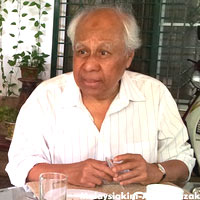 "I would brief them after each meeting. The whole trouble is that the Special Branch never asked Wisma Putra or any of the people in the loop because they would have got the right answer," he said, seemingly still unforgiving over the episode that changed his political fortune.
He added: "In any event, it's academic now. Most of those responsible have died. I hope God forgives them."
In his memoir The Singapore Story , former Singapore prime minister Lee Kuan Yew revealed that the arrests of Dollah, A Samad Ismail and Razak's press secretary Abdullah Majid - dubbed as the Three Abduls - was made after Lee pressured Hussein.
Corroborating this in his biography, An Unexpected Journey, former Singapore president and then head of external intelligence in the Defence Ministry, SR Nathan, confirmed that the arrests of the ‘Tiga Abduls' was the result of "cooperation between the security services of Malaysia and Singapore...".
Dollah said Samad, who was then deputy editor-in-chief at the New Straits Times , had ‘confessed' under interrogation that Dollah and Abdullah Majid were "influential pro-communists" in the government.
"Samad, who died in 2008, was arrested a few months earlier than me and later detained for five years and released with conditions. He was confined entirely in Kuala Lumpur, at various safe houses.
"I was a little disappointed with Samad, but I told him that I forgave him because he had no choice but to do what he was asked to do, because if he didn't, he would be sent back to Singapore."
Samad, who hailed form Singapore, was a naturalised Malaysian citizen and "was afraid of detention in the republic... damned if he did, and damned if he didn't".
A VIP detainee
In Kamunting, the former high flyer was confined in a cell for a whole month, spending his time chanting "Allah-u-Akbar (God is Great)" and planning what to do once he regained his freedom.
"The guards would put food in my semi-dark cell when I was asleep. I hardly slept because interrogation was an open-ended process. The food that I gave to my cats was better.
"They gave me tap water because they knew I only drink Evian mineral water, just to make me feel deprived and suffer.
"I was made to sleep only in my underwear on the cement floor, without a blanket. Thank God, I survived the ordeal," Dollah said.
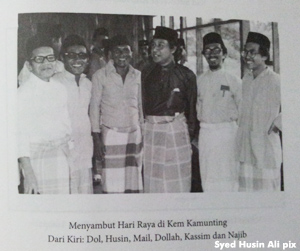 He was held in solitary confinement for two years and was let out for an hour a day to exercise. The next three years was spent in a barracks, "like a spartan third-rate boarding school" with other detainees, including Syed Hussin Ali, Kassim Ahmad and Abdullah Majid.
"Looking back, I must say that in some ways I was treated more like a VIP detainee. In fact, I was given facilities to make a lot of money, as long as I forget politics.
"And I would spend months in the first-class ward of the hospital in Taiping, and I made frequent trips to Ipoh under police escort to see my medical specialists.
"I made millions of ringgit buying and selling stocks while in detention. I also bought land and houses through my lawyers and bankers. So, how I can be a communist?"
"Hussein told people that I was a playboy on the outside but a determined communist inside. If communists live like me, then all Malaysians should become communists," Dollah said, laughing.
"To be accused of being a communist in the 1970s is akin to being an agent of Israel today."
Choosing winners
While he baulked at the suggestion that he was a "power broker", Dollah's hand in deciding who rises and falls politically in the 1970s may have paved his way to Kamunting.
One of those whose toes he stepped on was the then home minister and deputy prime minister wannabe Ghazali Shafie.
 Dollah wrote Razak's presidential address for the 1975 Umno general assembly, endorsing vice-presidential candidates Dr Mahathir Mohamad, Tengku Razaleigh Hamzah and Ghafar Baba. All other contenders, including Ghazali, lost in that election.
He said the object was not so much to stop Ghazali but to contain the "ultra, anachronistic Malays" like Syed Jaafar Albar and Harun Idris. Syed Albar later succeeded Harun as Umno Youth chief.
With politically-inclined Samad as his media ally, Dollah said, it was easy to provide good publicity for the three favoured vice-presidential candidates - Mahathir, Razaleigh and Ghafar.
Their victory kept those who were undermining Razak's leadership out of the Umno vice-presidency and the list of probable successors for the posts of prime minister and deputy prime minister, he said.
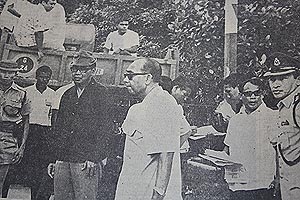
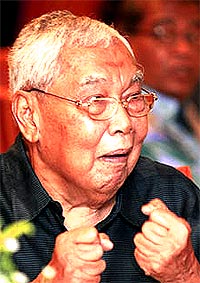 "Ghazali (
left
) would have lost, with or without me doing anything. He was really unpopular and the people were scared of him, especially as he was home minister and he could arrest and release people at will under the ISA," said Dollah.
"Ghazali (
left
) would have lost, with or without me doing anything. He was really unpopular and the people were scared of him, especially as he was home minister and he could arrest and release people at will under the ISA," said Dollah.
Ghazali, who died in 2010, was described by Dollah as an opportunist who would easily switch loyalty, and did.
Dollah continued: "Abdullah Majid was actually pro-Ghazali but Ghazali could not arrest me under the pretext of being a communist agent without arresting Abdullah Majid because he had a history of involvement with communism at the University Malaya in Singapore.
"He was Ghazali's good friend - like brothers - but he was arrested so that my arrest would not look personal."
How Mahathir became DPM
Dollah said he used whatever was left of his influence after Razak's death, to dissuade Hussein from choosing his favoured candidate Ghazali as the deputy prime minister.
"I told Hussein that tradition demanded that the deputy prime minister be chosen from among the Umno vice-presidents, since he as deputy president had moved up to become acting president.
"And if he doesn't believe me that Ghazali is a wrong choice - he should interview every Umno supreme council member individually and separately. So he did.
"He was grateful to me and told me that I was right. He only found one vote for Ghazali. Laughing, Hussein told me, ‘It must be his own vote. I, of course, voted against him."
Hussein resigned in 1981 on health grounds. "Had he not done so, and Ghazali had become deputy prime minister, I would either be languishing in detention, or have died there," Dollah said.
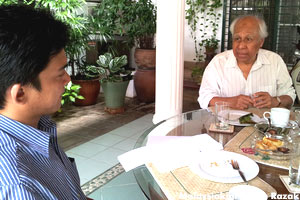 Dollah, who also served as an adviser to Razak, said he told Hussein that if faced with the same dilemma, Razak would have chosen Ghafar as an "interim deputy prime minister" and would later appoint Mahathir.
"Ghafar was a good Umno warhorse, but he was not very discreet with his peccadilloes. Despite that, Razak would have chosen him so that Ghafar would retire with a higher pension, besides motivating Malay-educated leaders that they could aspire to higher office.
"Hussein would not have this. He said to me that he would not make Ghafar his deputy. He preferred educated leaders from good backgrounds. Ghazali was considered clever because he studied in England."
Hussein also confided to Dollah that he did not pick Razaleigh, who had good credentials, good social background and good education because Razaleigh had unwisely declined Razak's offer of a ministership in 1974.
"In any event, Tengku Razaleigh had his wish fulfilled - he became finance minister under Hussein. I am certain that had Tengku Razaleigh joined the cabinet in 1974, Hussein would have picked him as his deputy and Razaleigh would have eventually become the prime minister," Dollah said.
A promise kept
Having succeeded in pushing Mahathir into the number two position, Dollah willingly headed into detention, knowing that he would be freed once Mahathir came into power.
"At a berbuka puasa at my house, Dr Mahathir was a bit concerned about his future and mine. It was a small gathering of my close friends and allies, Dr Mahathir, Ghafar Baba, Tengku Razaleigh and Rahman Yaacub (then chief minister of Sarawak)," he said.
It was then that Mahathir told him it was just "a matter of time" before he (Dollah) would be arrested and that he should "go to England and stay there until I (Mahathir) take over".
"Dr Mahathir said: ‘If you need financial help, we'll help you'... I told him I would not run away. If I did, they would say I must really be a communist. Let me face the ordeal.
"Mahathir asked: 'What if I don't become prime minister?' I told him - you will become prime minister, and he did."
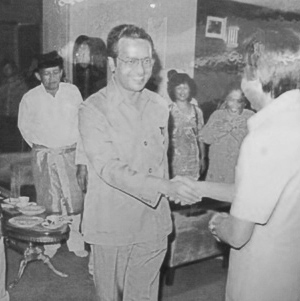 Dollah said he was very convinced that Mahathir would succeed Hussein because Mahathir was smart and played his role well.
"We were very certain that Hussein would not last for more than a term," said Dollah.
Mahathir kept his promise to Dollah and released him, along with 17 others and without condition, two weeks after he became prime minister on July 30, 1981, which was the eve of Hari Raya Haji that year.
The duo maintained their close relationship. Mahathir appointed Dollah as special envoy to the United Nations in 1996 and as editor-in-chief of the New Straits Times in 2000.
Dollah was sacked from his post at the NST in 2003 when Abdullah Ahmad Badawi became prime minister.
Former political detainee still supports ISA
This interview is part of Malaysiakini 's focus series on the Internal Security Act leading up to its repeal, expected to be tabled during the current sitting of Parliament.
Related stories
'Detention made me more of a hardliner'
'This is the communist's daughter!'
Torture, suicide and 47 days of hunger


Are you sure you want to delete this comment?
This action cannot be undone.