




EO repeal may have led to crime spike, says Pemandu
The repeal of the Emergency Ordinance (EO) is one of the factors considered for the recent spate in crime, the Performance Management and Delivery Unit (Pemandu) says.
The repeal of the Emergency Ordinance (EO) is one of the factors considered for the recent spate in crime, the Performance Management and Delivery Unit (Pemandu) says.
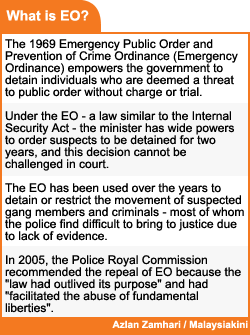 According to its crime reduction national key results area (NKRA) director Eugene Teh, the EO repeal is a "hypothesis" that it is working on.
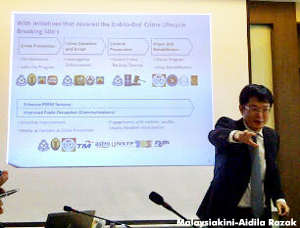
"We are looking to see if this is a key contributor or just a subset (factor)," he said in a media briefing today.
He added that police were also tracing back recent cases to see if those apprehended were recently released from the Simpang Renggam holding facility following the lifting of the Emergency.
Teh also admitted that it was true that violent crime was rising and that the reasons for this were still unclear.
“I think it is true that there is an increase...a spate in violent crime. Police are trying to understand why this is happening and I don't know if our programme is addressing this.
“Some are genuine cases, and so violent. If you want to do a snatch, why use a parang?” Teh said, sharing the public concern.
 Although admitting to a recent spate in crime, Teh said the statistics still showed a drop in crime since 2009, indicating a “disconnect” between fear of crime and the actual level of crime.
“The facts on the table show there is a disconnect between perception and what is happening,” he said.
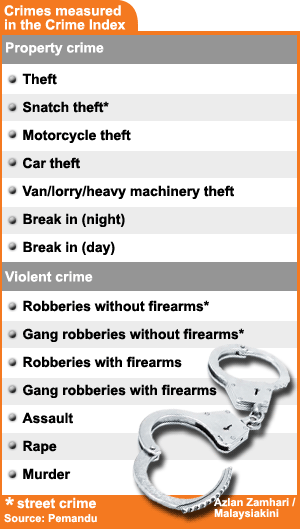
He said based on the crime index, there were 574 cases of crime a day in Malaysia in 2009. In 2010, there were 476 cases a day and in 2011, a total of 433 cases a day.
The crime index measures the number of police reports made for 14 types of crime considered to be “index crime” ( Chart, above left )
Why people are afraid
On the fear of crime, Teh said Pemandu's commissioned research showed that fear had risen from 48.9 percent in May 2011 to 54.6 percent in May 2012.
However, this was lower than in December 2009, when 58.5 percent of the respondents surveyed said they were afraid of becoming victims of crime.
 Teh said it was difficult to pinpoint why there were changes in the perception of crime among the respondents. However, it is believed that sustained fear in Sabah and Sarawak was a contributor to the hike.
“The fear did not drop in Sabah and Sarawak because the focus of the NKRA was in Kuala Lumpur, Selangor, Johor and Penang, the crime hotspots. So people in Sabah and Sarawak were not feeling (police) presence,” he said.
Further, he said, experiences in other countries showed that there was a time lag between reduction of crime cases and fear of crime.
“In the United Kingdom, crime went down but for five years (fear) didn't change. Fear grew because people were talking about crime more and they saw more police on the streets,” Teh said.
He said greater exposure to crime, via public discussions including in the media, would feed the perception.
“I am of the firm belief that we (cannot) tell people to take safety for granted, and that people still have to be cautious.
“This fear thing even got to me. After doing this job, I'm a lot more fearful. Previously, I watch a midnight show and just go back, but now I'm thinking, no more,” Teh shared.
Related stories
'Stop demoralising police by bashing them'
'Bulk of crime-fighting funds not for publicity'
Break-in fears force couple to sleep in car
I'm not mocking cops, says Komtar MCA chairperson
Penang awards four for aiding snatch theft victim
Twitterjaya: Safer than Gotham City but...
If the stats are true, why are we more fearful than ever?


Report this comment
Are you sure you want to delete this comment?
This action cannot be undone.