




Are Chinese newspapers racist, too?
COMMENT When questioned at a press conference about Utusan Malaysia ’s highly strident front-page piece: ‘ Apa lagi Cina mahu? ’ (What else do the Chinese want?), newly-minted Prime Minister Najib Abdul Razak retorted, “Ya lah, you blame Utusan , how about the Chinese papers?” and left in a huff. So do Chinese newspapers also resort to racism? I don’t think so. The facts speak for themselves.
COMMENT When questioned at a press conference about Utusan Malaysia ’s highly strident front-page piece: ‘ Apa lagi Cina mahu? ’ (What else do the Chinese want?), newly-minted Prime Minister Najib Abdul Razak retorted, “Ya lah, you blame Utusan , how about the Chinese papers?” and left in a huff. So do Chinese newspapers also resort to racism? I don’t think so. The facts speak for themselves.
Chinese newspapers have the highest per capital readership and it is not wrong to say many Chinese read more than one newspapers. There are more Chinese newspapers in the country than all newspapers in other languages combined. The largest weekday circulation newspaper in the country is a Chinese newspaper - Sin Chew Daily.
Chinese newspapers all have their own niche readership and compete against one another on the basis of their respective editorial offerings and not racism.
Essentially, Chinese newspapers are not owned by any political party nor are aligned to any. They do not survive on political handouts or patronage. They survive solely as commercial enterprises relying on reader loyalty and advertisements.
It is a phenomenon that only Chinese newspapers in Malaysia are proliferating. Even in a predominantly Chinese populace like Singapore, Chinese newspapers there have seen their better days.
In short, Chinese newspapers serve a useful purpose to the Chinese community. Racism is not part of their secret of success.
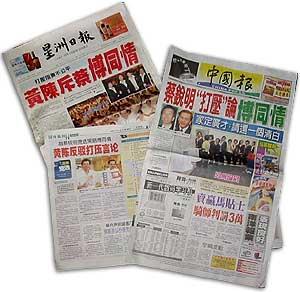 Chinese newspapers cater to Chinese interests and all things Chinese, among other things. Yes, they are as Chinese as can be. But by no stretch of imagination can this be tagged as racism.
To give a semblance of balance, some Chinese newspapers go out of the way to recruit even Malay columnists; not because they are Malays but because they write well. For instance, Sin Chew Daily has given editorial space to columnists like Tunku Abdul Aziz, Farish Noor, Karim Raslan, and occasionally, Zainah Anwar of Sisters in Islam. Space was even given to an Umno minister.
Sin Chew Daily
has even put up an English language website as a public service to enable those who can’t read Chinese to access its key editorial content, mainly its op-ed pages. There is no hidden agenda.It is not easy for Chinese newspapers to maintain an even keel. Some readers have been persistently lambasting main stream Chinese newspapers as servile apologists of the establishment and running dogs of the ruling coalition.
On the other, the government often times accuse Chinese newspapers as pro-opposition and anti-government when the facts speak otherwise.
Not easy for both parties
Just a few days before becoming Prime Minister, Najib made a courtesy call on Sin Chew Daily on his own initiative. Upon becoming PM, he made another visit, the first by any serving prime minister to a Chinese newspaper. He met the key editors and had a frank discussion.
Home Minister Hishamuddin Hussein called a meeting of editors of Chinese newspapers to “try to understand why Chinese newspapers are anti-government”. At the suggestion of the editors themselves, a monthly dialogue was initiated. But this fizzled out subsequently. It has not been easy for both parties.
In the run-up to the just completed general election, Chinese newspapers were careful to offer as fair coverage as possible under the circumstances. Editors even went to the extent of story count and photo positioning so as not to be accused as overly favouring either the ruling or opposition coalitions. Yet some remain entirely unhappy.
The election coverage was about election issues. These are the issue raised in the manifestos of both coalition parties contending in the elections. The Chinese newspapers were extra careful about race and religion if and when raised during the campaign period.
I do not know what prompted the prime minister to make his remarks about Chinese newspapers. I can only guess, he was fatigued by the vigorous campaigning or under pressure that the MCA, the main Chinese component in the ruling coalition had suffered a disastrous outing.
Only time will vindicate the Chinese newspapers. Racism has no place in the country's newspapers whatever the language stream it may be.
BOB TEOH was formerly a senior court reporter. He authored the book ‘Allah - More Than A Word’ and was once secretary-general of the Jakarta-based Confederation of Asean Journalists.


Report this comment
Are you sure you want to delete this comment?
This action cannot be undone.