




Street protests soon to push for IPCMC?
Non-governmental organisation Stop State Violence Movement does not rule out holding a street demonstration in the near future to keep the pressure on the government to establish the Independent Police Complaints and Misconduct Commission (IPCMC).
Non-governmental organisation Stop State Violence Movement does not rule out holding a street demonstration in the near future to keep the pressure on the government to establish the Independent Police Complaints and Misconduct Commission (IPCMC).
This follows a spate of nine deaths in police custody this year alone, said the Stop State Violence Movement, which is a coalition of 30 NGOs.
 The movement sees the highly-criticised Enforcement Agency Integrity Commission (EAIC), which is tasked with overseeing 19 enforcement agencies, as not having been effective since its formation two years ago.
Tenaganita founder and director Irene Fernandez said today the people have to keep up the pressure on the government following the rise in deaths in police custody.
"If it means coming out (to the street to demonstrate) for the IPCMC, to add the needed pressure, we will do it.
"If that is the only way for the people's voice to be heard, then we will take to the streets," Irene said.
Suaram coordinator R Thevarajan said the work of the Stop State Violence Movement would be just like the movement to abolish the controversial Internal Security Act (ISA), which also took some time before the ISA was abolished.
"For the ISA, it was not a short struggle to have it abolished. It was a long, bitter battle and in 2009, we saw a large street protest to abolish it.
"Maybe, for the IPCMC, such pressures can be used, including going to the streets," Thevarajan said.
'EAIC a toothless tiger'
Civil society groups, he said, have been making noise for the IPCMC to be set up for the past 10 years, but were only given a watered-down version, the EAIC, which does not even have the power to prosecute, which is recommended for the IPCMC.
Irene recognised that Pakatan MPs may face a tough battle in introducing a Private Members’ Bill to formulate the IPCMC bill by itself.
She said it would not be a problem for the Attorney-General’s Chambers to draft the IPCMC bill as the royal commission of inquiry (RCI) had already conducted an in-depth study and provided a recommendation in 2005 on how it is to be done.
Irene further described the EAIC as “a toothless tiger”, as all it can do is conduct investigations; and upon completion, it will refer the matter back to the particular agency for further action.
“This is proven when the EAIC only issued three warnings since its formation and it recently remarked that it has one investigating officer instead of six to look after the 19 enforcement agencies.
 “Another fundamental difference is that the EAIC reports to the Executive and it gives feedback to the respective agencies to take action, as with the three warnings. IPCMC, in comparison, is answerable to the Parliament. We want an institution which reports to the Parliament,” she added.
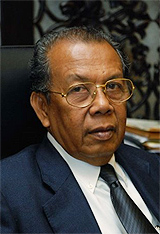
Former Chief Justice Abdul Hamid Mohamad ( left ) had last month pointed out the ineffectiveness of the EAIC which, over two years of formation, had only ordered one disciplinary action and two warnings to civil servants.
Irene stressed that “we all have been taught not to put all (our) eggs in one basket”.
“If there is only one institution in charge of looking after the enforcement agencies, it would result in no foresight or thinking. There is now public anger that a lot of money is spent on the EAIC and they are asking for an increase in budget. Yet for several years now, the number of custodial deaths does not seem to have been reduced, with nine already recorded so far.”
“Where else, the RCI which mooted the formation of the IPCMC is holistic, and has prepared a comprehensive report for the overhaul of the police force,” she said.
'Appeal process can be worked out'
Thevarajan said if there is a deficiency with the IPCMC - as pointed out by former inspector-general of police Musa Hassan - it is that there is no appeal process.
 However, the Suaram coordinator said that could be worked out with proper discussion when the bill is formulated as “we also believe that everyone, even criminals, should be allowed the process of appeal”.
Irene ( left ) added that such appeals can be made when filing for a judicial review.
She suggested that all enforcement agencies should have similar mechanisms as with the IPCMC to look at the rights of the people, and that Malaysia should ratify the Convention Against Torture to eliminate the use of torture to extract information or gain a confession.
Meanwhile, Komas coordinator Lena Hendry urged for a proper coroner's court to be set up - to specifically deal with custodial death cases - and the setting up of the Ombudsman system like in New Zealand, Canada and Sri Lanka to enforce human rights practices in all enforcement agencies.
EAIC: Panel member no longer representing cop
Are BN-aligned murderers being protected by police?
'BN's rejection of IPCMC the cause of crime situation'


