




We are 'Dayak', Sarawak CM told
Some 100 Ibans who call themselves ‘Borneo Iban Sarawak’ (Bisa) this afternoon protested at the Kuching Waterfront against the classification ‘bumiputera’ to replace the term ‘lain-lain’ on government forms.
Some 100 Ibans who call themselves ‘Borneo Iban Sarawak’ (Bisa) this afternoon protested at the Kuching Waterfront against the classification ‘bumiputera’ to replace the term ‘lain-lain’ on government forms.
“We want to be classified as ‘Dayak,” said Peter John Jaban, a Bisa leader and chief organiser of the protest.
The newly formed group is made up of ex-army and ex-police officers, retired civil servants, lawyers and businessmen.
Peter said that the protest was to send a message to the state government, especially to the Chief Minister Adenan Satem.
Two weeks ago Adenan announced that the government had with immediate effect replaced the words ‘lain-lain’ with ‘Bumiputera Iban, Bumiputera Bidayuh or Bumiputera Orang Ulu’.
“Dayak is the term chosen by the people themselves. It is used across Borneo comprising Sarawak, Sabah and Indonesian Kalimantan, to bind together an estimated 18 million to 20 million natives of various ethnic groups into one single group,” said Peter.
“While the Dayak may be Bidayuh, Berawan, Remun, Kenayan, Tring, Ahe, Selakau or any one of over 250 distinct tribes, together they are all Dayak, sharing a common heritage despite our differences,” he said at a speech delivered during the protest.
He said that the term ‘bumiputera’, had no meaning for the Dayak.
“It is not even taken from any Dayak language. It’s derived from Sanskrit. It was first promoted in the 1970s by the late Premier Abdul Razak, a Malay West Malaysian politician.
“How can this be the correct term to describe the Dayak when it is not their history or their heritage? It has been Dayak since time immemorial,” he declared.
National borders
He added that Undrip (United Nations Declaration on the Rights of the Indigenous People), under Article 33, recognised their right to determine their own identity as well as, under Article 36, the right to maintain and develop contacts, relations and cooperation with their own members across the Malaysian/Indonesian borders.
Peter ( left ) said that the Dayak were spread across Borneo, separated only by national borders and not by blood.
“Even the Malays of Sarawak are, in many cases, Dayak who converted to Islam, and choose to call themselves Malay. How can the Dayak be ‘Dayak’ in Kalimantan but suddenly became ‘bumiputera’ at the border?
“It’s just as God, Tuhan and Allah should not be divided by man-made lines on the map. Just as the Chinese of Malaysia are still Chinese despite being all over the world.
“Divide and rule has so long been the policy, but thankfully it seems not to be the goal of the new chief minister, who has stood up against the racist and derogatory terms ‘pendatang’ and promoted a government in harmony with opposition parties,” he said.
Peter stressed that the Dayak are bumiputera in that they are ‘orang asal’. “They are Kenyah, they are Kayan, they are Melanau, they are Kadazan-Dusun, but first and foremost, they are all Dayak,” he said.
He added the chief minister had finally put right a long overdue injustice by getting rid of the terms ‘lain-lain’ to classify the Dayak and had shown that he, in contrast to his predecessor, was willing to listen to the call of the people.
 “I plead that the chief minister once listens again to the community and does not replace the injustice of ‘lain-lain’ with another injustice – that of ‘bumiputera’," he said.
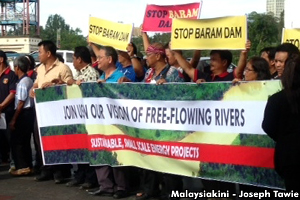
Meanwhile, NGOs Save Rivers and Gerakan Anak Sarawak (Gasak) held another protest at the same venue against the construction of mega dams especially the Proposed Baram dam.
The protest was to coincide with the international energy week held in Kuching from January 27 to 29, 2015.
Former prime minister Mahathir Mohamad had delivered a keynote address at the conference.


Are you sure you want to delete this comment?
This action cannot be undone.