




Nazri Aziz in a class of his own
COMMENT You get all types in Malaysian politics, a bemusing variety if you take Tengku Adnan Tengku Mansor as an example.
Testifying at the royal commission of inquiry into the VK Lingam videotape in January 2008, he was asked why the eponymous character under investigation had fingered him in what was an alleged attempt at case- and judge-fixing.
The current Umno secretary-general said he did not know, but that he was not surprised for he had heard even people in prison had used his name for some reason or another.
COMMENT You get all types in Malaysian politics, a bemusing variety if you take Tengku Adnan Tengku Mansor as an example.
Testifying at the royal commission of inquiry into the VK Lingam videotape in January 2008, he was asked why the eponymous character under investigation had fingered him in what was an alleged attempt at case- and judge-fixing.
The current Umno secretary-general said he did not know, but that he was not surprised for he had heard even people in prison had used his name for some reason or another.
 That he knew people in prison who would tell him what some inmates had said about him attested the width of Tengku Adnan’s (
photo
) contacts; the average pol would give quite a lot to have a good journalists’ contacts, if only because that would afford him a better feel for the pulse of the people.
That he knew people in prison who would tell him what some inmates had said about him attested the width of Tengku Adnan’s (
photo
) contacts; the average pol would give quite a lot to have a good journalists’ contacts, if only because that would afford him a better feel for the pulse of the people.
But more than a fine feel, a keen ear for what will play in the marketplace of political discourse is more valuable in this digitally-enabled days.
If you accept the proposition that in politics, only bores are insufferable, then perhaps you can score the comments our pols make off-the-cuff on a scale where the ludicrous bottom would be the stupefying remark that the unidentified Middle Eastern donor of RM2.6 billlion to Prime Minister Najib Abdul Razak did so for Malaysia’s stand against Islamic State, and the chuckling top would be Nazri Aziz’s bemused expression of gratitude to the international TV networks for boosting Malaysia’s tourism prospects by giving wide coverage to the Bersih and red shirt rallies.
That on this scale between the silly and sally the tourism minister not infrequently homes in on the upper register is becoming clear, more so now when arguments in deadly earnest are intensifying between political parties and within them.
As a consequence, the scope for gaffes, pratfalls, and the occasional bon mot is that much wider.
If arguments are the lifeblood of a democracy, it's imperative for pols to say something in the general chatter, what with blogs, Facebook and Twitter to enable the cacophony.
To voice with some panache what a pol wants to say encourages people to ignore the humdrum and be grateful that now and then, here and there, one of them pops up to say something that is not numbingly dull, or annoyingly carping like regularly emanates from the Gerakan Youth chief Tan Keng Liang.
Banality the bane of the social media
Banality is the bane of the crowded social media, so when you have someone of Nazri Aziz’s brio, you must be glad for the pause in the tedium that he provides with what he remarks about what other pols say and do.
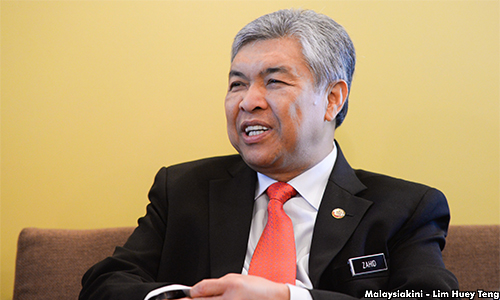 Even when those comments are in support of someone who is the epitome of the humdrum and the banal - Ahmad Zahid Hamidi (
photo
), the Deputy Prime Minister.
Even when those comments are in support of someone who is the epitome of the humdrum and the banal - Ahmad Zahid Hamidi (
photo
), the Deputy Prime Minister.
Nazri is rarely both, so it must come as a surprise that he supports Zahid to become the next prime minister, but then Nazri is the quintessential survivor, having moved along the allegiance spectrum with such deftness that he has not only survived Umno’s periodic wars of succession but has had his utility to each winner enhanced.
At various times, he has been a major supporter of all the victors as well as the vanquished in Umno’s internecine wars, at the youth and presidential levels, which makes his span of survival - nearly three decades long - through the successive changes in principal personnel in the party truly remarkable.
One would be hard put to find an equivalent in the ministerial survivor stakes the world over, unless of course one thinks of Andrei Gromyko, foreign minister in the defunct Soviet Union who was in the post from 1957 to 1985, a longevity that saw him survive radical changes in the upper tier of the soviet politburo.
But ‘Grim Grom’ was laconic and austere where Nazri is voluble and sardonic.
Of Gromyko, his onetime boss Nikita Krushchev said, “If I tell him to drop his pants and sit on a block of ice, he will do so,” which was, no doubt, meant as a compliment to the foreign minister’s acquiescent self.
Krushchev said it in the presence of Gromyko, whom the press observed was all grim countenance when the comment was made.
One suspects that a similar observation by a reigning boss at Nazri would elicit a subtly concealed two-fingered response which would be the essential difference between effervescent Nazri and dour Gromyko.
TERENCE NETTO has been a journalist for more than four decades. A sobering discovery has been that those who protest the loudest tend to replicate the faults they revile in others.


Are you sure you want to delete this comment?
This action cannot be undone.