




The life and death of Bruno Manser
The year was 1984 and then 30-year-old Bruno Manser embarked on a journey from his native Switzerland to the jungles of Sarawak, on the island of Borneo.
Written by Swiss-author Ruedi Suter, “Rainforest Hero -The life and death of Bruno Manser” chronicles Manser’s rise to prominence as an environmental activist, up until his ‘last’ known journey to Sarawak in May 2000.
Suter was in Malaysia as part of a multi-city tour to launch the biography and yesterday was the official international launch of the book.
The year was 1984 and then 30-year-old Bruno Manser embarked on a journey from his native Switzerland to the jungles of Sarawak, on the island of Borneo.
Written by Swiss-author Ruedi Suter, “Rainforest Hero -The life and death of Bruno Manser” chronicles Manser’s rise to prominence as an environmental activist, up until his ‘last’ known journey to Sarawak in May 2000.
Suter was in Malaysia as part of a multi-city tour to launch the biography and yesterday was the official international launch of the book.
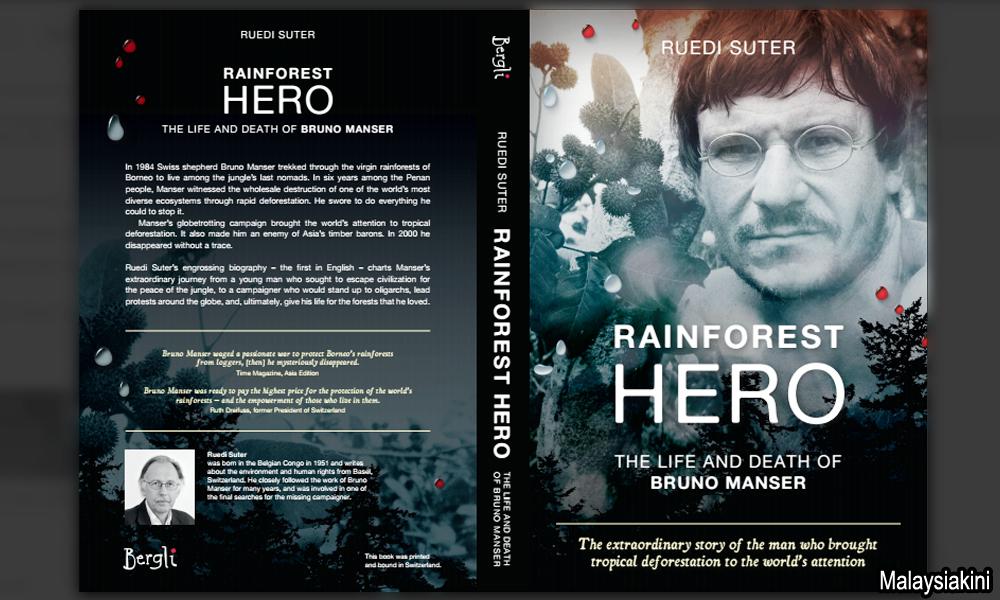 In Kuala Lumpur, the launch was held at Rumah Gerak Budaya, to coincide with opening of the International Tropical Timber Organisation’s annual conference, which begins in the federal capital today.
In the beginning, Suter said, Manser was in search of a simpler life, after he could no longer tolerate being a part of what he described as a European civilisation that is “largely based on robbery”.
“Bruno wanted to stop all that. He said, ‘I will not be a part of this worldwide destruction and the only way to do it is to lead a simple life’,” said Suter who described Manser as being both a dreamer and a fact-finder.
He noted that Manser then wanted to get to know a group of people who are still living primarily off the land.
That, he said, would soon be the point of time when Manser learned about the Penan people, one of Sarawak’s native indigenous tribes.
Lived with the Penan for six years
Manser eventually lived together with the Penan tribe for six-years and he found himself being a witness to the early days of what is now recognised as a state-sanctioned destruction of Sarawak’s forests through rapid deforestation for commercial purposes.
James Lalo Keso, a former Penan village chief from Long Lamai, an area near Sarawak’s border with Kalimantan, said the community at the time saw Manser as just another ordinary man.
“He lived like how the Penan lived and felt what we felt and so we accepted him. It was as simple as that,” James told Malaysiakini when met after the launch of the book.
And not only did the Penan accepted Manser, James said, the Swiss national was eventually seen as one of them, even being referred to as the 'Laki Penan' (Penan man).
While Manser has been credited for starting the organisation of road blockades against advancing loggers, James said his biggest contribution to the Penan community was his ability to attract domestic and international support for their struggle.
“Our struggle is about our land, our rainforest and our rights because we understand enough about the future. We knew this even before we met Manser.
“But he could tell the people what he saw, how he felt while living with us. We (the Penan) want Malaysia to know, we want the world to know what is happening to our jungles in Sarawak,” James said.
He was also responding to an audience member who had earlier questioned Suter’s perceived representation of Manser as a “saviour” for the Penan, based on a Western supremacist perspective.
James was part of the panel discussion on Manser's biography, along with Suter and Centre for Orang Asli Concerns coordinator Colin Nicholas.
'Relationship based on respect'
Nicholas said that Manser had developed a “reciprocative” relationship with the Penan people, a relationship based on a commitment to understand their struggle and to help others to help them.
“After reading the book, you really start to understand the person (Manser). I never knew him personally but there was a time that I also thought he was just another ‘white man’ who thinks he can be the ‘saviour’ of the indigenous people.
 “In reality, Bruno never declared himself to be a leader but the circumstances are such that he was forced to take up the role,” said Nicholas (
photo
) who pointed out that Manser was able to evade arrests by the local authorities due to assistance from the Penan themselves.
“In reality, Bruno never declared himself to be a leader but the circumstances are such that he was forced to take up the role,” said Nicholas (
photo
) who pointed out that Manser was able to evade arrests by the local authorities due to assistance from the Penan themselves.
Manser first entered Sarawak from Switzerland, on a tourist visa that reportedly expired on Dec 31, 1984.
He remained in hiding until the time he was forced to return to Switzerland after being declared Sarawak’s ‘State Enemy No 1’ for his role in organising the Penan to protest against logging activities.
One year later, Manser founded Bruno Manser Fonds (BMF), a fund designed to help conserve the rainforests and the indigenous population in Sarawak.
He also continued raising issues affecting the Penan and other indigenous communities on various international platforms.
On March 10, 2005, a civil court in Basel-Stadt, Switzerland, declared Manser to be legally dead after numerous failed search attempts in the five years since he had disappeared in the jungles of Sarawak.


Report this comment
Are you sure you want to delete this comment?
This action cannot be undone.