


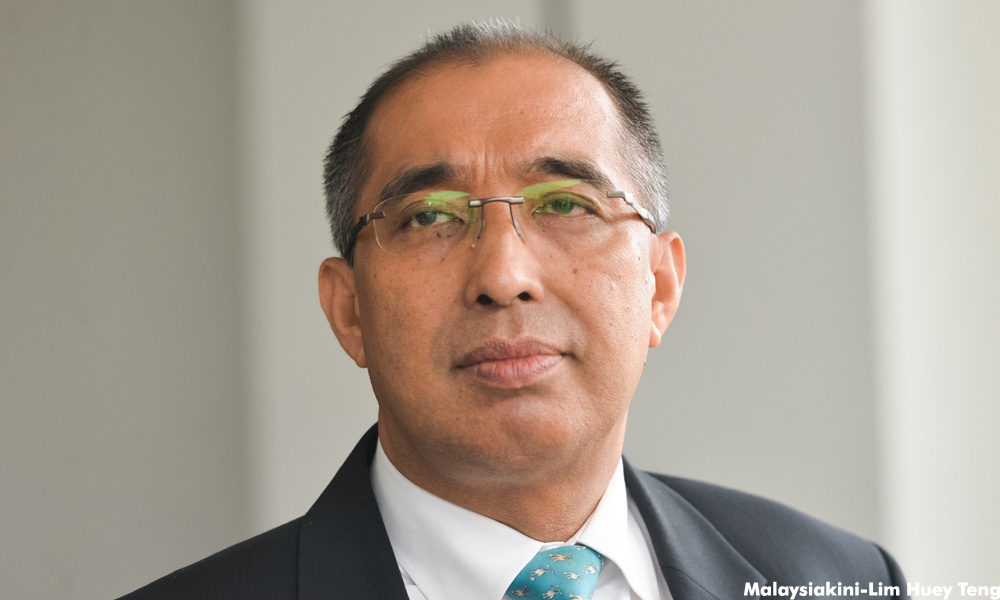

Salleh Said Keruak deserves a tongue-lashing himself
COMMENT For goodness’ sake, when Communications and Multimedia Minister Salleh Said Keruak quoted Sultan Nazrin Shah, he should at least have the courtesy to understand the intentions of the sultan of Perak instead of twisting it to mean more than what His Royal Highness had wanted to say.
I quote: “Information is no longer limited to sources that have been filtered and controlled by the authorities.” In just one line, Sultan Nazrin is saying that the government should stop thinking that it will be able to control what is told to the public or what is to be kept hidden.
This is indeed a slap in the face of Salleh himself, as the sultan himself has seen it fit to advise both the government of the day and the mainstream media that has been told to toe the line that times have changed.
COMMENT For goodness’ sake, when Communications and Multimedia Minister Salleh Said Keruak quoted Sultan Nazrin Shah, he should at least have the courtesy to understand the intentions of the sultan of Perak instead of twisting it to mean more than what His Royal Highness had wanted to say.
I quote: “Information is no longer limited to sources that have been filtered and controlled by the authorities.” In just one line, Sultan Nazrin is saying that the government should stop thinking that it will be able to control what is told to the public or what is to be kept hidden.
This is indeed a slap in the face of Salleh himself, as the sultan himself has seen it fit to advise both the government of the day and the mainstream media that has been told to toe the line that times have changed.
I am amused that the minister himself cannot even understand the speech in its totality. He is missing the entire forest for just a tree or two of his own choice and start shooting out of his mouth, babbling his way as though he understands so much about how the media works.
The rise of Malay Mail, and its demise
I have been with the media since 1995 and I cannot even tell how the media works. To put it briefly, it depends a lot on who is in charge of the media. I can quote a good example in the past, when the Malay Mail was under R Nadeswaran and others like Lee Boon Siew, Azmi Ansar and Daniel Chan.
Those were what we call the heyday of the Malay Mail , where my late father even took the trouble to pick up a copy to read every afternoon. It was the paper that you could turn to, with its ‘The Paper that Cares’ tagline, whenever you have a problem with the authorities.
The Malay Mail performed its role as the fourth pillar in encouraging the development of the country’s democracy. The people have a voice to speak up, whenever the authorities go overboard with their policies.
In fact, that was the beginning of my activism, when I started to do stories on uncollected garbage, potholes and every single thing that affects the people’s standard of living.
The moment it was taken over by RockyBru, the newspaper became what I described as a ‘sissy’ paper trying to target at the young people.
Since the ‘demise’ of the Malay Mail under RockyBru’s grand ideas of a ‘youngish paper that sells’ (or the way I see it), no other papers have managed to fill the vacuum.
Where’s the mainstream media heading to?
It is obvious enough to me why Sultan Nazrin is concerned about the direction that the mainstream media is taking. This is the reason why he saw it fit to speak up, so that the mainstream media bosses take up the challenge to accomplish its role as the check-and-balance watchdog.
The mainstream media, which is largely owned by political parties in Barisan Nasional, has become the ruling party’s mouthpiece in many ways. So much about the credibility of the news reported in the media, and if things go on as business as usual, it will be Salleh’s lecture room, where the rest of the Malaysian population of 30 million will have to listen.
It is not often that the mainstream media is willing to stake it out for the sake of its licence to operate in order to seek the truth. A good example is The Edge , where its permit to publish was suspended for reporting about 1MDB.
If I may put it, this is what Sultan Nazrin is unhappy about which spurred him to speak up against a “muted” press. On the contrary, why are people flocking to the online news portals such as Malaysiakini these days even if they have to pay for it?
The reason is that the information gap is too big that only some of these online media can close.
Journalism 101 for Salleh?
I have to urge the minister himself to sign up for Journalism 101, if he is saying that the alternative media reports false news. At the very least, he knows and understands how the media works round the clock, and how many stages of editing and sub-editing the copy has to go through before it appears in print.
In the process of gathering information, against a pressing deadline, it is never easy for a Malaysian journalist to obtain accurate information. Sometimes, it takes months before an answer is given, and even that, it does not answer all the questions that people are asking.
A very good example is the 1MDB scandal. From the time when we knew nothing about it, to the point when several media agencies picked up the story about RM2.6 billion which went into Prime Minister Najib Abdul Razak’s personal accounts, we have been asking one question after another, but where are the logical answers?
News has to be presented in a timely manner. Even if the ‘facts’ cannot be verified at the moment, it has become necessary sometimes to publish the allegations first, while waiting for an official reply. This is the problem when some people have things that they want to hide, or they are simply inefficient in handling the press enquiries.
As journalists, we would usually say that an e-mail has been sent to the minister’s office, and when the response finally comes, it will be reported as the minister’s own statement. We do not have a political agenda behind such reporting. In fact, most of us hate politics enough to turn down any offer to contest in an election, unless there is this strong reason to rescue this nation from going to the dogs.
I have often quoted the example of Tenaga Nasional Berhad (TNB) and Telekom Malaysia. In the past, it was impossible to get the public relations officer of Telekom on the line and she never took the trouble to call us back.
On one occasion, I was told to write a letter to submit my enquiries. After the article was published, the formal response came two months later in the form of a letter. That was how bad Telekom was, and I am not surprised that it is still the same today. Complaints fall on deaf ears.
For that reason, Telekom received a lot of brickbats for me, whereas TNB’s Syed Hidzam Osman, who was the personal assistant to the late Ani Arope, always received the thumbs-up from me. On several occasions, he even solved the complaints efficiently, and I told him and the complainants it is pointless for me to write the story. And, if I did, it was written as a bouquet for TNB.
So, for Salleh to say we are reporting falsehood, is like a kindergarten pupil telling her veteran journalist aunties that she does not how to spell ‘Journalism 101'.
STEPHEN NG is an ordinary citizen with an avid interest in following political developments in the country since 2008.


Are you sure you want to delete this comment?
This action cannot be undone.