
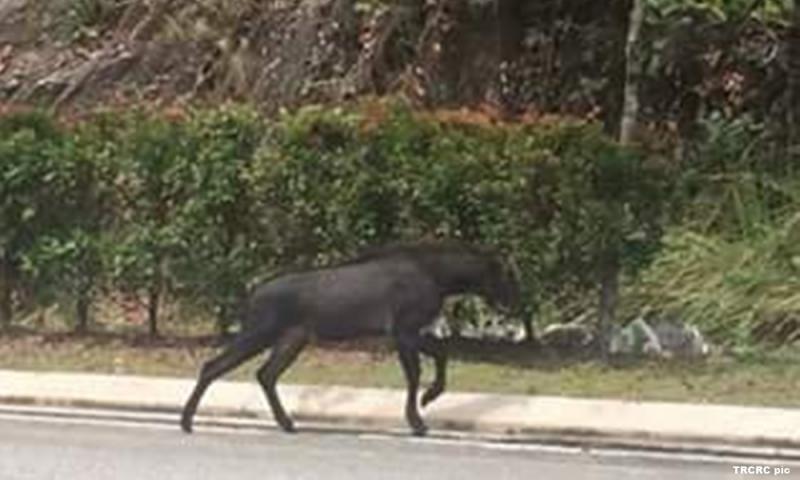
Sightings of the endangered Sumatran serow around the Ukay Perdana neighbourhood is a sign that its natural habitat has been disturbed by construction of the East Klang Valley Expressway (EKVE) which cuts across a local forest reserve, said local environmentalist groups.

Under normal circumstances, Malaysian Nature Society president Henry Goh said, the Sumatran serow ( Capricornis sumatraensis ) is a very shy animal that prefers to stay out of range and sight in the thickets of the forest.

“A possible cause for it to venture out of its natural home of steep primary and secondary forests and some limestone outcrops is human encroachment.

“In Malaysia, threats come mainly from habitat destruction caused by deforestation for logging, agriculture, hunting and in the context of the Selangor State Park, the construction of the highway which will cut through the heart of the heritage park,” he told Malaysiakini .

The area that runs through the Ampang Forest Reserve has been declared as a no-go zone for visitors, to make way for the construction of the 39.5km tolled highway which will connect Sungai Long to Damansara.

Meanwhile, Treat Every Environment Special (TrEES) director Leela Panikkar said the 106.5ha of land allocated for the project will also encroach on the Klang Gates Quartz Ridge in Ulu Klang, Selangor.

She pointed out that the area was gazetted in 1936 as a wildlife sanctuary chiefly to protect the serow, a goat-antelope species accorded full protection in Peninsular Malaysia under the Wildlife Conservation Act 2010.

“There are question marks whether the proposed measures mentioned in the environmental impact assessment report, viaducts and corridors across steep slopes, would lessen the effects on wildlife.

“Viaducts could be utilised by hunters increasing the probability of poaching of wildlife,” she said in reference to mitigation measures which have been cited by the state-government in response to critics.

On proposals for certain parts of the EKVE to be elevated, Leela said the highway will still become a physical and psychological barrier to many species of wildlife found in the area, limiting their access to vital resources.

High demand for serow meat

Despite being a protected species, WWF Malaysia executive director Dionysius Sharma said serow meat can still be found served in restaurants, as well as for use in traditional medicines.

“In the case of the Selangor State Park, consequences of not safeguarding the park will not only be felt by wildlife but also by humans as we depend on the ecosystem services it provides – water,” he said, noting that easier access to the areas could also attract more poachers.

The Ampang Forest Reserve and Klang Gates Quartz Ridge are areas within the Selangor State Park, the third largest park in Peninsular Malaysia and covers an area of approximately 914.41 sq km or over 108,000ha.

Gazetted as a state park in 2007, it also forms part of Peninsular Malaysia's central forest spine and functions as the most important watershed for Selangor, Kuala Lumpur and Putrajaya.

The Selangor state government had in June last year given its go-ahead for the federal project, despite concerns raised over potential impact on the environment.

Malaysiakini has contacted Elizabeth Wong, the state exco in charge of tourism, consumer affairs and environment, for comment.