


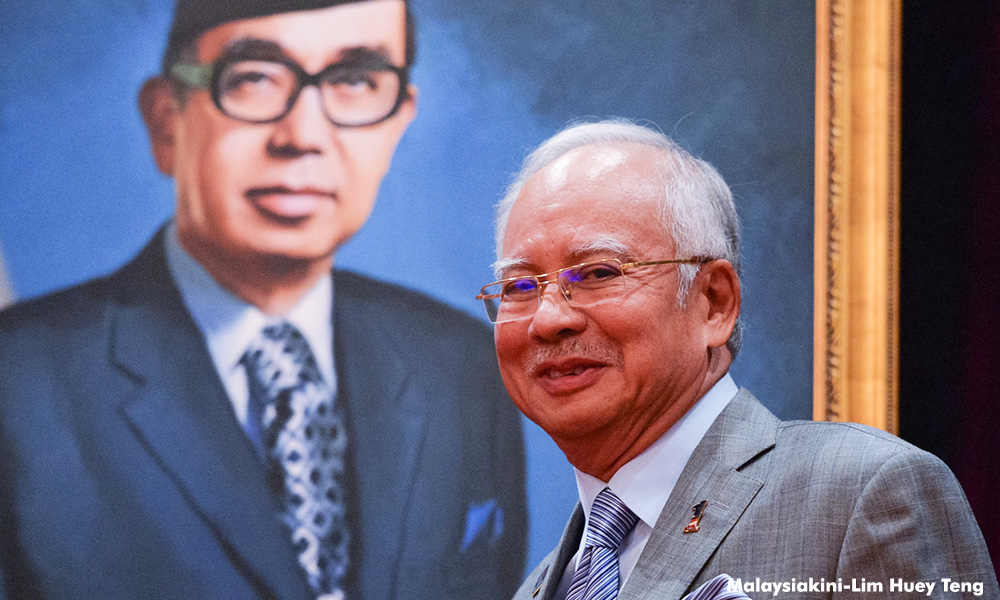

Razak fireworks spotlight Najib’s unravelling grip
ANALYSIS Almost four decades after Abdul Razak Hussein passed away while in office, the former premier has never been as well-celebrated as he has been this year.
Yesterday, Razak's son, Prime Minister Najib, took time off to pay tribute to his father, along with a long list of political veterans.
Even before the anniversary yesterday, Najib had taken to Facebook , repeatedly invoking nostalgia of his time as a boy with his father, who was the country's second prime minister.
ANALYSIS Almost four decades after Abdul Razak Hussein passed away while in office, the former premier has never been as well-celebrated as he has been this year.
Yesterday, Razak's son, Prime Minister Najib, took time off to pay tribute to his father, along with a long list of political veterans.
Even before the anniversary yesterday, Najib had taken to Facebook , repeatedly invoking nostalgia of his time as a boy with his father, who was the country's second prime minister.
The high-profile celebration of Razak, a respected Malay leader, comes at a time when Najib is plagued by several scandals.
Najib's constant attempts to trumpet supposed similarities between his government and that of his father may be seen as an attempt to bolster his struggling image.
Not everyone appreciated this, as evident in the statements of Razak's protege Rafidah Aziz, and his former aide Abdullah Ahmad, who said the former premier would be rolling in his grave if he saw the current state of the country.
Nonetheless, the sudden attention on Razak has naturally highlighted the contrast and similarities between father and son.
Razak tamed opposition
Razak rose to power in a time of chaos, shortly after the bloody May 13 riots in 1969, when democracy had been suspended and the country had been under the rule of the National Operations Council (NOC), led by him.
The NOC was dissolved and democracy restored in 1971.
While Razak's methods may be questionable, he was best known for restoring stability after the racial riots, in his six short years as prime minister.
Positioning the strife as being a result of Malays being left out and dominated by other communities, Razak embarked on a project to consolidate Malay position through political, economic, and demographic means.
He carved the Chinese-dominated Kuala Lumpur out of Selangor, removed the electoral weightage limit for the Malay-dominated rural constituencies, and abolished local elections.
He also succeeded in taming the opposition by bringing most of them into a grand coalition under BN, which eventually came to be dominated by his own party Umno.
The Sedition Act was also amended to broaden the definition of ‘sedition’ - preventing the questioning of Malays’ special position and the monarchy - which in later years was used against political dissidents.
Chaos to stability
He also crafted the New Economic Policy (NEP) which gave preferential treatment to the Malays in a bid to address the inter-ethnic wealth disparity.
The policy succeeded in lifting up the Malay community but at the same time, bred a culture of patronage among the political elite.
On the international stage, despite Razak's non-aligned policy, the then prime minister moved to establish diplomatic relations with China, which proved helpful for him among the Chinese community in the 1974 general election.
Razak's measures brought about stability and cemented Umno's hegemonic rise.
This hegemony helped his successors, and through gerrymandering and malapportionment of electoral constituencies, helped the ruling coalition to easily retain power over the decades despite the occasional upheaval.
Najib, who in the 2013 general election only won around 48 percent of the popular vote but about 60 percent of the parliamentary seats, is a beneficiary of Razak's legacy.
However, the legacy of hegemony and stability seems to be slowly slipping away.
Najib plagued with discord
Political analyst Wong Chin Huat pointed out that while Razak helped secure hegemonic power for the ruling coalition by achieving stability, Najib's administration appears to be plagued by increasing discord.
The one-party system that Razak created, Wong said, had two dimensions: On the one hand, it tied Malays to the NEP and, on the other, invoked the May 13 ghost to keep the non-Malays in check.
"After the May 13 riots, Razak rose to the top and kept a tight grip on the situation. His political trademark was stability.
"As for Najib, he did not come into office because of riots and if you look at the Low Yat incident and 916 red shirt rally, he is not capable of keeping the stability.
"Instead, fear is being sowed among Malays that they are under threat and riots are used to threaten non-Malays," he said.
Despite Najib's increasingly authoritarian methods, he is facing challenges in keeping his grip on things and on top of that, the scandal of RM2.6 billion making its way into his personal accounts has not helped.
Najib has even moved to introduce the National Security Council Bill which will grant him similar powers to when his father headed the NOC.
Right-wing elements have also become increasingly emboldened under Najib, as seen in the Low Yat riots, Sept 16 red shirts rally and more recently, the Kota Raya brawl.
Ghost of May 13 fading
Wong, who is also a fellow at the Penang Institute, said Najib's woes stemmed from the ‘May 13 ghost’ - often used by the ruling coalition as a threat that the country may lose its stability. But the threat has become increasingly ineffective, particularly after the 2008 general election.
"The threat is that if you dare to change the government and vote in favour of the opposition, you will be facing riots.
"But after the 12th general election, Selangor and Perak had no riots despite falling to the opposition... once the non-Malays do not fear (the May 13 ghost), their votes would be gone (from the ruling coalition).
"So, Najib has no choice but to veer right by provoking Malay sentiments, as he needs more Malay voters to offset the loss of non-Malay votes (for BN).
"Some see Razak as a unifying leader but Najib is seen as a divisive leader," he said.
Also, the BN component parties, including MCA, Gerakan, MIC, and PPP are unable to stop the coalition's shift to the right as it has today been reduced to parties with little influence and mostly serve as window- dressing for BN to claim it is a multiracial coalition.
The changing realities also mean that Najib is having a hard time emulating his father's political strategies.
Far cry from Razak
Najib has sought cooperation between Umno and PAS but this comes at a time when the former, which is now the bedrock of BN, is plagued by serious infighting.
"Najib is approaching PAS from a position of weakness, which shows he needs PAS more than PAS needs him.
"Unlike his father, Razak was at that time in a very strong position, and so was the BN," said University of Tasmania Asia Institute director James Chin.
In short, Razak had built a new coalition while he was in a strong position, while Najib is attempting the same from a weak position.
According to a Merdeka Centre survey last August, support for Najib's government - even among the Malay community - is at an all-time low, at only 31 percent.
Furthermore, the demographics has also changed, with the majority of Malays residing in urban centres.
Related reports
Analyst: Chinese bogeymen may scare Malays into Najib’s hands
Razak fireworks spotlight Najib’s unravelling grip
Razak's legacy – a blessing and also a curse for struggling Najib


Are you sure you want to delete this comment?
This action cannot be undone.