


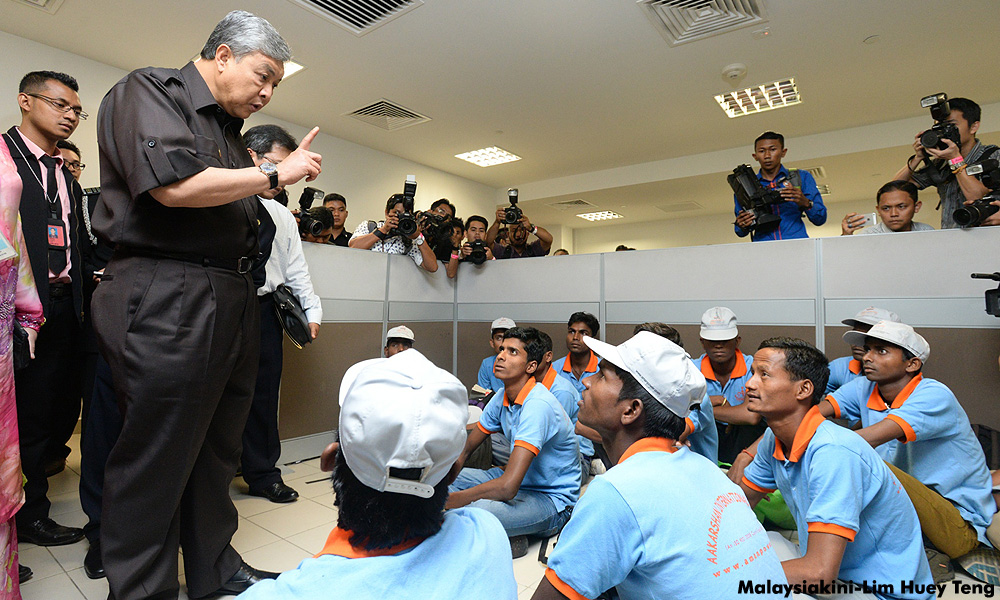

Zahid has to really think twice about 1.5m Bangladeshis plan
COMMENT I have said before, and it’s coming closer to home now, what I had earlier predicted about workforce strikes and the like that would happen, with the escalating cost of living.
While politicians gloat in their ‘donations’ in billions of ringgit, Malaysian employees are feeling trapped in the lower and middle income level. If not handled properly, things could get out of hand.
The disparity between the rich and the poor even within the same race is big. When Rosmah Mansor, wife of Prime Minister Najib Abdul Razak, spoke of her RM1,200 hairdo while commenting about the Goods and Services Tax (GST), it reminded most of us of the French Queen Marie Antoinette’s famous words to the peasants, “If they do not have money to buy bread, let them eat cake then.”
COMMENT I have said before, and it’s coming closer to home now, what I had earlier predicted about workforce strikes and the like that would happen, with the escalating cost of living.
While politicians gloat in their ‘donations’ in billions of ringgit, Malaysian employees are feeling trapped in the lower and middle income level. If not handled properly, things could get out of hand.
The disparity between the rich and the poor even within the same race is big. When Rosmah Mansor, wife of Prime Minister Najib Abdul Razak, spoke of her RM1,200 hairdo while commenting about the Goods and Services Tax (GST), it reminded most of us of the French Queen Marie Antoinette’s famous words to the peasants, “If they do not have money to buy bread, let them eat cake then.”
Yesterday, various workers unions coming under the NGO coalition Pertubuhan Rapat Malaysia (Rapat) have threatened a “public uprising” if Deputy Prime Minister Ahmad Zahid Hamidi went ahead to bring in 1.5 million Bangladeshis into Malaysia.
Most of us would only think of the coming general election to show our displeasure, but workers unions are now sounding out their frustrations with the current administration. Collectively, they represent a huge majority in the workforce.
If Zahid cannot come to the negotiation table and justify the reason for recruiting 1.5 million Bangladeshis, there is no need later to use the police to swoop down on some of these union leaders. A wise leader would take heed of the rumblings from the populace before the lid is released.
Do we really need 1.5m Bangladeshis?
Look at the petrol stations. At most petrol stations, there are many Bangladeshis who are employed just to fill the quota, but they hardly do anything to service the customers.
If Zahid has conveniently forgotten the reason why the government at one point argued against over-dependence on foreign workers and introduce self-service in petrol stations, perhaps it is time for the then-human resources minister concerned, Dr Fong Chan Onn, to speak up.
Based on an interview with the president of the SMI Association of Malaysia end of last year, the small and medium enterprises in the country have reported a drop of 30 to 50 percent in their sales in 2015. With a lower domestic demand, and the country not increasing its exports overseas, why do we need 1.5 million workers?
The Small and Medium Entrepreneurs Alliance (Ikhlas) has given Zahid an ultimatum of one month to produce a list of all the companies that require Bangladeshi workers. Let us see the list before we agree with Zahid.
‘No 3D’
Youth and Sports Minister Khairy Jamaluddin then said that most young Malaysians do not want to do the 3D (dirty, dangerous and difficult) jobs.
That is because he is thinking as an elite member of society. Khairy is misled in his belief that Malaysians are generally unwilling to dirty their hands or do work that he himself would not do.
If that is true, why are Malaysians flocking to Singapore, Japan and other more advanced countries - some working as security guards, apple pickers and kitchen hands, while others are in tanker cleaning facilities?
Back in the 90s, there was an explosion at a tanker cleaning facility in Singapore, where a Malaysian killed was a childhood friend of mine. Is it not for the money that they are prepared to dirty their hands and even risk their own lives?
The definition of 3D was only coined by people like Khairy to justify Zahid’s attempt to recruit 1.5 million Bangladeshis into the country. There are in reality no 3D jobs, because every job is a dignified profession, if we care to re-define the scope of work.
It is the failure of the government of the day to educate the public on the 3D jobs. In more advanced countries like Australia, for example, the whites are willing to provide professional cleaning services (what we call garbage collectors) and they get better pay doing such jobs.
These professional cleaners demand that all household wastes must be segregated and placed in proper garbage bags. Any household that fails to comply with the regulations will find their garbage not collected for the day. These blue collar ‘professionals’ are highly paid, compared to some white collar employees who can enjoy the comfort of the office environment.
For this reason, some students choose to take up blue collar jobs during the summer vacation, because they were paid highly and treated well on the job.
Over here in Malaysia, the blue collar employees are paid meagre wages, while the middlemen (or corporations) pocket the lion’s share of the profits.
Straining on Malaysian hospitality
If 1.5 million Bangladeshis are recruited, they will automatically put a strain on all Malaysians. While the government wants to push for zero squatters, most owners of these squatter homes will find it lucrative to rent them out to the Bangladeshis.
They will need food, causing food prices to soar further up. As a nation, we are unable to produce enough even to feed 30 million mouths; now, we have to feed another 1.5 million people. Subsidies that were supposed to benefit the Malaysian poor will be enjoyed by our friends from Bangladesh, whose income will surely be remitted to their home country.
When they are sick, they will pack the local public hospitals, worsening the current situation in some of the outpatient clinics. There is no guarantee that with 1.5 million Bangladeshis, there will not be some who will turn out to be burglars at night. My mother’s house was burglarised several years ago, allegedly by two Bangladeshis.
Having said this, I wish to add that I concur with Selangor state assembly speaker Hannah Yeoh who said that Bangladeshis are like any of us . In fact, 30 years ago, I spent two months travelling around the country to see for myself what true poverty was about.
While some of the Bangladeshis have aspirations, and they are prepared to work hard to achieve their dreams in life, the truth is, when they are here, they are being used and even abused by certain parties with vested interests besides just being employed during the day.
STEPHEN NG is an ordinary citizen with an avid interest in following political developments in the country since 2008.


