




Aid is not enough to win Muslim hearts, US told
Washington has earned some credit among Muslims for its aid to victims of the Asian tsunamis but must change its foreign policy to counter the perception that it is anti-Islam, the leader of the world's biggest Islamic group said today.
Washington has earned some credit among Muslims for its aid to victims of the Asian tsunamis but must change its foreign policy to counter the perception that it is anti-Islam, the leader of the world's biggest Islamic group said today.
Prime Minister Abdullah Ahmad Badawi, who heads the 57-nation Organisation of the Islamic Conference (OIC), told AFP in an exclusive interview that US actions were not always consistent with its insistence that Muslims were not being targeted.
"If you are talking about relationships with the Muslim countries it is not just providing aid in the way they have provided it now - which is very good, I'm not suggesting it is not good - but there has to be more than that," Abdullah said.
"The whole foreign policy stance has to be corrected."
President George W Bush and incoming Secretary of State Condoleezza Rice have made it clear they believe US aid for victims of the Dec 26 tsunamis which killed more than 280,000 people - most of them Muslims - would ease the widespread dislike of the US in the Islamic world.
"I think in a way it will help," Abdullah said. "But they have to do something more on a permanent basis, not just on these particular occasions.
"I think the whole stance of the policy of the US towards Muslims - there is something that could be construed as negative profiling.
"President Bush says he is not anti-Islam or anti-Muslim. But his policy towards some countries, which are Muslim countries, OIC countries, can be interpreted as an example of not being consistent with the policy of not being anti-Islam and not anti-Muslim."
No to action against Iran
Abdullah, whose country strongly opposed the US-led invasion of Iraq, criticised Washington for now threatening possible military action against Iran.
 Bush said last week he could not rule out resorting to force unless Iran can be persuaded to abandon a nuclear energy program which Washington believes is a cover for developing a bomb.
Abdullah said "statements of pre-emptive action, like Iran, also the issue of Syria," should be replaced by negotiations.
"I always believe it is better to talk. Talk with the idea of solving the problem rather than talk with threats - that will not go down well."
Iraq, Iran and Syria are all members of the OIC, of which Abdullah is current chairman.
On Sunday's elections in Iraq, Abdullah said: "I am very concerned on what the outcome is going to be because there is still violence there.
"But I do hope that the election will be able to take place. That's very important, because it marks the beginning of a new Iraq.
"It is a very important landmark for Iraq and I think the Iraqis should seize the opportunity."
He said he knew the Sunni Muslim minority, which was in power under former dictator Saddam Hussein, was unhappy with some aspects of the election, "but a constitution has to be drafted so all these issues can be taken up again."
Unfair allegations
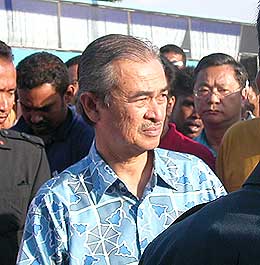 Turning once more to the tsunami disaster, Abdullah rejected as "unfair" allegations by some western critics that Islamic countries had not done enough to help the victims - most of whom are Muslims living in the Indonesian province of Aceh.
"As soon as this tsunami disaster struck several countries, I had evidence from United Nations sources that Islamic countries have been making their contributions," he said.
"They believe what they have done is enough, so I don't question this."
Earlier, Abdullah told the opening session of a meeting of an OIC Commission of Eminent Persons that many parts of the Islamic world were in "deep crisis" with Muslims suffering more from militancy and terrorism than others.
"Some of the OIC countries are rich and their people affluent. But they are too few and far between. The OIC landscape is littered with nations that are poor and people that are hungry."
The meeting comes ahead of a planned summit of the OIC at the request of Saudi Arabia, which is expected to address reform of an organisation often accused of being no more than a talking shop.
Abdullah said Muslims must "take effective measures to deconstruct the intellectual and ideological foundations of religious extremism and sectarianism, for they do great damage to the cause of Islam and the welfare of Muslims.
"We need to close the great divide that has been created between the Muslim world and the West," he said.


Are you sure you want to delete this comment?
This action cannot be undone.