


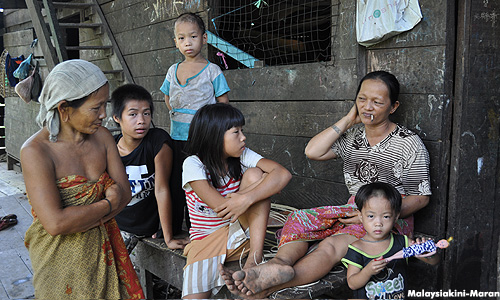

Why there are so few poor rural households in Sarawak
COMMENT One question which has often been nagging at the back of my head is this - if the economic indicators for rural Sarawak is as bad as what I’ve outlined, why are there so few poor households in the official statistics for Sarawak?
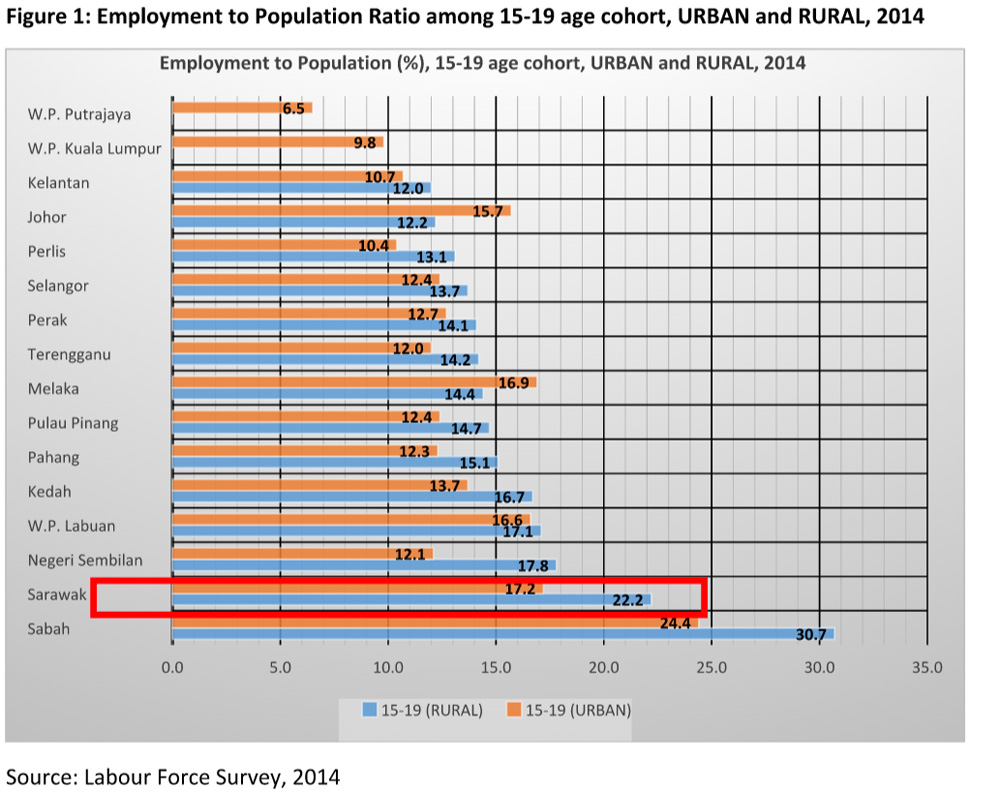
I think I’ve found an important component of the answer to this question in the Labour Force Survey 2014 data. According to this survey, 17.2 percent of the 15-19 age cohort in urban Sarawak are in the workforce, which puts Sarawak in the second position behind urban Sabah, at 24.4 percent.
COMMENT One question which has often been nagging at the back of my head is this - if the economic indicators for rural Sarawak is as bad as what I’ve outlined, why are there so few poor households in the official statistics for Sarawak?
I think I’ve found an important component of the answer to this question in the Labour Force Survey 2014 data. According to this survey, 17.2 percent of the 15-19 age cohort in urban Sarawak are in the workforce, which puts Sarawak in the second position behind urban Sabah, at 24.4 percent.
But this is not significantly higher than Malacca (16.9 percent) or Johor (15.7 percent). Where the differences are starker is between rural Sarawak and peninsular Malaysia. Twenty-two percent of the 15-19 age cohort in rural Sarawak is in the workforce, compared to 14.4 percent in Malacca and 12.2 percent in Johor. (See Figure 1 below)
What this means is that there is a large percentage of school-going age children that are leaving school at the secondary level and forgoing tertiary education in Sarawak compared to peninsular Malaysia. Many of them end up working in the agriculture sector, helping out at the family farms or kebuns, in order to supplement the family incomes.
For these children, their future incomes will have limited upside because of their decision not to complete their secondary education or not to pursue a tertiary level education qualification.
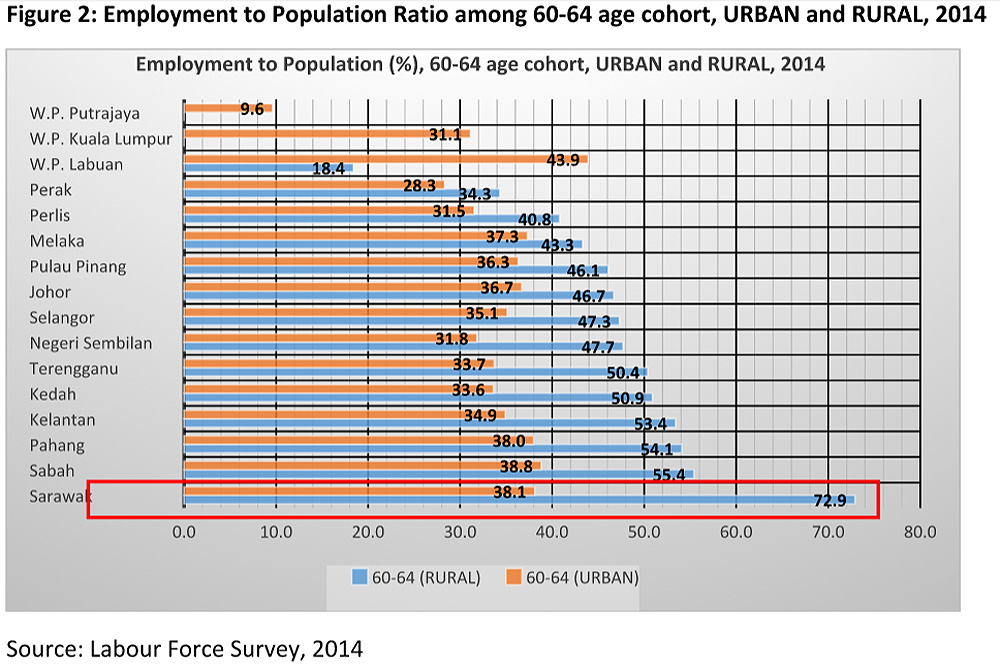
On the other end of the scale, the labour force statistics shows an even greater urban-rural divide in Sarawak among the 60-64 age cohort that are in the workforce. 38.1 percent of the 60-64 age cohort in urban Sarawak are in the workforce which is slightly higher than Pahang (38.0 percent) and Malacca (37.3 percent).
But in rural Sarawak, a whopping 72.9 percent of the 60-64 age cohort are still in the workforce compared to 54 percent in Pahang and 53 percent in Kelantan, which are also both relatively rural states where the agriculture sector is very important. (Figure 2 below)
This is consistent with my own experience in rural Sarawak where many elderly folks still go to their kebuns early in the morning to work and only returning after dusk. While it may be good for the elderly to keep a healthy lifestyle late into their lives, it would be less ideal if the elderly are forced to continue working past 60 because they have no choice but to work in order to survive.
It is almost certain that those who are working in the agriculture sector in Sarawak do not earn enough to accumulate much retirement savings in their EPF accounts. For those who are not fortunate enough to have children who are earning a decent living in the urban areas, they have no choice but to continue working in the kebuns.
The phenomenon of a higher than normal percentage of the young (15-19 age cohort) and the old (60-64 age cohort) explains partly why most household incomes in Sarawak is higher than the Poverty Line Index (PLI). With a larger number of persons in a household working, especially in the rural areas, total household incomes will naturally be higher even though average incomes per person in these households are probably very low, perhaps even lower than the minimum wage.
Low level of agricultural productivity
The problem of low incomes in rural Sarawak is exacerbated by the low levels of productivity of the agricultural sector in the state. When we mention padi production, many people would naturally think of Kedah, the rice bowl state of Malaysia. But many people would be surprised by the fact that Sarawak has the second largest planted area of padi after Kedah. (See Figure 3 below)
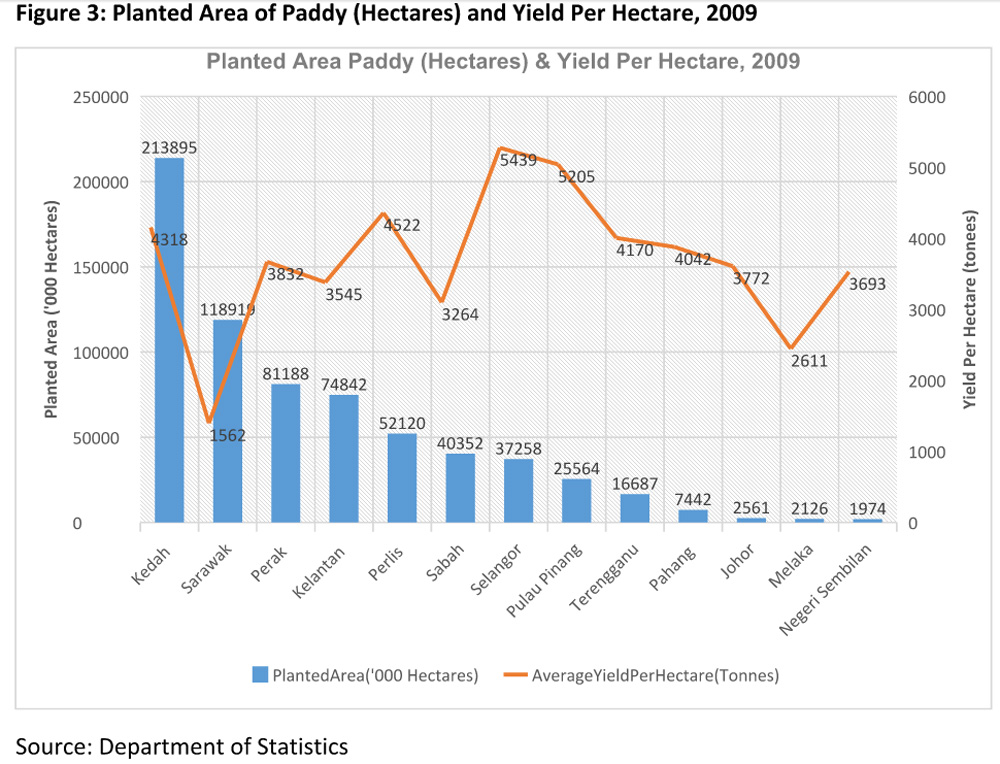
But what ails padi farmers in Sarawak is the low padi yields which, at 1,562 tonnes per hectare, is the lowest in the country. Padi yields in Kedah, at 4,318 tonnes per hectare, is almost three times that of Sarawak. (Figure 3 below). Although padi yields in Sarawak had increased to 1,890 tonnes per hectare in 2013, this was still less than half the national average of 3,879 tonnes per hectare.
The productivity of cash crops such as palm oil is not much better. According to statistics from the Malaysian Palm Oil Board, Sarawak, at 2.57 tonnes / hectare, has the second lowest CPO productivity among the major palm oil producing states in Malaysia, behind only Kelantan.
Part of the reason for the low CPO productivity in Sarawak is the higher percentage of immature palm oil trees in the state. The unsuitability of peat soil for the planting of palm oil could be another reason.
The lower productivity of the agriculture sector in Sarawak, as shown using the padi and CPO yields per hectare, translates into lower incomes for the agriculture workers in rural Sarawak.
This explains the larger percentage of both young (15-19 age cohort) and old (60-64) that are in the workforce in Sarawak and also the large percentage of households in Sarawak which earn less than 2000RM a month (at 33 percent, the second highest in Malaysia). Low agriculture productivity means you need to have more people working in the kebuns in order to make a living. But this living is barely above the poverty line income of RM920 in rural Sarawak.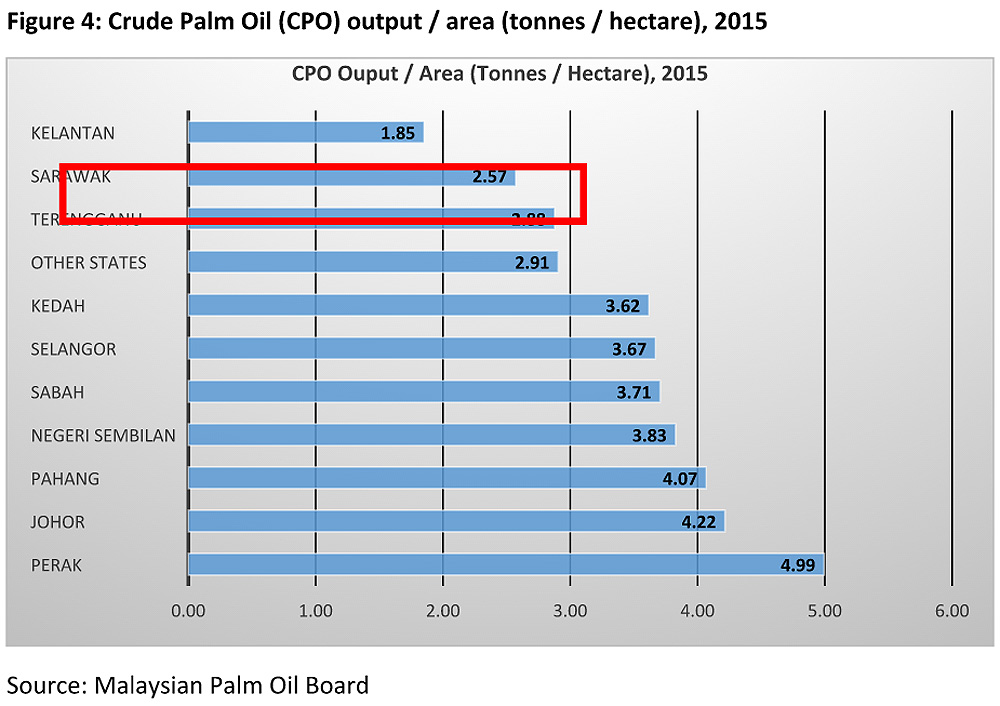
Part 1: Sarawak, a tale of two nations
Part 2: Sarawak’s highly unequal economic structure
Part 3: Low incomes a massive challenge for Sarawak
Yesterday: Complex causes of poor education levels in Sarawak
Tomorrow: Political competition will boost rural development in Sarawak
ONG KIAN MING is the DAP Member of Parliament for Serdang. He can be reached at im.ok.man@gmail.com


Are you sure you want to delete this comment?
This action cannot be undone.