



Long way to go before local film scene is truly revived
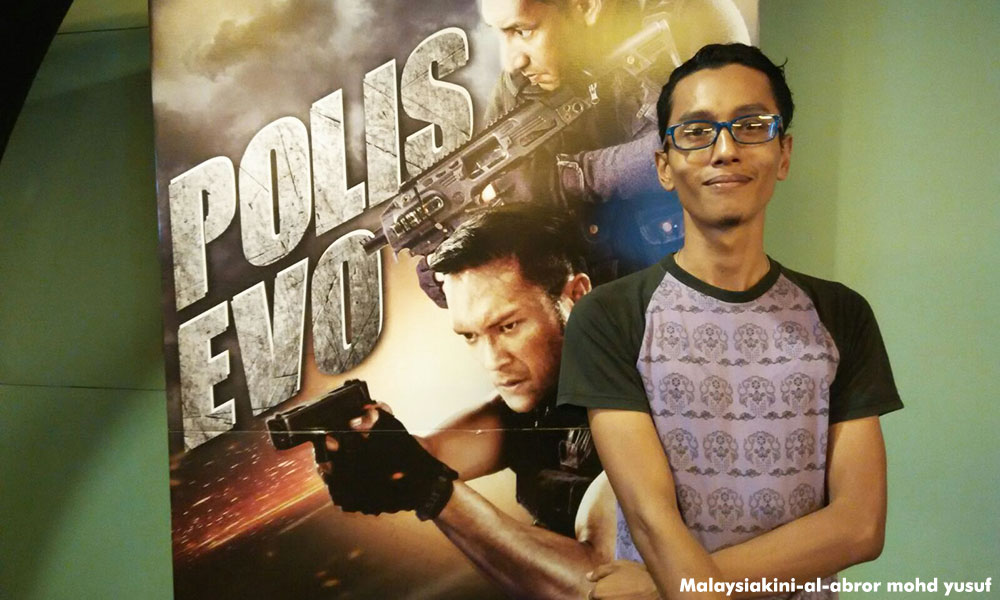
MALAYSIANS KINI 'Ola Bola', 'The Journey', 'Munafik' and 'Polis Evo'. These are some of the more recent local films that have garnered public interest and made headlines while they were screening.
However, what about all the other local films that do not seem to have left marks at all?
"A revival should be like nine good films and one bad film, but in reality, we have like 20 to 30 films that do badly," Ipoh-born filmmaker James Lee lamented to Malaysiakini.
Lee was one of the pioneers of the Malaysian New Wave cinema about a decade ago and, along with fellow filmmakers Amir Muhammad, Tan Chui Mui and Liew Seng Tat, formed their own production company, Da Huang Pictures, in 2005.
 Tan (photo), who made the critically-acclaimed movie 'Love Conquers All', shares the same concern.
"You would say revival (of the local film industry) because sometimes local films make RM10 million or RM17 million in the box office. But that is the only thing you judge.
"Maybe it's too simple, because while one film might have made RM17 million at the box office, other local films are getting maybe less than RM1 million," the 37-year-old filmmaker said.
Box office discrepancies
Tan has a point.
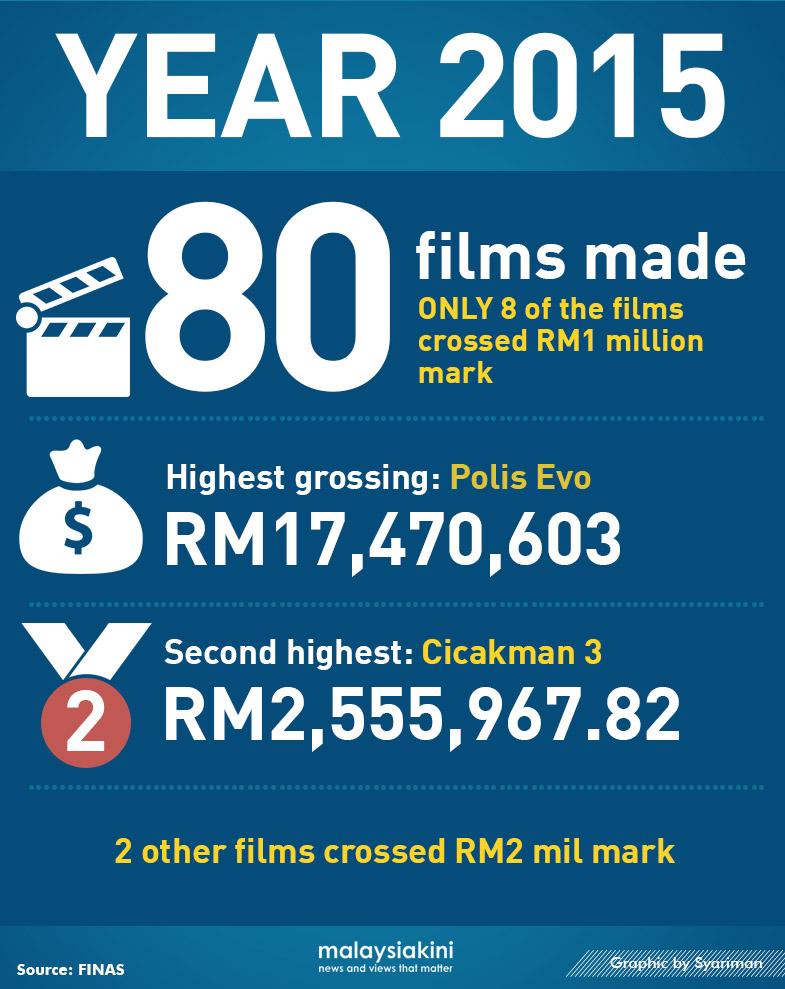
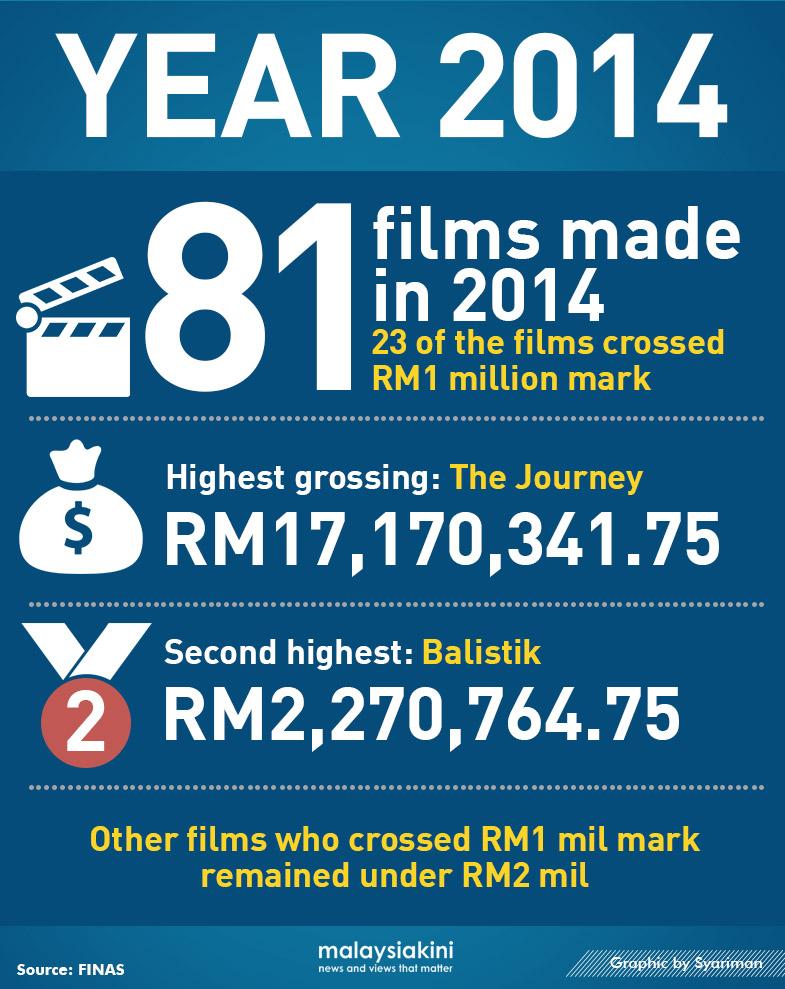
National Film Development Corporation Malaysia (Finas) records show last year, out of the 80 local films made, only eight films crossed the RM1 million mark, with the highest earning being 'Polis Evo' at RM17,470,603.
The second highest grossing film for 2015 was 'Cicakman 3', trailing far behind at RM2.56 million.
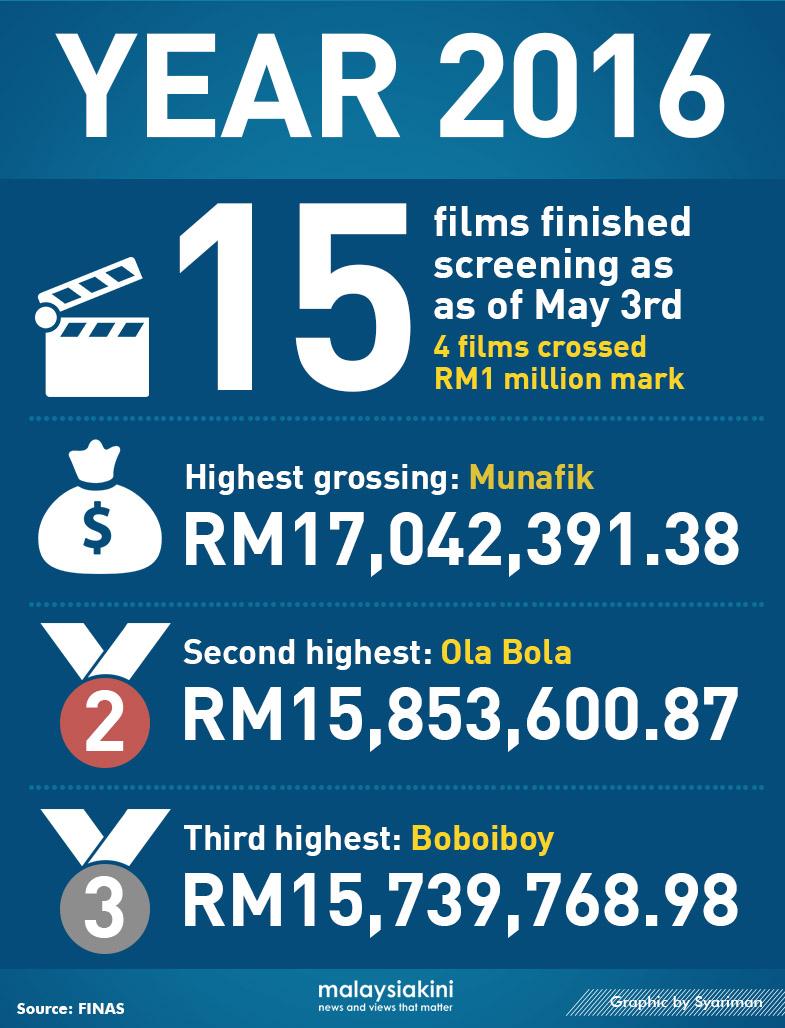
As at May 3 this year, 15 local films have finished screening in cinemas and so far, only four films have crossed the RM1 million mark.
The top three highest grossing films this year also have a smaller gap between them, with their earnings ranging from RM15 million to RM17 million.
 Lee (photo), sceptical of talk of revival of the film industry, said that for a whole industry to be revived, every section of it needs to be stable.
"The people who watch these films (like 'Ola Bola' and 'The Journey'), it doesn't mean they will watch other Malaysian films. The industry is not well-represented.
"The revival is just for them (the directors of high-grossing local films), and not the industry," he explained.
Disillusioned by the film industry, Lee actually left conventional filmmaking in 2012 and is now making films and short films under his production house Doghouse73 Pictures, which are then uploaded onto YouTube for free viewing.
His latest film, action-thriller 'Burn', will be released this year.
New generation of filmmakers
Judging films by their box office earnings is one way to determine the quality of the films, but for 'Bunohan' director-writer Dain Iskandar Said, there is more to a film’s success than its takings.
 "People tend to think that the box office is the yardstick and the measure for quality, (but) it isn't to me," he said.
Dain takes much more issue with the fact that many young filmmakers do not have the right priorities in making films.
He said he loves the fact that today, films can be made on any device, but he lamented that many young filmmakers are getting caught up with the technology and have forgotten the basics.
"Let's say you want to be a novelist. You can put a sentence together, but it doesn't mean you can be a novelist.
"You can have cameras swinging left, right, flying in the air and going up the nose, but what about story, writing, performance?
 "Unfortunately, people mistake technology for the artform. Technology isn't an artform, it's just a tool," Dain said.
Tan is also concerned about the next generation of filmmakers, though her concern stems from the fact that most young filmmakers only aspire to be directors.
"Every film school focuses on directing but we don't have enough producers or scriptwriters.
"(The workshops) decentralise things from directing... we have to stop glamourising directing," she said.
Tan has been part of several film workshops, supported by Finas, under the banner 'Next New Wave' at the Content Malaysia Pitching Centre - a Finas outfit aimed at supporting Malaysian creative content producers, which houses a theatrette in Kuala Lumpur that is now synonymous with Friday night film screenings.
'McDonaldisation' of films
The Friday night screenings organised by Kelab Seni Filem Malaysia, in which Tan is active, is only one of several such screenings, catering to a growing group of Malaysians interested in Malaysian and Asian cinema.
Other screenings in the Klang Valley include cult Malay films screenings by Pusat Kajian and Apresiasi Filem in Shah Alam and selected international films curated by enthusiasts at Kelab Filem Titiwangsa and Kelab Filem Bangsar.
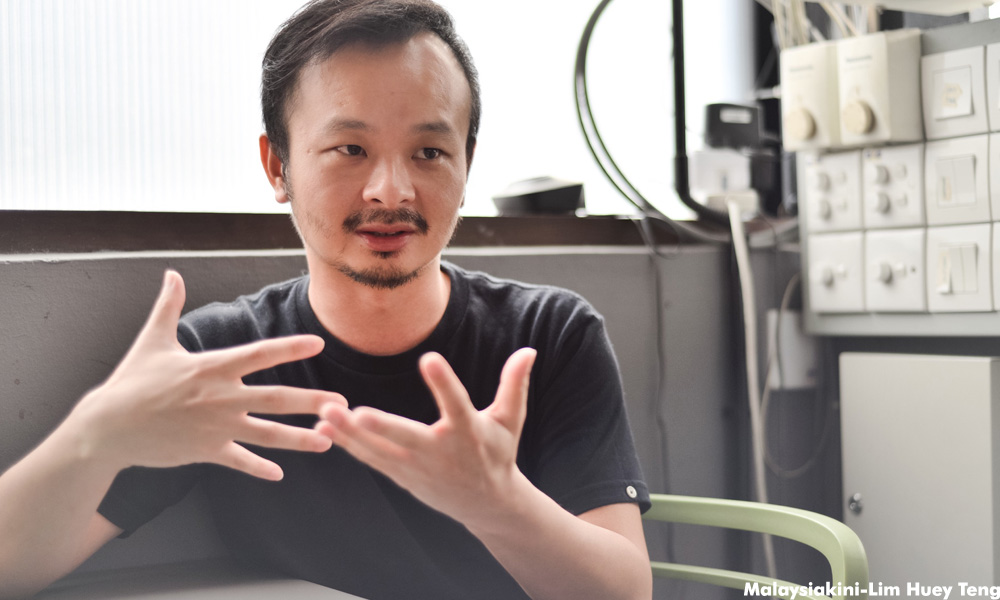 Outside dark rooms filled with film nerds across the city, in the cineplexes and on silver screens, Da Huang Pictures filmmaker Liew Seng Tat (photo) says diversity is wanting.
"Of course it's improving, but from a filmmaker's point of view, it's not enough yet," the ‘Lelaki Harapan Dunia’ director said.
In 2014, 'Lelaki Harapan Dunia' had flopped at the box office, but went on to be selected as the Malaysian entry for the Best Foreign Language Film at the 88th Academy Awards, though it was not nominated.
Liew described the local film industry as a chicken-and-egg situation, as there is not enough film diversity because the local audience are not very adventurous.
But, he added, it is not the fault for the audience either, because they have been fed the same sort of films over and over again, until they have come to define films in a very formulaic manner.
"Most filmmakers tend to follow Hollywood. This has led to the 'McDonaldisation' of the industry.
 "Since filmmakers think everyone wants to savour the film version of McDonald's, they make 'McRendang' while there is an abundance of different foods from many parts of Malaysia,” Dain said, agreeing with Liew.
"So, in the last 20 years, the people have lost faith in local films, because filmmakers have been feeding them substandard McDonald's," explained the auteur, who is in the midst of making his new film, a supernatural-thriller called 'Interchange'.
The taste for films of the audience is indicative of the larger problem, which is the lack of film culture and what Dain describes as 'cine-literacy' in our society.
"When you have a mature society that is totally cine-literate and highly educated, visually and narratively, you can sustain the diversity (of films)," Dain said.
Liew believes it is also part of a filmmaker's job to improve film awareness and education - this is why he and Tan revived Kelab Seni Film Malaysia and hold Friday night screenings.
"(The club) is a type of education... and the workshops are a very specific type of film education targeted at filmmakers for very specific skills," Tan said.
The filmmakers believe fresh faces and ideas, coupled with support from Finas, have brought about improvements in the industry.
But to reach the golden age again? It’s still a long way to go.
Yesterday: Malaysia movie mania: Are viewers back for good?
MALAYSIANS KINI is a series on Malaysians you should know.
Previously featured
Branded as 'deviant', Muslim scholar remains defiant
For Thasleem, life has indeed come a full circle
M’sian int’l hackathon champ shows computer games good for you
Pianist bears no grudge over concert cancellation due to Bersih 2
This Malaysian youth has helped 10,000 Syrian families and counting
How the Malay indie publishing mafia sparked a reading renaissance


