
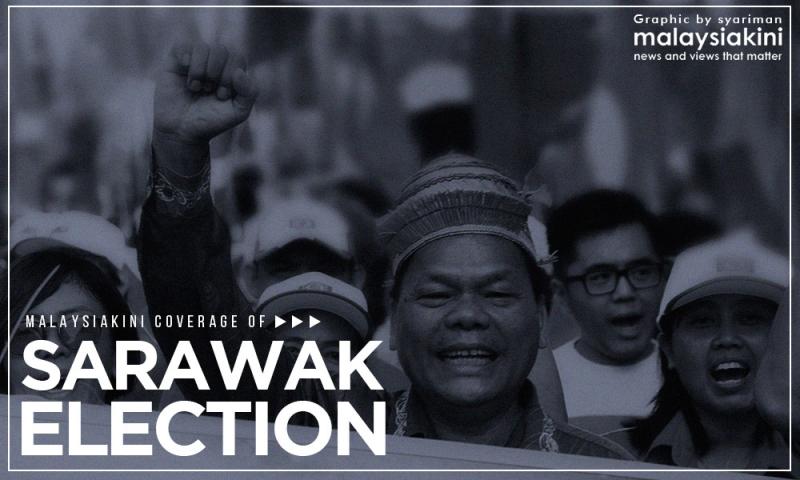
ANTIDOTE Some Malaysians have been calling Sarawakians stupid for giving BN 88 percent of the seats in the state assembly, and for throwing a lifeline to Najib Abdul Razak and Umno.

The anger, insults and discrimination directed against Sarawakians will probably hit blue-collar workers in peninsular Malaysia hardest, while damaging Pakatan’s prospects in both Sabah and Sarawak.

Flying over to peninsular Malaysia the day after the polls, I was aware that the ink on my finger would mark me out as a Sarawakian voter. It reminded me, like a very visible bruise, of an election result that insulted everyone’s intelligence.

The election was rigged by alleged gerrymandering, malapportionment, bribery and bullying. Many candidates treated the vote as a commodity. Huge numbers of voters did, too, and sold out. Still, it is undeniable that BN would have won, even without cheating.

I accept that stupidity reigns supreme in Malaysian politics - throughout the nation, not only in Sarawak.

Most Malaysian voters in Malaysia have accepted bribes for their votes - directly as cash in Bantuan Rakyat 1Malaysia (BR1M), or indirectly in the form of funding for religious or vernacular schools, and places of worship.

Many stupid Malaysians welcomed the ‘reformist’ Abdullah Ahmad Badawi with 92 percent of parliamentary seats in 2004. He snoozed his way to a landslide victory.

Some stupid Malaysians praised the reformist Najib in 2010 for promising to review the New Economic Policy, for setting up Pemandu, for abolishing the Internal Security Act, and for parroting a (demonstrably stupid) 1Malaysia slogan.

Some stupid urban Malaysians may like to think they are less stupid than others, but they have short memories and little historical perspective.

Umno’s poor governance is an inevitable result of communal politics, ethnic and religious discrimination and a so-called ‘social contract’ that, racists say, can never be re-negotiated.

Umno’s venom is a distillation of our collective hatred. Umno’s dominance is our collective karma as a nation.

Many Malaysians are also ignorant of the history of Sarawak. The first chief minister, Stephen Kalong Ningkan, was thrown out by Tunku Abdul Rahman and Abdul Razak Hussein, under emergency law.

Umno replaced Kalong Ningkan with the more pliant Tawi Sli, for a brief, cosmetic stint, then appointed the late Abdul Rahman Ya’kub, his nephew Abdul Taib Mahmud, and now, Taib’s former brother-in-law, Adenan Satem, as subsequent chief ministers.

The Ya’kub-Taib-Adenan dynasty has ruled as an Umno proxy since 1970 - on the condition that this family is left alone to hand out timber and plantation licences to relatives and local cronies, such as the Big Six logging companies. Their guiding principle is ‘Sarawak for Sarawakian tycoons’.

This extraction of resources from Sarawak is both local (through companies owned by Taib’s family such as Cahya Mata Sarawak and Naim Holdings, and other Sarawakian tycoons) and federal (including 95 percent of Sarawak’s oil royalties).

Sarawak’s resulting poverty, as well as a neo-colonialist mindset among successive federal governments and many ordinary peninsular Malaysians, have entrenched the divisions between east and west.

What can Malaysians do for GE14?

Malaysians supporting Pakatan can get over their grief reaction at losing five seats. It’s only natural to be angry, and to lash out at Sarawakians by calling them “stupid”, “naive” and “backward”.

But this behaviour is selfish, self-defeating, and really quite stupid.

Malaysians who care about their fellow citizens must plan now for the 14th general election, due for 2018.

Sabah and Sarawak have a history of voting for opposition parties (Parti Bersatu Sabah in 1985 and Parti Bansa Dayak Sarawak in 1987, for instance, and Pakatan Rakyat in 2011 in Sarawak) - but only when they are offered a viable alternative.

Parti Sosialis Malaysia, or PSM, has urged Pakatan parties to contest under one symbol. Even if the Registrar of Societies vetoes this, Pakatan parties must confirm their GE14 candidates for straight fights against BN by the beginning of next year at the latest, to avoid last-minute haggling. This will prevent a repetition of the nomination day disaster in Sarawak.

Pakatan must offer an alternative

Pakatan must also keep working, from now, on their grassroots organising in poorer constituencies, where access to the Internet and new media are scant, instead of only concentrating on the election campaign.

Registration of new rural voters must be made a top priority - not simply for short-term election results, but also for voter education and political awareness.

PSM has set a fine example, inspiring a groundswell of support by providing social services and engaging the youth (while sharing political and socialist economic theory), within communities of urban pioneers and semi-urban estate workers.

Pakatan must similarly enhance its appeal as an alternative government, from now until GE14. Pakatan will no longer enjoy success offering its candidates as ‘not BN’ (Adenan, ironically, capitalised on this sentiment by labelling himself as ‘not Taib’).

Former premier Mahathir Mohamad stayed out of the recent campaign in Sarawak. This was wise, because he remains a hugely divisive figure.

Pakatan ought to allow Mahathir, Muhyiddin Yassin and other Umno rebels to fight their own battle against the dominant faction in Umno in GE14.

But appearing on the same platform blurs the distinction between Umno and Pakatan. This may have contributed to the lack of Pakatan’s appeal as an alternative government in the Sarawak elections.

Finally, it is essential that political leaders set aside their egos in dividing up seats to contest in GE14.

Only a shocking eight percent of eligible Kota Sentosa voters had gone to the polls by noon on March 7. This safe urban Kuching seat was contested by Sarawak DAP chairperson Chong Chien Jen. He eventually won with a majority of 2,819, and a final voter turnout of 67 percent - far lower than his majority of 4,824, with a turnout of 75 percent, in 2011.

This was an obvious example of widespread disgust felt by Sarawakians towards the squabbling between DAP and PKR over six state seats (all of which were subsequently won easily by BN).

The disillusionment with Pakatan’s failure to present a viable alternative government coalition was a major reason for the low voter turnout.

Such voting behaviour was certainly not stupid. But it would be stupid to ignore it.


KERUAH USIT is a human rights activist - ‘anak Sarawak, Bangsa Malaysia’.