


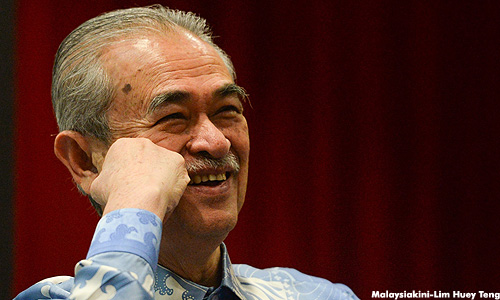

Despite pressure, Pak Lah chose not to intervene in 2004 Anwar case
When he was the prime minister, Abdullah Ahmad Badawi chose not to intervene in PKR de facto leader Anwar Ibrahim's appeal against his sodomy conviction in 2004, despite pressure from various parties for Abdullah to do so.
Abdullah also agreed to fast-track the issue of Anwar's passport upon his release so he can seek medical treatment abroad, and sent son-in-law Khairy Jamaluddin as an emissary to inform Anwar's family of this decision.
When he was the prime minister, Abdullah Ahmad Badawi chose not to intervene in PKR de facto leader Anwar Ibrahim's appeal against his sodomy conviction in 2004, despite pressure from various parties to do so.
Abdullah also agreed to fast-track the issuance of Anwar's passport upon his release so he could seek medical treatment abroad, and sent son-in-law Khairy Jamaluddin as an emissary to inform Anwar's family of this decision.
"As a Muslim I am answerable to Allah. My job as chief executive does not give me the right to interfere with the judiciary," he was quoted as saying by former New Straits Times Press deputy chairperson Kalimullah Hassan.
Kalimullah told this to journalist Wong Sulong, who penned Abdullah's authorised biography, launched yesterday.
Wong wrote that Abdullah's rise was inextricably linked to Anwar's downfall in 1998, where Anwar had "miscalculated and lost", resulting in his sacking as deputy prime minister in 1998.
Abdullah said he was "shocked" to hear the news of the sacking in 1998 and made a phone call to then PM Dr Mahathir Mohamad from New York, where the latter was attending a United Nations session.
"After hearing Mahathir's explanations, Abdullah told the prime minister that he was satisfied with his explanations and that Mahathir would have his support," the biography reads.
In 2004, when Anwar's appeal was up at the Federal Court, Kalimullah and Abdullah's son-in-law Khairy were approached by a number of businessmen and politicians urging the PM to intervene in the case.
Similarly, special adviser to the PM Annuar Zaini said he was approached by businessmen and politicians on the same issue but Abdullah would not budge when relayed the message.
Kalimullah said he and Khairy told Abdullah that an intervention would strengthen the belief that the executive meddled in the judiciary.
Abdullah then replied that he was glad the duo thought so because he had already decided not to intervene.
"If (the judges') decision is to free Anwar, then I have to respect and accept it. If they made a biased decision by discounting the evidence, then in the Afterlife they are answerable to God.
"Likewise, if I interfere in their decision, then I have to answer to make my Maker. I am not willing to take that onerous burden upon myself," Kalimullah quoted Abdullah as saying.
Following the verdict, Khairy was sent to Anwar's home to tell Anwar the government will expedite his application for a passport but he will need to apply for it immediately.
Two weeks before that, Anwar's wife Dr Wan Azizah Wan Ismail met with Abdulllah to plead for her husband's release so he could seek urgent treatment in Germany.
Pak Lah trusted editors
The PM had on the day of the verdict also met with then deputy prime minister Najib Abdul Razak, then education minister Hishamuddin Hussein, then Home Ministry secretary-general Aseh Che Mat and then inspector-general of police Bakri Omar to discuss whether newspapers would be allowed to run the verdict on its front pages.
The verdict was on the front page of the two leading English newspapers, The Star and The New Straits Times, which also published the judgment in full.
"By and large, Abdullah trusted the good sense of the editors of the mainstream media and allowed much leeway to the media in highlighting weaknesses in his administration.
"The only subjects that Abdullah would not tolerate were newspapers playing up racial and religious issues, as evidenced by the actions he took against editors and newspapers which violated this principles," Wong wrote.
Among advances cited in the biography was an invitation for Malaysiakini editor Steven Gan to attend Abdullah's Hari Raya open house and providing Information Ministry accreditation to Malaysiakini's journalists.
However, the online media remained suspicious of the Abdullah administration over threats to take action using the Sedition Act 1948 and the Internal Security Act 1960 against the media, the biography read.
Sin Chew Daily journalist Tan Hoon Cheng, blogger Raja Petra Kamaruddin and Seputeh MP Teresa Kok were arrested under the Internal Security Act during Abdullah's tenure.
The arrests were, however, blamed on then home minister Syed Hamid Albar.
It led to Zaid Ibrahim's resignation as de facto law minister.
"Zaid's resignation came at a time when a city society was beginning to warm up to him.
"But it appeared too that Pak Lah was no longer the person in charge of his own cabinet, or for that matter, his own fate," lawyer Edmund Bon was quoted as saying.


Are you sure you want to delete this comment?
This action cannot be undone.