



Wading into the S'gor-Negri Sembilan water standoff
KINIGUIDE Water disruptions are an inconvenient but frequent occurrence for residents in parts of Selangor, sometimes lasting for days and causing long, angry queues to collect water from lorries.
However, things took on an unusual geopolitical twist last week when pollution that allegedly originated from Negri Sembilan entered Selangor’s raw water supply.
Although the supply has now been restored, we revisit the issue in this edition of KiniGuide for a closer look at what happened.
How did the problem start?
The disruption was caused by the closure of the Sungai Langat water treatment plant after odour pollution was detected at 7.30am on Oct 23 in its raw water intake.
Since then, the plant had operated intermittently while authorities waited for the pollution to clear. It was shut down at least five times over the past week, but the problem of pollution persisted.
KINIGUIDE Water disruptions are an inconvenient but frequent occurrence for residents in parts of Selangor, sometimes lasting for days and causing long, angry queues to collect water from lorries.
However, things took on an unusual geopolitical twist last week when pollution that allegedly originated from Negri Sembilan entered Selangor’s raw water supply.
Although the supply has now been restored, we revisit the issue in this edition of KiniGuide for a closer look at what happened.
How did the problem start?
The disruption was caused by the closure of the Sungai Langat water treatment plant after odour pollution was detected at 7.30am on Oct 23 in its raw water intake.
Since then, the plant had operated intermittently while authorities waited for the pollution to clear. It was shut down at least five times over the past week, but the problem of pollution persisted.
The Semenyih water treatment plant was not fully operational until 3.15am on Oct 29, while water supply was not fully restored until Oct 31.
How many people were affected?
Reports varied on whether there were 1.6 million or 1.8 million people affected. These were in parts of the Hulu Langat, Kuala Langat, Sepang and Petaling districts.
To make matters worse, the disruptions coincided with the preparations and celebrations for Deepavali that fell on Oct 29.
The Semenyih water treatment plant produces 685 million litres of treated water per day (MLD), out of Selangor’s total capacity of 4,675 MLD. However, the state has no reserve capacity to make up for the 14.5 percent shortfall.
What was in the water?
Selangor authorities traced the source of the pollution to soil contaminated with 4-bromodiphenyl ether at a site in Nilai, near Kilometre 45.9 of the Elite Highway where signs of grass with chemical burns could be seen.
Earlier reports naming other chemicals - such as octabromodiphenyl ether - were erroneous.
These supposedly got washed into Sungai Buah, and then flowed 4.7 kilometres downstream to enter Sungai Semenyih. The Semenyih water treatment plant is a further 3.2 kilometres downstream from the confluence of the two rivers.
The chemical had a distinct odour that was often described as "diesel-like", and was considered harmful and potentially fatal if swallowed or inhaled, as well as toxic to aquatic life.
Little is known about 4-bromodiphenyl ether, however, including its level of toxicity and effects on human health.
Broadly speaking, 4-bromodiphenyl ether belongs to a class of chemicals called "brominated flame retardants".
These are often added to foam, plastic, upholstery, and other materials to prevent or delay it from catching fire, hence buying time for people to escape a burning building.
What did the Selangor government do?
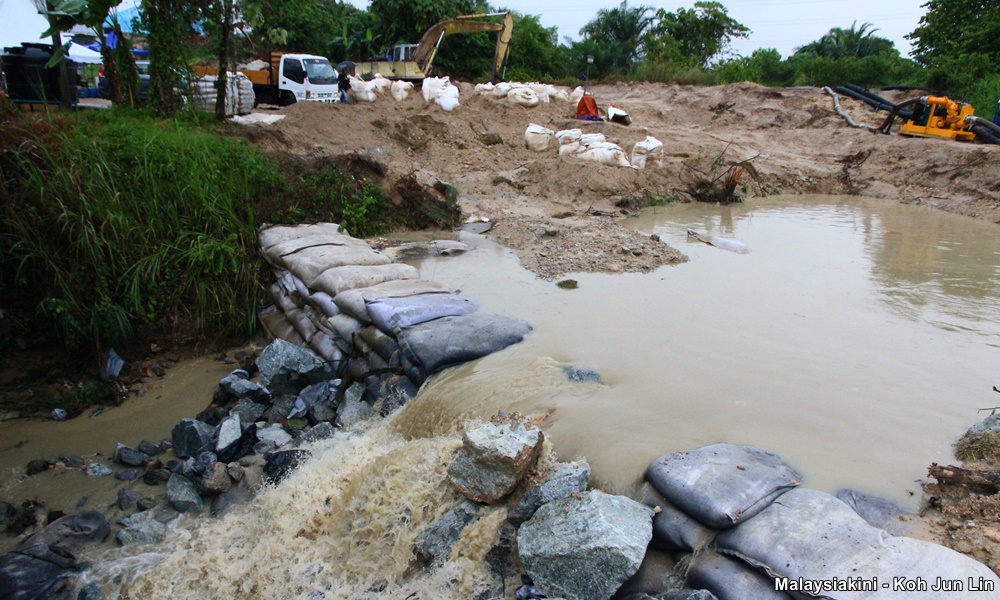
Since Oct 27, the Selangor government began building bunds at the confluence between Sungai Buah and Sungai Semenyih, in part to divert the water into a nearby pond for treatment, and in part to facilitate monitoring and treatment of the water.
On the following day however, the first of the three bunds overflowed amid heavy rain while the other two were not yet ready, forcing another closure of the water treatment plant.
In the meantime, the Selangor government also experimented with ways to reduce the odour pollution – diluting the polluted water did not work and heating it did not break it down. However, activated carbon did the trick.
Thus, 10 tonnes of activated carbon were used to treat the water at the confluence on Oct 29, and another 10 tonnes were used to treat the contaminated site in Nilai. This enabled the Semenyih water treatment plant to keep running even when the bunds overflowed again that day.
However, Selangor exco member Elizabeth Wong told reporters on Oct 30 that this had depleted all activated carbon stocks in the state and the method was not sustainable. She urged Negri Sembilan to clean up the contaminated site.
In addition to these mitigation works, Selangor also said it had turned over samples and findings from its investigations to its Negri Sembilan counterparts and the police.
What did the Negri Sembilan government do?
Amongst the Negri Sembilan authorities involved in investigating the pollution were its State Water Regulatory Authority (BKSA) and Nilai Municipal Council, alongside the federal government’s Department of Environment, Drainage and Irrigation Department and Forestry Department.
Against Selangor’s accusations of apathy towards its plight, Negri Sembilan Menteri Besar Mohamad Hasan had denied doing nothing about the pollution.
"Claims saying that the Negri Sembilan government is not cooperating or does not care, these claims are untrue," Mohamad said.
"We have never put political differences above the interest of the public," he is reported as saying by Malay Mail Online on Oct 31.
The report quoted him saying that the Negri Sembilan Department of Environment and other departments were investigating the matter, but the report made no mention of a clean-up operation.
Another report by The Star on Oct 24 said BKSA officers were on the ground to assist in cleaning up the site. This was before Selangor stepped in to treat the site with activated carbon.
What did the federal government do?
The Department of Environment has formed a joint taskforce with the Selangor government to investigate the pollution.
The National Water Services Commission is also assisting.
How did the pollution originate?
Negri Sembilan Environment Department had studied the possibility that the pollution originated from an overturned lorry at Kilometre 46.2 of the Elite Highway, according to Malay Mail.
However, Selangor Water Management Lab’s water quality chief Abdul Karim Endut told reporters on Oct 30 that this was not the case.
He said while the accident indeed took place, this was at another part of the Elite Highway and the lorry involved was not carrying 4-bromodiphenyl ether.
What about the allegations of sabotage?
At the onset of the crisis, Selangor Menteri Besar Mohd Azmin Ali had claimed that there is "strong evidence" of sabotage by Umno and BN to undermine the Selangor government.
He did not disclose any evidence to back his claim, which had since been echoed by several Pakatan Harapan elected representatives. However, he said the Selangor Water Management Authority (Luas) had lodged a police report over the matter.
Natural Resources and Environment Minister Wan Junaidi Tuanku Jaafar said investigations had not found any evidence of sabotage so far, but stopped short of ruling out the possibility.
The Semenyih water treatment plant shutdown due to pollution since Oct 23 was the latest such case in recent months.
On Oct 7, the Langat and Cheras water treatment plants were shut down after odour pollution was detected. This was believed to have originated from Bentong, which was then washed down the Semantan River into Selangor.
The Semenyih water treatment plant was also shut down on Sept 22, following odour pollution that was later traced to illegal factories in Selangor that occupied the river banks.
This instalment of KiniGuide was compiled by Koh Jun Lin.


Are you sure you want to delete this comment?
This action cannot be undone.