




TI: Apply recommendations to all public sectors
Transparency International-Malaysian Chapter (TI) today called for the recommendations contained in the police commission's report to be applied to all other public sectors as well.
Transparency International-Malaysian Chapter (TI) today called for the recommendations contained in the police commission's report to be applied to all other public sectors as well.
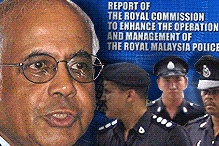 "This report must be taken as a beginning to address allegations of corruption, delays, inefficiencies and selective investigations and prosecutions in other enforcement agencies under the various ministries, including the customs, road transport, immigration and health," said TI-president Param Cumaraswamy in a statement.
He was commenting on the 125 recommendations compiled in the 607-page Report of the Royal Commission to Enhance the Operation and Management of the Royal Malaysian Police that took 18 months to complete.
The report was made available to the public on Monday. It was drawn up by a team of commissioners led by former chief justice Mohd Dzaiddin Abdullah, following extensive gathering of feedback on the state of police operations.
"The recommendation for improved and rigorous implementation of the declaration of assets management should be enforced uniformly in all other sectors of the public service.
"It should begin with all those holding leadership positions in the public service so as to set a trend of leadership by example," urged Param.
Whistleblowers Act
As for the commission's encouragement for whistle-blowing in relation to corruption cases, he said it fell short of a recommendation to enact a Protection of Whistleblowers legislation which is needed urgently in the country.
Although he welcomed the commission's call to repeal or review several restrictive laws such as the Internal Security Act (ISA) and Emergency (Public Order and Prevention of Crime) Ordinance 1969, Param noted that the commission failed to address two serious obstacles for compliance with human rights law generally in the country.
"In recommending the repeal of the Emergency (Public Order and Prevention of Crime) Ordinance 1969, the commission should have addressed whether there is still a need to continue with these proclamations and should have recommended revocation," he said.
The second obstacle, was that the commission should have recommended that the government ratify and implement of the Covenant on Civil and Political Rights and incorporating those provisions in the domestic law.
The Restricted Residence Act 1933, the Emergency (Public Order and Prevention of Crime) Ordinance 1969 were called for repeal.
Dealing with children
 Meanwhile, the Malaysian Bar president Yeo Yang Poh said he supported the commission's recommendations for awareness and observance of women and children's rights in the police force.
However, he suggested that all laws relating to the rights of the child should be reviewed.
He also emphasised that police personnel should be fully trained to deal with cases involving children.
"What is shortcoming so far is the training among personnel. It's the mindset that impedes the implementation of the Act," he said when contacted today.
Citing an example, he said a different approach should be adopted when questioning children during investigation. "This is a technique that our force should climb up to date."
He highlighted that both men and women police personnel should be able to deal cases of domestic violence tactfully and not regard them as personal matters which need to be deal at home.
Yeo also supported the setting up of the proposed Independent Police Complaints and Misconduct Commission under an Act of Parliament.
He said the independent body should be made answerable to Parliament and be required by law to submit either a quarterly or half-yearly report to the Parliament.


