




Police Commissions report: Dialogue sought with IGP
Opposition parties and non-governmental organisations are seeking a dialogue with Inspector-General of Police Mohd Bakri Omar to discuss the findings of the Royal police commission.
Opposition parties and non-governmental organisations are seeking a dialogue with Inspector-General of Police Mohd Bakri Omar to discuss the findings of the Royal police commission.
This was concluded at a roundtable conference organised by DAP at the Parliament building today. Among those who attended the discussion titled 'Police reforms - who guards the guardians?' were DAP secretary-general Lim Guan Eng, party parliamentarians Teresa Kok and Tan Seng Giaw as well as Parti Keadilan Rakyat (PKR) information chief Tian Chua.
Also present were representatives from human rights groups, women's groups and Malaysian Trades Union Congress (MTUC) assistant secretary K Somasundram.
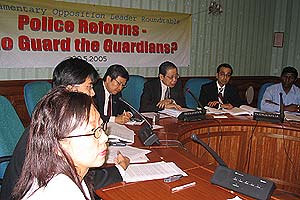 Opposition Leader Lim Kit Siang, who chaired the discussion, called for a single-minded commitment to fully implement the
125 recommendations
in the report according to its time-frame as the recommendations 'represent the most serious, creditable and far-reaching police reforms in the nation's history'.
Opposition Leader Lim Kit Siang, who chaired the discussion, called for a single-minded commitment to fully implement the
125 recommendations
in the report according to its time-frame as the recommendations 'represent the most serious, creditable and far-reaching police reforms in the nation's history'.
The veteran politician also took the mainstream media to task for allegedly 'calculating the news emphasis to reduce the high public expectation that significant reforms would ensue from the report'.
'People, not state friendly'
Lim, who is Ipoh Timor MP, criticised Prime Minister Abdullah Ahmad Badawi's decision not to set up any similar commissions to improve other agencies.
He said this ran contrary to the premier's decision to bring about civil service reforms.
The commission unveiled its 607-page report to the public on Monday. It was drawn-up by a team of commissioners, headed by former chief justice Mohamed Dzaidding Abdullah, after collecting feedback from the public over a period of 18 months.
The report highlighted the existence of widespread corruption in the force, instances of abuse of power, among many other shortcomings. It also made recommendations on how to improve the situation.
Meanwhile, Guan Eng said the current concept of the police force serving the state should be changed to the force serving the people.
This, he added, will encourage the police to be more 'people-friendly'.
Although he welcomed the commission's recommendations to employ more non-Malays into the force, he said it is important to create an equal cultural value in the force.
 National Human Rights Society (Hakam) vice-president Malik Imtiaz Sarwar said it is not only essential that the public obtain a full transmission of the report, police personnel should also receive it in order to realise what is expected of them.
Police watch and human rights committee chairperson R N Rajah said the report failed to outline the role of the proposed Independent Police Complaints and Misconduct Commission (IPCMC).
He said the independent body should have the "powers to execute, and not just be a data collector or a monitoring agency."
The conference also agreed to form a coalition to disseminate information on the report to the public.
Time for positive change
Breaking his silence yesterday, the inspector-general of police issued a stern warning to corrupt policemen to turn over a new leaf or face the consequences.
 Mohd Bakri, who is attending a conference in Bali, Indonesia, said the time has come for police personnel to undergo a positive change in line with the noble aspirations of the people and government.
"I want to see a clear and positive change, and my officers and men have no choice but to realise that objective," he was quoted as saying by Bernama.
He said that since his appointment as the inspector general of police, he had taken action against many of his officers and men for indiscipline, poor performance and corruption.
On the reference of the report to a senior police officer who had declared RM34 million worth of assets, Mohd Bakri said he would look into the matter upon his return to Malaysia.
He also said that several of the 125 recommendations of the commission had been implemented even before the report was brought out.
"We had already implemented about 10 of the recommendations even before the report was out, and with some fine-tuning we can carry out 20 more soon," he said.
Mohd Bakri said several of the recommendations would have to be looked at in depth or would take time to be implemented because it involved further discussions with others.


Are you sure you want to delete this comment?
This action cannot be undone.