


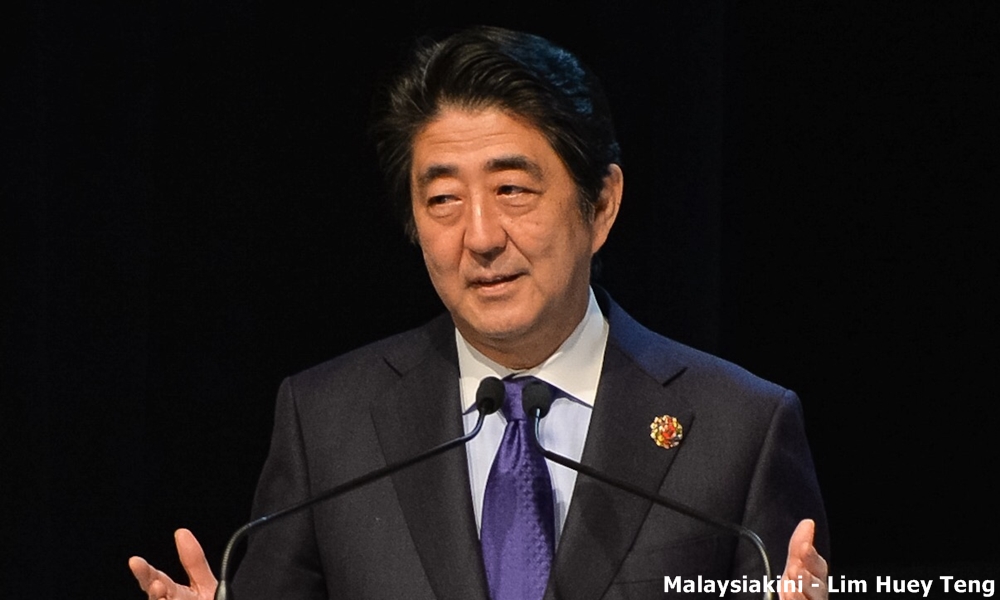

Japan, US seal bonds during Abe's symbolic visit to Pearl Harbor
US President Barack Obama and Japanese Prime Minister Shinzo Abe yesterday honoured the victims of Japan's surprise attack on Pearl Harbor 75 years ago at a solemn ceremony that they also used to rededicate the alliance between their two countries.
The historic visit by Abe to Hawaii included speeches by both leaders at a memorial dedicated to the more than 1,100 sailors who died on the USS Arizona, marking a further step in the reconciliation process between the two wartime enemies.
"I offer my sincere and everlasting condolences to the souls of those who lost their lives here" and to all who lost their lives in World War II, Abe said.
Abe did not apologise for the attack, which on Dec 7 this year marked its 75th anniversary.
Nor did he speak of the "deep repentance in my heart" that he included in a speech delivered to the US Congress in April last year.
In Honolulu, however, he made some poignant remarks, saying that in the serenity of the venue, he could almost hear the voices of the crewmen on the Arizona talking to each other about their futures and dreams.
"All of that was brought to an end. When I contemplate that solemn reality, I am rendered entirely speechless. Rest in peace, precious souls of the fallen," he said, speaking through a translator.
Obama praised the friendship between the US and Japan, saying it had never been stronger. It had made both nations more successful, prevented another world war and lifted people out of extreme poverty, he said.
"It is here that we remember that even when hatred burns hottest, even when the tug of tribalism is at its most primal, we must resist the urge to turn inward," Obama said.
The alliance between the US and Japan is bound by shared interests and "stands as the cornerstone of peace and stability in the Asia Pacific, and a force for progress around the globe," he said.
Obama and Abe spoke before a small gathering at the memorial, which included some veterans who defended the US naval base when Japan attacked. Both made references to individual soldiers who were recognised for exceptional valour during the battle.
The two leaders laid wreaths made of peace lilies in the shrine room at the memorial, which bears the names of American service members killed in the attacks on a wall.
They also dropped purple flowers into the water from the edge of the memorial, a large white structure suspended over water above the sunken remains of the Arizona, which was destroyed during the battle.
The surprise air attack killed 2,403 Americans and led to the United States entering World War II.
Although Abe's visit is not the first by a Japanese leader to Pearl Harbor, it is the first to include ceremonies and speeches together with a sitting US president.
Abe arrived on Monday in Hawaii, where Obama spent a portion of his childhood and where he and his family are spending the Christmas holiday.
Abe's journey follows Obama's visit in May to Hiroshima, Japan, where US forces dropped a nuclear bomb at the end of the war. Obama did not apologise for the decision, ordered by US president Harry Truman in 1945, either.
The last visits to Pearl Harbor by Japanese prime ministers were in the 1950s, the Japanese government confirmed.
Some critics say Pearl Harbor is far from being comparable to Hiroshima.
"It's a naval base," said Haruko Moritaki, a leader of the Hiroshima Alliance Nuclear Weapons Abolition.
Abe, who has long been criticised for pushing a whitewashing of Japan's wartime aggression, should visit victimized countries in Asia, said Moritaki, who has visited places like Nanjing in China, where experts say the Imperial Japanese Army killed between 100,000 and 200,000 people in 1937.
"He should visit Nanjing," she said.
- dpa


