




Aid not reaching those in need in Aceh, says tsunami survivor
There has been an outpouring of aid to tsunami victims, including those in the devastated Indonesian province of Aceh. But is it reaching those in need?
There has been an outpouring of aid to tsunami victims, including those in the devastated Indonesian province of Aceh. But is it reaching those in need?
According to one survivor of last December's catastrophe , the situation on the ground leaves much to be desired.
Wishing only to be known as Ismail, the Acehnese had travelled to Malaysia to 'tell the world' about the victims in his hometown, who have yet to receive sufficient aid.
Speaking at a press conference in Kuala Lumpur today, he said a majority of the 1,800 displaced people in his temporary camp do not get enough food and health care while children are deprived of proper education.
"My task is to tell the world the truth. Some of the people in my camp chipped in money to get me here to try and bring back help," he said with the help of a translator.
"International aid supplies from organisations under the United Nations have not been distributed enough and when it is given, it is not divided fairly," he added.
 He said in his camp, each family - regardless of size - is given a monthly ration comprising a sack of rice, a box of instant noodles (about 40 packets) and seven ounces of cooking oil.
They are not given any other food supplies apart from these, claimed the father of five, who lost a child to the killer waves.
'Direct aid was better'
Among reasons contributing to the situation - particularly in his camp Jantho and a few other camps where he has friends - is that the distribution process is controlled by the government and left to the whims of a 'camp head' - usually a village head from the destructed areas.
"It was much better when aid was given directly by relief organisations," he said, adding there is corruption and nepotism among authorities in these areas, especially in distribution of money.
Asked if he was fearful of exposing this information, Ismail said he must as it was something he was entrusted to do.
However, he said that adverse repercussions for this were real and cited examples of 'disappearances' in the camps.
Contacted later, the Indonesian embassy in Kuala Lumpur said its aid distribution in Aceh is under the supervision of the Ministry of Welfare - which operates from both in Aceh and administration-hub Jakarta.
"The aid distributor is organised in a proper manner. I cannot confirm his (Ismail's) claims. He needs to contact us in order for us to check," said the mission's First Secretary of Information Eka Suripto.
Eka said he was unsure of the exact rations but noted that a bag of rice in Indonesia is normally around 50kg and can feed a family of three.
He also could not confirm if perishable food supplies were given to victims by the local government.
"For the time being, the distribution and reconstruction planning is moving on. There may be some delays but it is going on," the diplomat clarifed
Many international relief organisations were ' encouraged ' to leave the strife-torn province in March.
Give jobs to victims
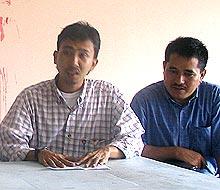 Meanwhile, two Indonesian students studying in Malaysia, who accompanied Ismail, told the press conference that there is a dire need for international intervention into the on-goings in the province.
"There is a need for proper education facilities for children at the camps. They are now being taught by people in the camps itself.
"They are not getting any formal education. There are also problems faced by widows and young graduates," said one of them, who identified himself only as Alfian ( photo, left ).
Seeking work and earning a living was close to impossible in the land which saw its extended structural devastation matched only by the amount of lives lost, numbering around 170,000.
The students encouraged Malaysia and other neighbouring countries to open its doors and provide able-bodied tsunami victims from Aceh employment opportunities.


