



PKR displays savvy but not nearly enough
COMMENT | PKR is being politically astute on one fraught issue and less so in another.
The party's political bureau has backed Menteri Besar Azmin Ali's decision to opt for maintaining stability in Selangor by not dropping three PAS executive councilors in the state government.
This despite the decision of the PAS muktamar in late April to cut ties to PKR, which move was endorsed by the Islamist party's highest decision making body, the syura council, on May 11.
The PAS operatives in the Selangor state government should properly quit their posts but they haven't.
That's just as well. This indicates that not all the PAS cohort in Selangor agree with the party's decision to cut ties to PKR.
That much was quite clear from the very beginnings of the rumbles in PAS signalling disgruntlement with the state of its relations with PKR.
The grousing has been there since the time PAS severed relations with DAP in June, 2015. But there were signs the discontent was not a majority view within the party.
Factions in the party, especially in its Selangor chapter, were not convinced its ties to PKR, though strained by the closeness of PKR's links to the abominated DAP and later, with PAS outcasts Amanah, had reached crisis point.
Clearly, PAS' cohabitation with PKR and DAP in the state government since 2008 has had the effect of inuring their Selangor operatives to the privileges and perquisites that come from wielding power.
Abrupt abandonment of these advantages is something that comes easy, especially when intra-coalition relations at the state level are not vexing to PAS.
Thus PKR is being astute to ignore the hostility PAS evinces at them at the corporate level while maintaining can-do ties with the party at Selangor state level.
The move is calcuated to exploit the sentiment of the PAS grassroots that may not be agreeable with the party's upper-echelon-initiated move to collaborate with Umno, the latter having long been regarded as the Islamist's party chief adversary.
Thus, though the decision not to drop the Selangor PAS operatives from government is ackward as logic, it is savvy as strategy to keep PAS diehards from thoroughly spurning the opposition at the coming general election (GE14)...
COMMENT | PKR is being politically astute on one fraught issue and less so in another.
The party's political bureau has backed Menteri Besar Azmin Ali's decision to opt for maintaining stability in Selangor by not dropping three PAS executive councillors in the state government.
This despite the decision of the PAS muktamar in late April to cut ties with PKR, which move was endorsed by the Islamist party's highest decision making body, the syura council, on May 11.
The PAS operatives in the Selangor state government should properly quit their posts but they haven't.
That's just as well. This indicates that not all the PAS cohort in Selangor agree with the party's decision to cut ties with PKR.
That much was quite clear from the very beginnings of the rumbles in PAS signalling disgruntlement with the state of its relations with PKR.
The grousing has been there since the time PAS severed relations with DAP in June, 2015. But there were signs the discontent was not a majority view within the party.
Factions in the party, especially in its Selangor chapter, were not convinced its ties with PKR, though strained by the closeness of PKR's links to the abominated DAP and later, with PAS outcasts Amanah, had reached crisis point.
Clearly, PAS' cohabitation with PKR and DAP in the state government since 2008 has had the effect of inuring their Selangor operatives to the privileges and perquisites that come from wielding power.
Abrupt abandonment of these advantages is something that comes easy, especially when intra-coalition relations at the state level are not vexing to PAS.
Thus PKR is being astute to ignore the hostility PAS evinces at them at the corporate level while maintaining can-do ties with the party at Selangor state level.
The move is calculated to exploit the sentiment of the PAS grassroots that may not be agreeable with the party's upper-echelon-initiated move to collaborate with Umno, the latter having long been regarded as the Islamist party's chief adversary.
Thus, though the decision not to drop the Selangor PAS operatives from government is awkward as logic, it is savvy as strategy to keep PAS diehards from thoroughly spurning the opposition at the coming general election (GE14).
Credit to PKR for thinking constructively amid constraints imposed by PAS' hostility towards it at the corporate level.
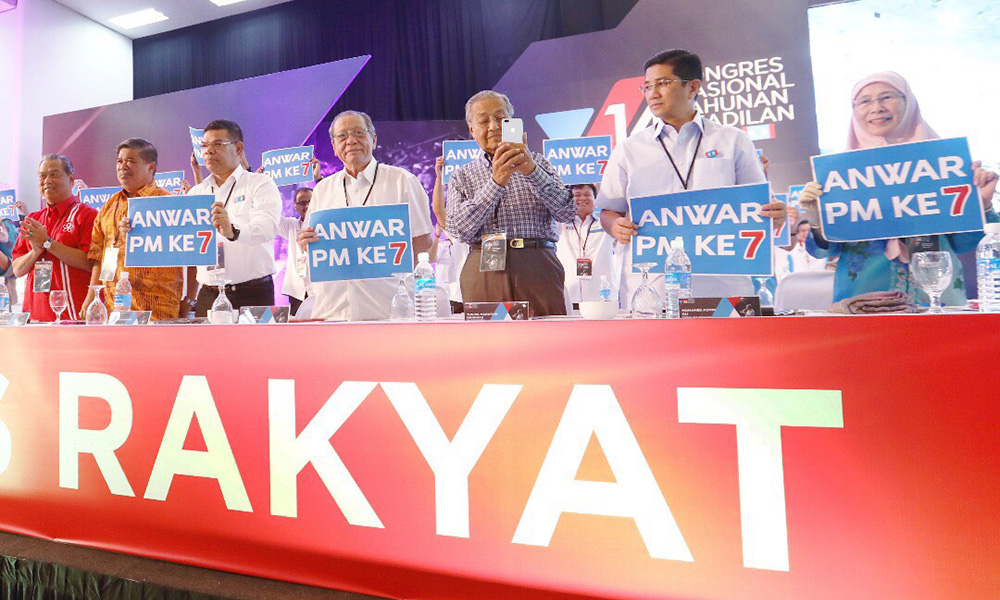
Would that such creativity influence PKR's thinking on the issue of who is to be PM-designate of the opposition coalition under which PKR, DAP, Amanah and Bersatu are to gearing to fight BN in GE14.
However, by pushing for their jailed de facto leader Anwar Ibrahim to be the coalition's PM-designate, PKR is opting for premature foreclosure of a subject that's best left to the pros and cons of what should be continuing debate of a fluid question.
Dr M has become the man of destiny
The core issue of the GE14 is the legitimacy of Najib Abdul Razak as PM of Malaysia which is tied to the veracity of a critique of that legitimacy deployed by the former premier, Dr Mahathir Mohamad.
Seen in that light, Mahathir should be the opposition's PM-designate, notwithstanding it was Mahathir's policies and actions during his long premiership that has engendered the Najib fistula, and regardless of the advanced age of Mahathir himself.
The former PM has become the man of destiny of Malaysian politics, the person who shapes events for good or for ill. By seeking to remove Najib, Mahathir is intrinsically admitting he had been wrong, though his subscription to Machiavellian political craft precludes admission of wrongdoing.
By making common cause with the rest of the opposition to remove Najib, he is being pragmatic about what it would take to make a success of the campaign for removal.
PKR should match that pragmatism with political savvy of its own, recognising that what votes Mahathir can bring to the opposition's cause are votes - disgruntled with Najib but not necessarily gravitating to the opposition - Anwar is unable to attract.
PKR should wager that Mahathir can lure those votes away from Umno.
Also, in the event of a cliffhanger on the Peninsula between BN and the opposition, a proffer can and should be made to a BN component party from Sarawak to shift its MPs to the opposition.
Such a proffer could be accompanied with the offer of the PM's post to that party. This is not so much opportunistic hawking of the position as exigent facing-up to the necessity for removal of the Najib fistula.
Where is the danger in such an offer if an agreed manifesto forms the basis of governance in the event of a opposition takeover?
Who can say that such an offer is unpalatable should Act 355 come to a vote in the next parliamentary session beginning in late July and it transpires that most MPs from Sarawak and Sabah have voted against it and several Muslim ones on the Peninsula have joined in the 'Nays'?
The political waters are roiling enough to eventuate in outcomes at once intriguing and improvisatory.
TERENCE NETTO has been a journalist for more than four decades. A sobering discovery has been that those who protest the loudest tend to replicate the faults they revile in others.
The views expressed here are those of the author/contributor and do not necessarily represent the views of Malaysiakini.


