




Haze-hit Port Klang plunged into twilight
Malaysia's west coast was plunged into twilight on Thursday as thick yellow clouds of smoke from Indonesian forest fires rolled in from the sea, engulfing ports and villages.
Malaysia's west coast was plunged into twilight on Thursday as thick yellow clouds of smoke from Indonesian forest fires rolled in from the sea, engulfing ports and villages.
One of the worst-hit areas is Port Klang, a sprawling industrial town packed with factories and offices arrayed around a large harbour full of container ships, fishing boats and ferries plying routes to Indonesia.
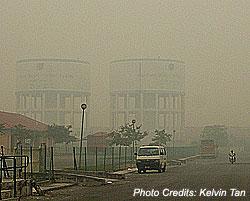 The normally bustling centre was rendered a ghost town by the fallout from hundreds of blazes raging on Indonesia's Sumatra island, which is separated from Malaysia by the narrow Malacca Straits.
Port operations ground to a halt for two hours and the National Security Council said the area had entered a state of emergency.
Fatimah Talib, a 50-year-old tea shop owner, rubbed her itchy eyes as she looked at the handful of customers sitting coughing at their tables which faced onto the street.
"The authorities should take action, this is an annual event," she said, referring to the annual burn-off by Indonesian farmers which wreaked even worse havoc in 1997 and 1998.
"I'm seeing fewer customers, people are staying indoors and ships have been delayed for up to two days because of the haze. It's very quiet now, it's almost like a ghost town," she said.
Many citizens were attempting to go about their daily business, turning up at their offices and keeping shops and cafes open.
Hazardous conditions
Haryati Abu, 36, complained of headaches, sinus pressure and sore eyes but said she was still cycling to work each day despite the hazardous conditions.
"It's very dangerous because I can't see vehicles in front and motorists can't see me. The haze is really bad in the morning," she said.
Paper masks are hard to obtain, and many women resorted to pulling their Muslim headscarves across their faces to try to protect themselves from the haze which has caused rates of asthma and respiratory conditions to rise.
As cars and motorcycles attempted to negotiate the gloom, with visibility down to just 200 metres, a local university distributed reflective stickers to stop vehicles bumping into each other.
The southwest monsoons are blowing the smoke and dust squarely into Malaysia's central west coast and inland to the capital Kuala Lumpur, while leaving most of the rest of the country relatively clear.
The environment department said Thursday that the air pollution index had increased dramatically, with Port Klang recording 529 and the coastal town of Kuala Selangor reaching 531. An API above 300 is considered hazardous.
In Kuala Lumpur the index reached 321, shrouding the city in a yellowish mist and hiding the tops of the Petronas Towers, the world's second tallest building.
Coughing tourist
Bemused tourists wandered through the smoke, which also billowed into hotel lobbies and shopping centres.
"We only arrived here this morning and already my daughter has started coughing a lot," said Briton Lyn Metcalfe who was on a one-day visit to Kuala Lumpur with her daughter Harriet, 17.
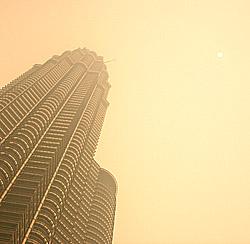 "We went up to the Petronas Towers but we couldn't see very much - even in the hotel corridors you can smell the smoke," she said.
Abdullah Hali, 50, a businessman who puffed on a cigar as he sat in a city cafe, initially made light of the situation. "Maybe it's a good thing because it will get rid of all the mosquitoes," he joked.
But turning serious, he said the government and other Asian countries had to tackle the problem.
"There's nothing they can do to stop the wind. Unless there is cooperation from Asian countries to help the Indonesians to find a new way of farming."


