
Women-only electoral seats: A solution to gender gap in policy making?
The creation of women-only seats in legislative bodies is perhaps one way Malaysia can address the gender imbalance in law and policy making.
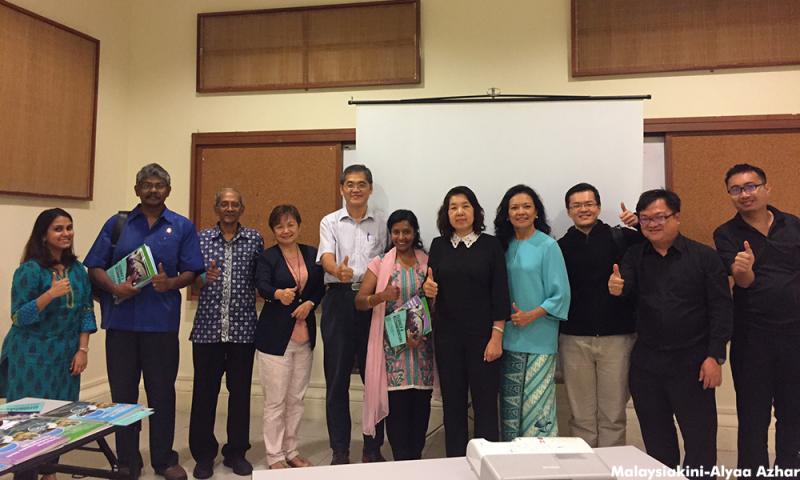
This was stated during a briefing on Monday that discussed the "Women-only additional seat" (Woas) proposal.
Penang Women's Development Corporation (PWDC) programme manager Selva Vathany Kanapathi Pillai said the proposal has merit because Malaysia is now ranked 106 among 144 countries in World Economic Forum's Global Gender Gap index.
The biggest inequality exists in terms of women's political empowerment, Selva Vathany said...
The creation of women-only seats in legislative bodies is perhaps one way Malaysia can address the gender imbalance in law and policy making.
This was stated during a briefing on Monday that discussed the "Women-only additional seat" (Woas) proposal.
Penang Women's Development Corporation (PWDC) programme manager Selva Vathany Kanapathi Pillai said the proposal has merit because Malaysia is now ranked 106 among 144 countries in the World Economic Forum's Global Gender Gap index.
The biggest inequality exists in terms of women's political empowerment, Selva Vathany said.
But how would Woas fit in with Malaysia's electoral system? According to Penang Institute fellow Wong Chin Huat (photo), it cannot, unless the first-past-the-post (FPTP) and single-member constituency features are jettisoned altogether.
This was because Woas would be more suitable for a party-list proportional representation system, where seats involve multi-member constituencies that are large in size and may at times be "non-constituencies".
"This is where an entire political unit becomes one single constituency, like in the Netherlands and Israel. Then, it becomes a non-constituency.
"This would address issues of redelineation and you won't have the Election Commission (EC) drawing up boundaries," Wong pointed out.
Hybrid ballot system
Under the party-list proportional representation system, parties nominate lists consisting of candidates and voters, in turn, will vote for parties as opposed to individuals.
Admitting that this might be a far-fetched idea for Malaysia, Wong proposed a mixture of the FPTP and party-list system.
"Voters will have two ballots - one constituency ballot for FPTP MPs and a party ballot for list MPs."
Under the party-list system, women or minorities under-represented can be mitigated, he added.
Although multi-member constituencies and two ballots require amending Article 116 and 117 of the Federal Constitution, Wong pointed out how Article 117 is silent on "nominated members".
He cited the decision of the Sabah state government which had, in 1985, appointed six nominated members, besides the 73 elected members.
"(Non-BN controlled states such as) Penang and Selangor can likewise amend the state constitutions," Wong added.
Downside - an even bigger Parliament
Additional seats under the party-list system are allocated based on vote share after the parties' votes are aggregated.
"If it's 100 percent gender quota for women, then it's women-only additional seats, otherwise, they are just non-constituency seats."
When it was pointed out to him that Parliament would, therefore, be bloated as a result of the proposed system, Wong admitted that he does not support a large Parliament.
"But it's a lesser evil for an electoral change. I concede size is an issue, this is a trade with the devil."
He also acknowledged that the proposal could face opposition from women themselves.
"They see it as a token, that they are not bringing votes to the party and are getting a free ride.
"However, this should be a short-term measure. After that, we should have a mixed member majoritarian system that will have a semi-proportional outcome," Wong added.


Are you sure you want to delete this comment?
This action cannot be undone.