




Corruption frustrates efforts to halt Indonesian fires: activists
Corruption and law enforcement problems are frustrating efforts to bring to justice plantation companies accused of causing forest fires in Indonesia, environmentalists said today.
Corruption and law enforcement problems are frustrating efforts to bring to justice plantation companies accused of causing forest fires in Indonesia, environmentalists said today.
Environmentalists said big palm oil producers in Indonesia's Sumatra and Kalimantan had for years used the slash-and-burn method to clear land for their plantations but little action was taken by the government to stop the practice.
Many of the palm oil plantation firms are owned by businessmen from Malaysia, where anger has been mounting over the smothering haze caused by the forest fires in Indonesia.
Malaysia on Thursday declared a state of emergency in some areas as the air pollution index soared due to choking haze blown across the Malacca Strait from the fires on Sumatra island.
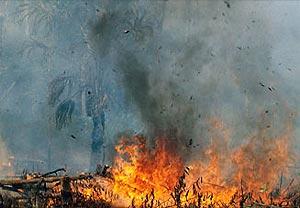 "Clearing land by burning is the cheapest method. They don't have to use heavy equipment or pay many workers to do the job," saud Farah Sofa, an activist with Walhi, Indonesia's leading environmental watchdog.
She said the method also increased the acidity of soil to make it more suitable for planting without the use of chemicals or other special treatments.
"These have become incentives for burning. But there is the problem of law enforcement," she said.
The 1999 law on forestry allows companies to use fires to clear land if they obtain a permit from local authorities. The problem is that permits are easy to obtain, Sofa said.
Walhi's investigation showed that 80 percent of forest fires originated from plantations, Sofa said.
The watchdog has sued 84 plantation companies for intentionally causing forest fires but courts threw out the charges, citing a lack of evidence, said Ruly Syumanda, the group's forest campaigner in Riau province on Sumatra.
"Corruption and collusion is rampant. It's become public knowledge and no longer a secret," he told AFP .
Small holders too
Forestry ministry spokesman Masyud said plantations were partly to blame but were not the only culprit.
"The plantations are partly to blame. We are trying to identify companies responsible for the fires. But they are not the only ones to blame. Local people have also engaged in clearing land using fires for farming," he told
"As far as companies are concerned, we are working harder to identify them and obviously legal action will be taken if there's evidence."
Asked about corruption, he said: "We haven't thought about that. We are trying to enforce law."
Police and prosecutors have often argued they could not do anything because they did not have evidence as to who carried out the burning, Syumanda said.
Syumanda said firms paid locals around 100,000 rupiah per hectare of land they burned.
In 2001 the government brought 12 plantation companies to court but only four were found guilty, with each fined between 80 million rupiah and 100 million rupiah and a Malaysian company manager was sentenced to two years' jail.
Annual hazard
The environmentalists also criticized the government for its handling of the fires and the choking haze they are causing.
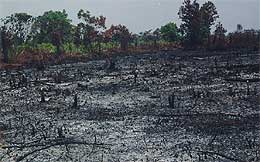 "It has become an annual hazard. The government should have learned from the 1997 haze crisis and taken steps to anticipate its recurrence but instead it is very slow and only took action after our neighbours," Sofa said.
In 1997 and 1998, choking haze caused mainly by Indonesian forest fires enveloped parts of Southeast Asia, including Malaysia, for months.
Officials have said most of the blazes were caused by small farmers' practice of clearing land using fires.
Indonesian Forestry Minister Malam Sambat Kaban and Malaysian Environment Minister Adenan Satem met on Thursday to discuss the crisis and agreed to cooperate on preventing people using fire to clear land and to carry out cloud-seeding to induce rain.
Indonesian President Susilo Bambang Yudhoyono has pledged to do all he can to put out the fires and to take action against those responsible, his spokesman Dino Patti Jalal said Friday.
"Firm action will be taken against those responsible," he said, quoting the president.


