
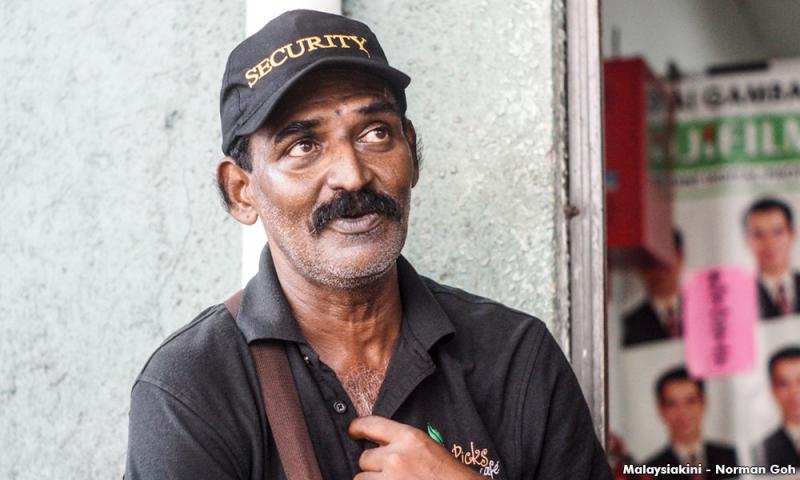
Ganesh is a homeless man who has been out on the streets for the past eight months. Most of his days are spent sitting on the pavement outside the Urban Transformation Centre or Pudu Sentral.

His daily view is the LRT carriages passing through the Plaza Rakyat LRT. Since last month, there is also the new Sungai Buloh-Kajang MRT line, adding to the stream of commuters passing by.

However, Ganesh's own routine, underneath shadows from the structure costing millions of ringgit in renovation works, has remained unchanged.

On some days he would be in time to collect free food packets distributed by officers from the Federal Territory Islamic Council (MAIWP). That could be his one and only meal for the day.

Most nights are spent hiding from enforcement officers or risk being “swept off” the streets.

It was barely 1pm on the day Malaysiakini encountered Ganesh at his usual spot. The 100 packets of food being distributed were finished and the MAIWP officers were already preparing to leave.

“They come to give food. Why don’t they ever ask, ‘what is your problem?’ We (the homeless) are not asking for money.

“We have the skills... why don’t they say, ‘we will try to find a job for you’?” Ganesh said.

The 51-year-old had spent 30 years in Simpang Renggam Prison and he has since learned to craft a suit and various other apparels.

“I can draw the pattern, cut the cloth and sew an entire suit,” he insisted. Now a free man, Ganesh said all he wanted was an opportunity to use the skills he had picked up while behind bars and earn an honest living.

“How much longer do I need to sleep on the streets? Every so often police will come and disturb, come to take us away.

“I went into prison refusing to study, but now I can speak Chinese, I can speak English. Why can’t people just give us a chance?” he stressed.

What the homeless need most

Ganesh said he approached Malaysiakini’s team after observing an interview conducted by the portal earlier with the MAIWP officers.

He said he felt compelled to let more people understand that what they needed most is an opportunity to move on with their lives and not just donation of food or clothes, although such assistance is still welcomed.

“I sit here, I see people get on and down from the LRT.

“I also want to ride on the LRT, the new MRT... but how, if you don’t give me a chance to work?” he lamented, pointing out how society and even his own family members have attached a negative stigma on ex-convicts.

Ganesh also pointed out that he is not alone facing the same situation on the streets.

“There are many job opportunities for the foreign workers. No matter which shop I go to. Why? I want to know.

“Why are our own people sidelined? The rich keep getting richer and more people end up living on the streets," said Ganesh, adding that he only has the shirt on his back, while foreign workers were making a decent living.

However, he conceded that he may still be luckier than others, including young teenage girls caught in a cycle of drug abuse to forget their sufferings.

Money for votes

Rather than offering opportunities for the homeless to earn a living, Ganesh claimed that there were instances where RM30 or RM50 were given “in exchange for votes”.

“You are the ones damaging us (homeless). When you give RM30, RM50 for votes, I have to be honest, you can throw me back in jail and I will have no problems.

“But how much longer do we want to live this way?” asked Ganesh, who noted that four Kuala Lumpur City Hall (DBKL) trucks came the previous night and picked up the homeless people “like rubbish” to be thrown away.

“They (enforcement officers) come and put people into their trucks, took them away... Tested their urine, after that released them again.

“The people will come back here to sit again. So why not try and give them the opportunity to work?”

Ganesh added that the current policies had only served to widen the gap between the rich and the poor in society.

In the run-up to the SEA Games 2017 in Kuala Lumpur, several activists and soup kitchen operators noted an increase in the government’s enforcement against vagrants or homeless people - a trend they said has been observed during other major international events in the past.

Among others, the Dapur Jalanan group said its volunteers had witnessed a “sweeping” operation at around 12.30am on Aug 1, involving some 30 DBKL and Welfare Department officers.

Echoing Ganesh’s views, the group said in a statement that the homeless should not be treated as criminals only for trying to continue living.

“They are here, around the city, because they are victims of our own (government) system that is still moving towards achieving a developed nation status,” said Dapur Jalanan, whose recent Hari Raya 'open street' celebration at Jalan Panggung, Kuala Lumpur, saw hundreds coming together for a night of food and festivities.

According to their statement, the homeless people rounded up in the enforcement operation were taken to a National Service camp in Kuala Kubu Baru for three weeks.

'Amend Destitute Persons Act 1977'

While acknowledging all ongoing efforts by the government and voluntary groups, social activist Syed Azmi Alhabshi said the very definition of the word “homeless” under the Destitute Persons Act 1977 should be relooked at in order to better meet their needs.

“The main thing about being 'homeless' is having 'no home' and so a proper planning on a temporary safe space for them is necessary,” Syed Azmi (photo) added.

In the meantime, he said, he had personally gone to a National Service camp where the homeless were taken to, and is also prepared to help release them.

Rather than attacking the enforcement agencies, he said those who wished to assist the homeless could use the time they have to spend in the camps to find potential jobs and permanent shelters.

“To fight for them just to let them be on the streets is not a plan that suits everyone,” Syed Azmi added.

As for Ganesh, remaining on the streets is not a part of his future plans.

With bigger dreams to work as a tailor, he is ready to take on any job that could help him to move on and one day reunite with family members whom he had left behind.

"My trouble is my own trouble," he said in stressing that he was only speaking up to help others who were in a similar situation.