


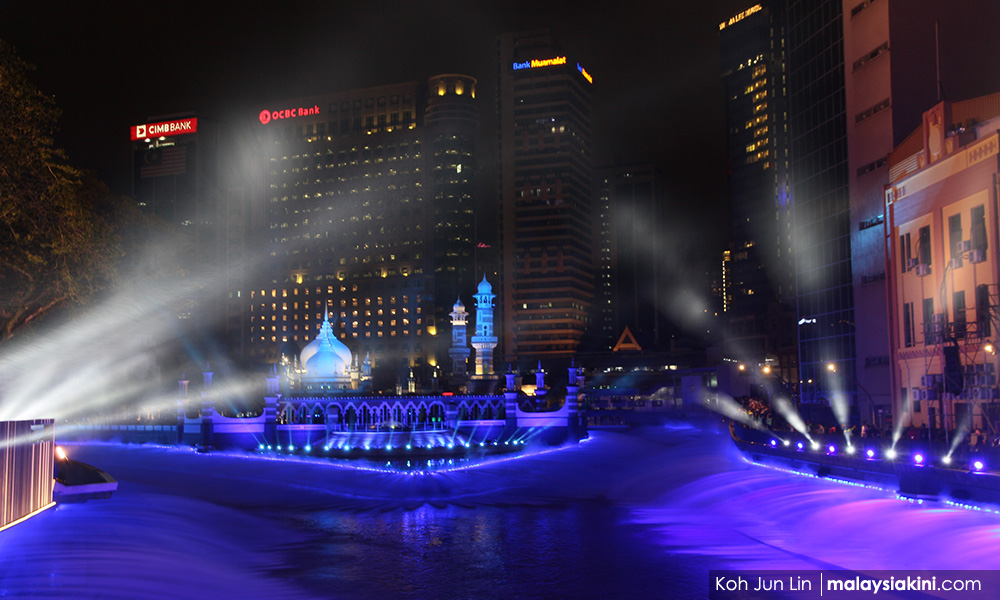

Gombak, Klang rivers 'turn blue' as Najib opens Kolam Biru
Prime Minister Najib Abdul Razak’s vision of cleaning up Kuala Lumpur’s rivers reached a new milestone yesterday with the launch of Phase One of the RM4.4 billion River of Life project.
The occasion last night was marked with performances by a musical fountain that was newly installed at the confluence of Gombak River and Klang River, accompanied by fireworks.
A stretch of the two rivers, about 500 metres long, was also fitted with sprays filling the air over the rivers with water jets and mist, which were then lit with blue LED lights.
The two features were part of Kolam Biru (Blue Pool), which is at the heart of the River of Life project...
Prime Minister Najib Abdul Razak’s vision of cleaning up Kuala Lumpur’s rivers reached a new milestone yesterday with the launch of Phase One of the RM4.4 billion River of Life project.
The occasion last night was marked with performances by a musical fountain that was newly installed at the confluence of Gombak River and Klang River, accompanied by fireworks.
A stretch of the two rivers, about 500 metres long, was also fitted with sprays filling the air over the rivers with water jets and mist, which were then lit with blue LED lights.
The two features were part of Kolam Biru (Blue Pool), which is at the heart of the River of Life project.
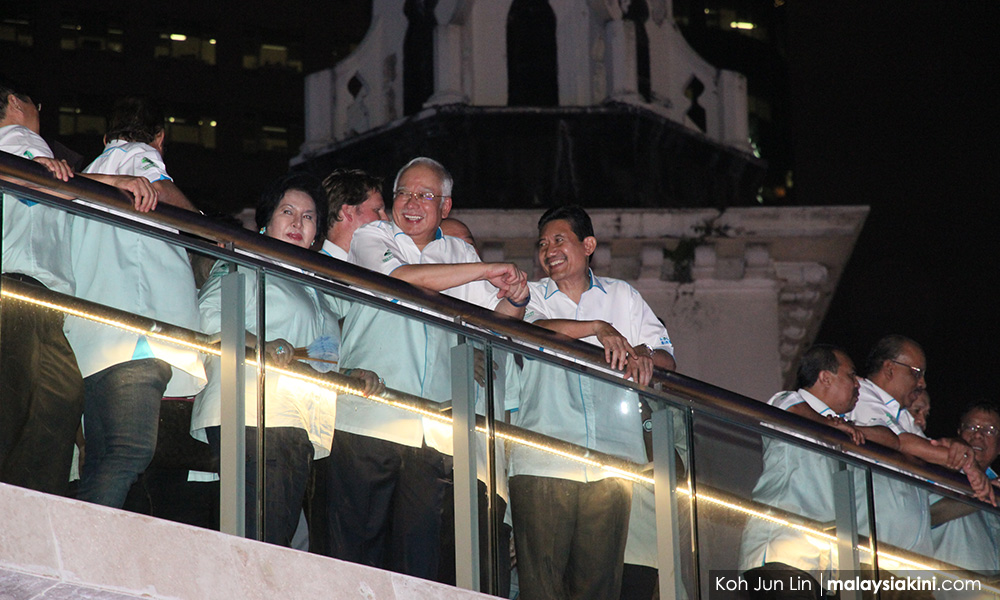
Standing with the confluence of the two rivers as his backdrop, Najib said that was where everything about Kuala Lumpur started, and it was therefore fitting that such a historical site is beautified to enhance its attractiveness.
“When I visited this project in February this year, I imagined that since this place is the birthplace of everything connected to Kuala Lumpur, this is the most historic place and we should make it a beautiful and attractive place.
“What we did was none other than the River of Life project.
“When I was told that this project that I launched in 2011 would only be completed in 2020, I said that was too slow, and I want to see just this part, this first phase,” Najib said in his speech.
Between chuckles, he joked that one idea that came up in a discussion afterwards were to turn the river’s brown-coloured water “blue” at night through “new technology,” apparently referring to the blue LEDs lighting up the night. The audience laughed along with Najib’s remarks.
For the record, the confluence of Gombak River and Klang River is where the city of Kuala Lumpur (literally meaning ‘confluence of mud’) derived its name.
 The Masjid Jamek Sultan Abdul Samad mosque that sits between the two rivers is the city’s oldest mosque, and the surrounding area includes several landmarks, including the Sultan Abdul Samad building that formerly housed the Supreme Court, and the Central Market, which is now Pasar Seni.
According to a fact sheet distributed at the event, Phase 1 of the River of Life project encompasses the area from St Mary’s Cathedral to the north to the Pasar Seni LRT station in the south.
The rest of the project is slated for completion in 2020. This includes cleaning Kuala Lumpur’s eight rivers totalling 110 kilometres in length, which is 81 percent complete, and beautifying 10.7 kilometres along Gombak River and Klang River (49 percent complete).
The fact sheet states that the overall progress is 72 percent as of this month.
It also states that the rivers surrounding Masjid Jamek have been equipped with 1,047 jet nozzles, each capable of shooting river water up to 15 metres, as well 1,551 fogging nozzles supplied with water from Syabas, and 2,056 LEDs.
New pedestrian bridge
The musical fountain is equipped with 148 jet nozzles, 44 fogging nozzles and 183 LEDs. It will be supplied with treated river water.
 A new pedestrian bridge over Gombak River shortens the walk from the Masjid Jamek LRT station to Dataran Merdeka.
The newly renovated broadwalk along the river also features a 150-metre long “Blue Corridor,” where visitors are encouraged to touch treated river water in the pond.
Najib said the water had been treated to Class IIB standard, meaning that it is safe for aquatic life as well as recreational use and body contact.
He hopes the water quality would be further improved, and told the Natural Resources and Environment Ministry to ensure strict enforcement to deter the pollution of the rivers.
“Our people’s attitude is that they treat rivers as garbage dumps and they throw everything into the rivers. We cannot have such a mentality.
“Rivers are our heritage. This river is for all of us to enjoy, not for us to throw our garbage,” he said.
Najib said the River of Life project would raise the value of riverfront properties, and he hoped that visitors and tourists would one day patronise cafés and restaurants along the river.
As he spoke, bits of garbage could be seen floating down the river, although not in quantities seen in the years before. There was also a mild stench in the misty and blue-lit air.
The two rivers have been infamous for garbage, which in turn have been blamed as among the culprits causing flash floods that hit the city centre.


Report this comment
Are you sure you want to delete this comment?
This action cannot be undone.