




UN: Address challenges to reach development goals
Malaysia has made remarkable progress in eradicating poverty but many challenges still need to be addressed, said United Nations resident co-ordinator to Malaysia Richard Leete.
Malaysia has made remarkable progress in eradicating poverty but many challenges still need to be addressed, said United Nations resident co-ordinator to Malaysia Richard Leete.
"There is a problem in Malaysia. The rate of participation of women in the workforce has not changed in 30 years.
"(Furthermore), the maternity benefit schemes (here) are among the worst compared with more than 100 countries," he said today.
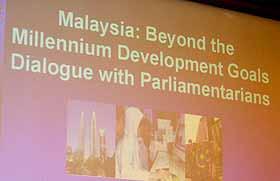
He was briefing about 50 people, comprising members of Parliament, foreign dignitaries and civil society representatives at a dialogue session on Malaysia's progress in attaining the Millennium Development Goals (MDGs) at Parliament House in Kuala Lumpur.
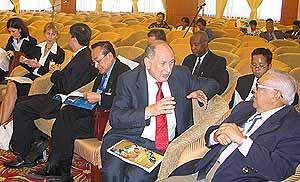 In September 2000, world leaders adopted eight MDGs which was re-endorsed by Prime Minister Abdullah Ahmad Badawi at this year's UN Summit.
Leete (in red tie) said national statistics clearly showed that the participation rate stood at less than 50 percent and has consistently remained at that level over the last 14 years.
He said the focus should be on enhancing equity, eradicating extreme poverty, promoting gender equality, halting the spread of HIV/Aids as well as improving education and environmental management.
Despite the "remarkable progress" in eradicating poverty, he said there were still major challenges in achieving the goals well beyond the eight MDGs.
Women representatives
The attending ruling and opposition MPs were also urged to support a motion brought by Women, Family and Community Development Minister Shahrizat Abdul Jalil to improve the employment benefits for women.
Although representation of women in Parliament and state assemblies respectively had doubled since 1990, Leete said their participation in politics and economics was still lacking.
"There may be a case for affirmative action for women in politics by placing women candidates in 'safe seats' (during a general election). This could help realise the target of 30 percent women participation at all levels (of the legislature)."
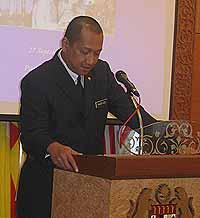 He said that Malaysia was still shy of the target with only 10 percent of women parliamentarians in Parliament and six percent in state assemblies.
Furthermore, he revealed that statistics showed Malaysian women were more educated than men.
In his opening address earlier, Minister in the Prime Minister's Department Mohd Nazri Abdul Aziz encouraged participants and speakers to engage in an 'open and frank' discourse on these challenges.
"The aim of the dialogue is to raise awareness of the challenges facing the remaining MDGs. Hopefully, a summary of our discussion will be conveyed to the Economic Planning Unit for a possible inclusion in the 9th Malaysian Plan."
Reduced poverty
The discussion also raised concerns over the state of the country's poor and the level of human development.
Although Malaysia has reduced its household poverty rates from 50 percent in 1970 to 5.1 percent in 2002, he said there were huge economic disparities among the ethnic groups.
"Greater emphasis must be placed on Kelantan and Sabah with regards the sharp spatial inequalities in human development," he said.
Although there has been progress in poverty reduction for the past 12 years, the rate in seven states, namely Sabah, Sarawak, Terengganu, Kedah, Kelantan, Perak and Perlis, have remained above five percent.
 Leete also called for greater emphasis on indigenous groups who are deemed the poorest.
"I fully support the PM's call for the right of development for all. We must let the poor have some voice in decisions affecting them."
Asked by an MP on why the UN did not invest more money for Malaysia to realise the MDGs, he said the agency was not just an avenue for funds.
"The UN is no longer a cheque-book to Malaysia. The government now matches half of every US dollar we bring into the country. Malaysia is a comparatively rich nation," he replied.
He added that the agency assists the government to mobilise resources, to strategise and to develop related policies.
Also present were Dr Han Tieru of the World Health Organisation, Dr Sunoor Verma of the UN Children's Fund and Caroline Verma of the UN High Commissioner for Refugees offie in Kuala Lumpur.


Are you sure you want to delete this comment?
This action cannot be undone.