




Let the people speak
 They are the people you see daily, plying a quiet trade on the pavement or in small shops, or scrambling in and out of public transportation as they go about their routines.
From hawkers to security guards and students, they too have opinions on how the country's economic and financial policies should be shaped.
 They are the people you see daily, plying a quiet trade on the pavement or in small shops, or scrambling in and out of public transportation as they go about their routines.
From hawkers to security guards and students, they too have opinions on how the country's economic and financial policies should be shaped.
But such is their lot in life that they are passive recipients of decisions made by the powerful and well connected. So what is on their mind as Budget Day approaches?
Markolis, the cobbler
A cobbler by day and a lorry driver by night, he bashfully concedes that he has no expertise in policy making. But he is certain he can contribute ideas as to what should go into the budget.
First, though, he has to overcome one source of anxiety: "We have the right to speak, but cannot do so. If we speak up, we might get caught and end up in prison."
Markolis, 36, knows it is simpler for the powerful to express their views and points out the obvious that this is not the case for ordinary people.
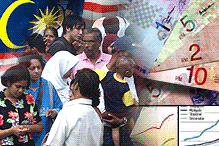 "They can say whatever they like, but people like me don't dare (do so). I think they should let the people speak. Only we know what we go through.
"Others would not know anything about our difficulties unless they ask us. At the end of the day, we are left to make ends meet."
He suggested that the authorities go around and meet those at the grassroots, to seek out views on what people want from the budget.
"It would be good if they could come to us and see what we are doinghow our cost of living has gone up because of the increase in petrol prices (due to two reductions in the subsidy since May)."
Markolis, who has operated at the corner of a row of shoplots in Bangsar for the last five years, is at his pavement post for eight hours a day.
He says the number of customers has fallen by 10 percent this year. On a good day, he could be asked to repair 30 pairs of shoes. When there are no customers, he goes home empty handed to his wife and four children.
"(The authorities) should remember that many people have a fixed income and receive some amount at the end of every month, but that others don't. They should take into consideration the impact of economic policies on people at the grassroots.
"What to doI have to look for other sources of income. I drive a lorry for four hours every night. This matter is not easy to talk about. I do not want to get into trouble."
Markolis hopes that Budget 2006 will ease his financial burden and reduce inflation.
Hanifi, the goreng pisang seller
Hanafi works 12 hours a day, rain or shine, and takes only one day off each month. As he goes about his work with practised ease at a busy street corner, he shouts out his responses over the noise of passing vehicles.
He says he has had little education and can barely keep up with the budget when the details are revealed. However, he knows this much the decisions made by others have a direct impact on his life.
"I may be busy with my work, but I do notice the negative impacts of decisions, such as the rising cost of living. Almost everything costs more now," he says.
"They are supposed to ask us what we think. Maybe they (the finance ministry) could send its officers to set up a booth at the bus or LRT stations when it is time to prepare the budget. This will make it easier for us to give our opinion."
Tham, the pensioner
Recently retired, the former IT consultant has time on his hands.
"Of course I look forward to the budget. I want to know if (the price of essential food items) is being controlled," he says.
Tham, 57, enthusiastically agrees that the authorities should reach out to the grassroots when preparing the budget, since the decisions will affect everyone.
"I think the people who have suffered, and are still suffering, are the ordinary people.
"No one is fighting for us. The government says it will protect us, but in the end, it is fellows at the top who benefit from the budget not us."
In this respect, he wants consumer associations to be more active in protecting the public interest.
Karen, the student
Karen, 23, notes that the authorities only take the trouble to meet the public ahead of the general elections. She reckons it is time this is done in relation to the budget as well.
"They should set up a department, so that we can call up and say what we think should go into the budget," she says.
If everyone co-operates to collectively express their opinions, she adds, the authorities will have no choice but to pay attention.


Are you sure you want to delete this comment?
This action cannot be undone.