


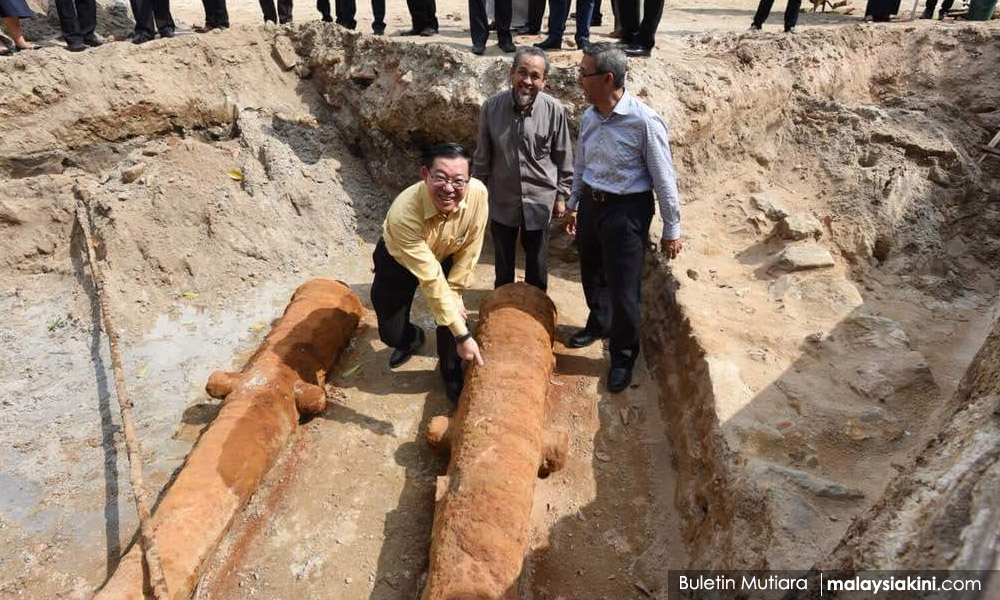

200-year-old twin cannons found at Penang’s Fort Cornwallis
Penang will now have to relook and amend the historical interpretation of the 232-year-old Fort Cornwallis as a peaceful site, following the discovery of two ancient cannons dating back some 200 years at the site.
An excited Penang Chief Minister Lim Guan Eng, who visited the site yesterday, dubbed the find as "double angpows", as it happened during the Chinese New Year period.
Saying that the discovery of the twin cannons was totally unexpected, Lim noted that the state's archaeologist, Mokhtar Saidin, whose team found the items at 2pm on Monday, has determined the age of the artifacts to be at least 200 years old.
They bore the markings and symbols 'GR', identified as Britain's King George III, who ruled from 1760 to 1820...
Penang will now have to relook and amend the historical interpretation of the 232-year-old Fort Cornwallis as a peaceful site, following the discovery of two ancient cannons dating back some 200 years at the site.
An excited Penang Chief Minister Lim Guan Eng, who visited the site yesterday, dubbed the find as "double angpows", as it happened during the Chinese New Year period.
Saying that the discovery of the twin cannons was totally unexpected, Lim noted that the state's archaeologist, Mokhtar Saidin, whose team found the items at 2pm on Monday, has determined the age of the artifacts to be at least 200 years old.
They bore the markings and symbols 'GR', identified as Britain's King George III, who ruled from 1760 to 1820.
George III was known for having lost the American colonies in the War of Independence, which ended with the country's freedom from British occupation on July 4, 1776.
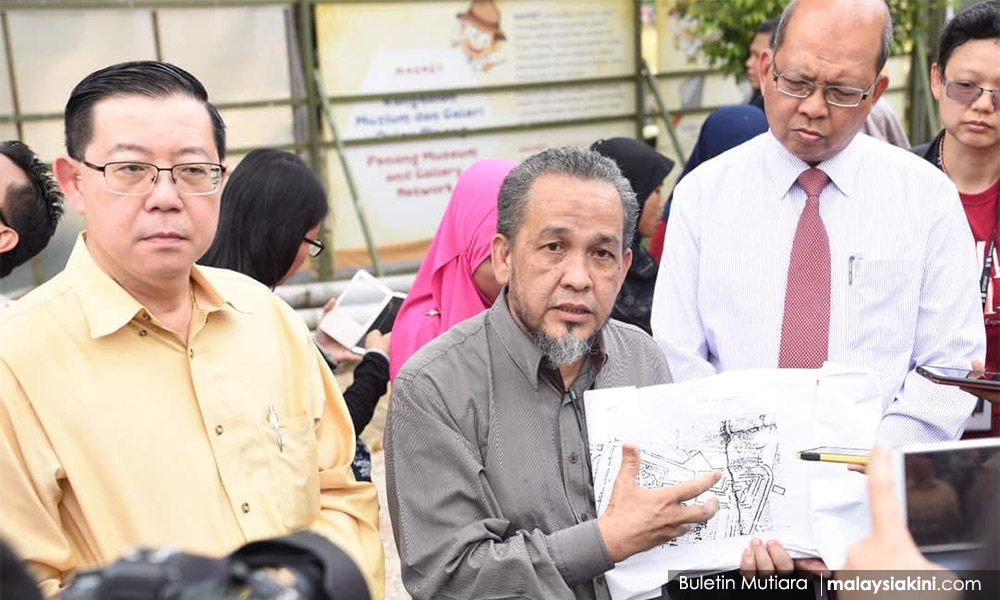
Congratulating the well-known don for his find, Lim said Mokhtar (holding site map) was appointed Penang's chief archaeologist last month, and the state was a pioneer in this initiative.
"Now you do not only have Guar Kepah to examine, but these cannons as well," Lim told Mokhtar, referring to the state's first archaeological site in North Seberang Perai, where a 6,000-year-old prehistoric human settlement was discovered in 1860.
World Heritage Unesco site
Lim said during the British colonial period, all forts and castles had moats - deep, broad ditches, either dry or filled with water - surrounding them.
He noted that the moat encircling Fort Cornwallis, located in what is known today as The Esplanade, or Padang Kota Lama, was not that deep, measuring merely about one metre in depth.
"We want to bring back the fort to its original state.
"In the process of building the moat, in time for George Town's 10th-anniversary inscription into the World Heritage Unesco Site in July this year, we have made this very fortuitous discovery," Lim told reporters at the site.
"These cannons were not recorded in any known maps before.
"That is why it is a significant discovery for Penang. Our history is filled with such discoveries and we hope there are more to come," he added.
Lim said his administration would see to the security of the artefacts to prevent them from being stolen.
"We will ensure they are under protection, while diggings by Mokhtar's team will continue to find out if there are any other artefacts," Lim said.
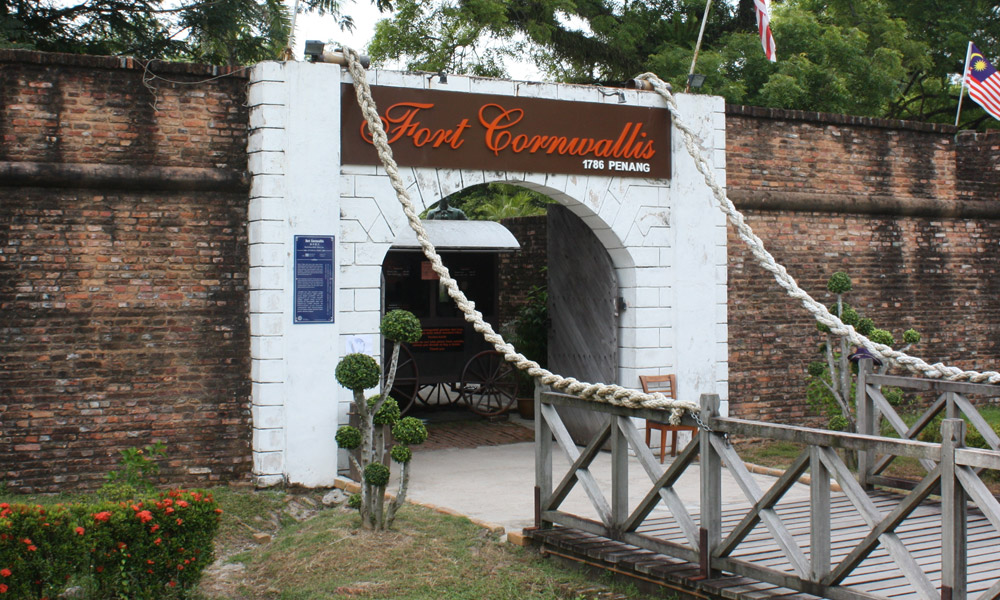
To restore Fort Cornwallis to its former glory, the Penang government is collaborating with Think City Sdn Bhd and the Aga Khan Trust for Culture.
It is an initiative under George Town Conservation Development Corporation, a project implementation vehicle set up to improve the public realm following the George Town Special Area Plan.
Relooking historical interpretations
Meanwhile, Mokhtar said his team from Universiti Sains Malaysia has been carrying out excavation works on the site since last year.
"We were looking for the main entrance to the fort, which was an interesting exercise, but found the cannons first," said Mokhtar, who is director of Universiti Sains Malaysia's Centre for Global Archaeological Research.
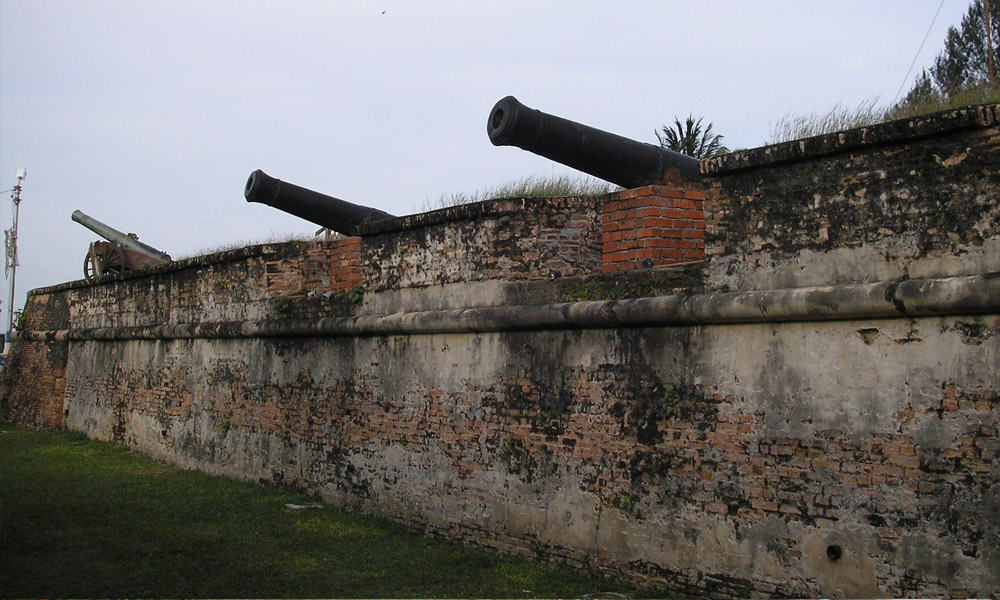
"Both had symbols of King George, but in maps as far back as 1877, there were no indications of these cannons, so it must be younger than that, but still about 200 years old," Mokhtar said.
"Right now we know the length of the cannons, they are 2.2 metres and 2.35 metres respectively, we know their specific era but more studies need to be done on the items to find out more information about them," he added.
Mokhtar said the chief minister has granted the team permission to take the items back to USM for further examination.
He said the find has implications on the initial inscription of Fort Cornwallis as a peaceful site.
"We have to relook and rewrite the inscription of the fort after we conduct a thorough examination of the artefacts," added the don.
Both Lim and Mokhtar then congratulated the young archaeologists - a team of three young women - who discovered the cannons.


